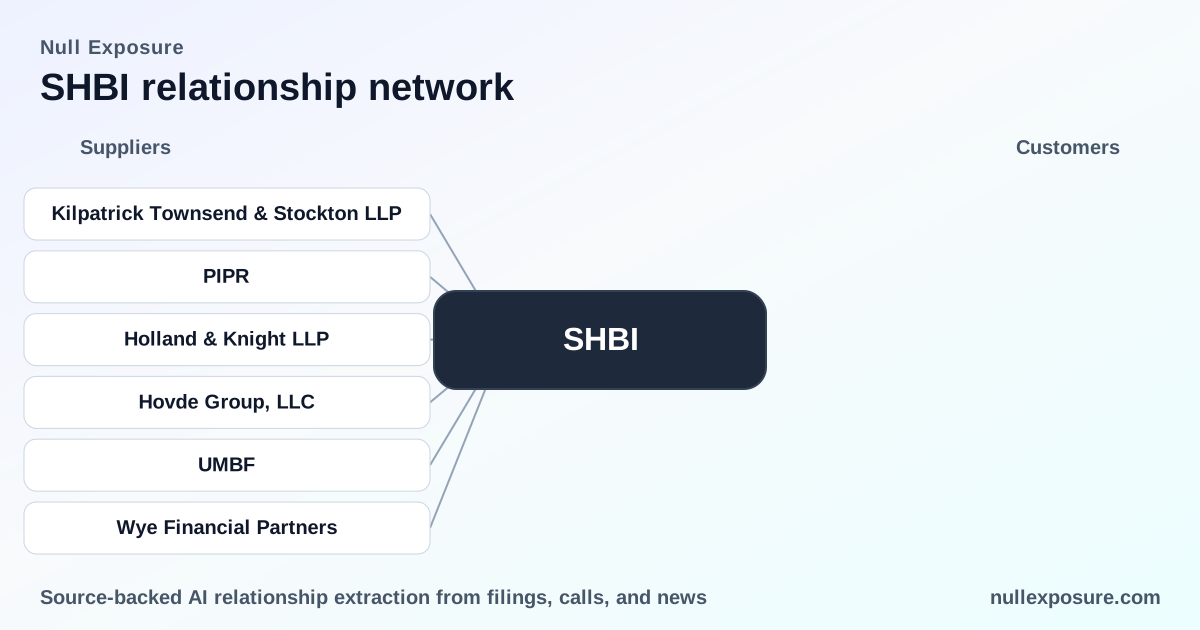
Shore Bancshares (SHBI): supplier relationships that matter to investors
Shore Bancshares operates as a regional bank holding company, monetizing primarily through interest spread on commercial and consumer loans, fees from deposit and trust services, and capital markets actions such as private placements and subordinated note issuances. Revenue drivers are loan growth, fee income from wealth/trust services, and access to capital markets to fund regulatory capital and balance-sheet flexibility. For investors and operators evaluating supplier risk, the recent public filings and press releases show Shore uses a mix of law firms, placement agents, trust banks and wealth partners to execute financing and client-facing services—each relationship carries distinct operational and reputational exposure. Visit the NullExposure homepage for a full supplier profile and monitoring options: https://nullexposure.com/
Where the company makes its money and why the suppliers matter
Shore is a traditional regional bank: net interest income from lending plus non-interest fee income from deposit services, mortgages, and wealth management form the core P&L. The company’s reported metrics — a market capitalization near $595M, trailing P/E ~9.9, return on equity ~10.5% and revenue of roughly $217M (TTM) — underline a profitable regional franchise with capital needs that are episodic and financing-driven. Because Shore periodically accesses capital markets (for example, subordinated notes and exchange offers), placement agents, legal counsel, and trust banks are operationally critical for timely execution and regulatory compliance.
Relationships that execute financings or serve as the exchange/transfer agents directly influence Shore’s cost of capital and time-to-market; wealth management partners influence fee-income stability and deposit stickiness. For an actionable supplier risk view and to track disclosure-driven supplier events, see NullExposure: https://nullexposure.com/
The active supplier relationships disclosed (plain-English summaries)
Piper Sandler & Co.
Piper Sandler served as the lead placement agent on Shore’s private placement of subordinated notes, managing distribution to institutional investors and pricing negotiation. According to a PR Newswire release covering the March 2026 offering, Piper Sandler led the placement while Hovde Group acted as co-placement agent (PR Newswire, March 2026).
Hovde Group, LLC
Hovde Group acted as co-placement agent on the same subordinated notes private placement, supporting distribution and investor outreach alongside Piper Sandler. The co-placement role is documented in both PR Newswire and Quantisnow coverage of the March 2026 transaction (PR Newswire; Quantisnow, March 2026).
Kilpatrick Townsend & Stockton LLP
Kilpatrick Townsend served as legal counsel to the placement agents for the subordinated notes offering, providing execution support and transaction-level legal review that affects closing risk and documentation quality. PR Newswire’s announcement of the completion of the notes offering references Kilpatrick Townsend in that capacity (PR Newswire, March 2026).
Holland & Knight LLP
Holland & Knight served as legal counsel to Shore for the subordinated notes private placement, handling company-side securities, disclosure and regulatory documentation tied to the issuance. The company’s press release on the offering names Holland & Knight in that company counsel role (PR Newswire, March 2026).
UMB Bank, N.A.
UMB Bank is acting as exchange agent for Shore’s exchange offer related to its 6.25% fixed-to-floating rate subordinated notes due 2035, responsible for prospectus distribution and agent communications to eligible institutions. Citations in Futunn, Yahoo Finance (Singapore) and a PR Newswire notice confirm UMB’s role as the corporate trust/exchange agent (Futunn, March 2026; Yahoo Finance, March 2026; PR Newswire, March 2026).
Wye Financial Partners
Wye Financial Partners provides Shore’s trust and wealth management services, delivering fee income and client-facing advisory products that support deposit retention and non-interest revenue. The Globe and Mail investor update on Q4 2025 references Wye Financial Partners as the bank’s wealth and trust channel (The Globe and Mail, March 2026).
What these supplier relationships imply for investors and operations
These partnerships show a classic financing-and-advisory supplier mix for a regional bank executing capital raises and maintaining client-facing wealth services. Key implications:
- Execution dependency on placement agents and legal counsel. Successful subordinated debt issuance requires coordinated placement and clean legal documentation; Piper Sandler, Hovde, Holland & Knight and Kilpatrick Townsend together reduce execution risk but concentrate issuance dependence on a small set of specialist intermediaries.
- Operational coupling to a trust/exchange agent. UMB Bank’s role as exchange agent is operationally critical for bondholder communications and exchange mechanics—any failure would directly affect creditor relations and regulatory timelines.
- Revenue diversification through wealth management. Wye Financial Partners supplies fee income and trust capabilities that lower Shore’s reliance on interest margin, strengthening fee-based revenue composition.
Midway investor action: if you are tracking supplier concentration and financing cadence, sign up for monitoring and supplier analytics at NullExposure: https://nullexposure.com/
Company-level signals from the constraints (contracting posture, criticality, maturity)
Shore discloses active engagement of third parties for cybersecurity assessment, monitoring and penetration testing, indicating a contracting posture that includes externally sourced security services. The constraint metadata flags this as a company-level signal with a high confidence score (0.80) and characterizes these third-party relationships as active service-provider engagements. From an operational lens:
- Contracting posture: Shore routinely contracts external specialists to implement and audit cybersecurity controls, which implies formal vendor agreements and periodic engagement cycles.
- Concentration and criticality: Cybersecurity providers are materially important to operations because they protect customer data and ensure regulatory compliance; this elevates counterparty criticality even if single-vendor concentration is not disclosed.
- Relationship maturity: The disclosure language implies recurring and ongoing engagements (monitoring and penetration testing), denoting relationships beyond one-off consulting projects.
Investor takeaway: treat cybersecurity vendors and UMB Bank (exchange agent) as operationally critical partners, and treat placement agents and legal counsel as episodically critical during capital transactions.
Bottom line — what to watch and the investor call to action
Shore’s supplier footprint is concentrated where it counts: capital markets execution, legal support and trust services. That structure supports efficient borrowings and diversified fee revenue, but it also concentrates operational risk around critical third parties for financing and cybersecurity. Key near-term monitors: subsequent filing details on placement fees, any amendments to the exchange agent engagement, and renewed cybersecurity attestations in the next 10-K or 10-Q.
For investors and procurement teams who require continuous supplier risk signals and disclosure-driven alerts, NullExposure provides dedicated monitoring and supplier relationship intelligence—start here: https://nullexposure.com/
Final contact prompt: review the detailed supplier dossier and sign up to receive transaction-triggered alerts at NullExposure: https://nullexposure.com/