Sotera Health (SHC): Sterilization services with long-term supply economics and concentrated input risk
Sotera Health provides sterilization, laboratory testing and advisory services to medical-device, pharmaceutical and food customers and monetizes by charging fee-based processing and testing services backed by long-term supply and purchase commitments for critical inputs. The business combines steady, contractually-backed throughput revenue with concentrated raw-material exposure (notably EO gas and Co‑60) that drives both durable margins and idiosyncratic supply risk. With roughly $1.16 billion in trailing revenue and $553 million of EBITDA, the company runs a capital-light, service-oriented model that is sensitive to input access and regulatory licensing. For a concise supplier-risk view, visit https://nullexposure.com/.
How the company actually makes money and why contracts matter
Sotera sells time-sensitive sterilization and testing capacity to life‑science customers who value validated, audited processing and regulatory traceability. Revenue is recurring, driven by customer demand for certified sterilization and multi-year service agreements, while a substantial portion of the company’s cost base comes from purchased sterilant sources and radiological materials contracted out years in advance.
This commercial posture produces three practical characteristics for investors:
- Long-term contracting posture: the company explicitly relies on multi-year supply and service contracts to stabilize input pricing and capacity, which converts volatile commodity exposure into predictable operating cost lines.
- High counterparty concentration for specific inputs: in the U.S. ethylene oxide (EO) supply is effectively a single-supplier market for industry-relevant applications, and multi-decade supply contracts for Co‑60 extend the company’s dependency horizon.
- Large committed spend: minimum purchase commitments reported by management total in the low‑billions, signaling capital and off‑balance long-term obligations that materially influence free‑cash-flow flexibility.
For a quick supplier-concentration dashboard and supplier detail, see https://nullexposure.com/.
The named relationships you should track (short, actionable notes)
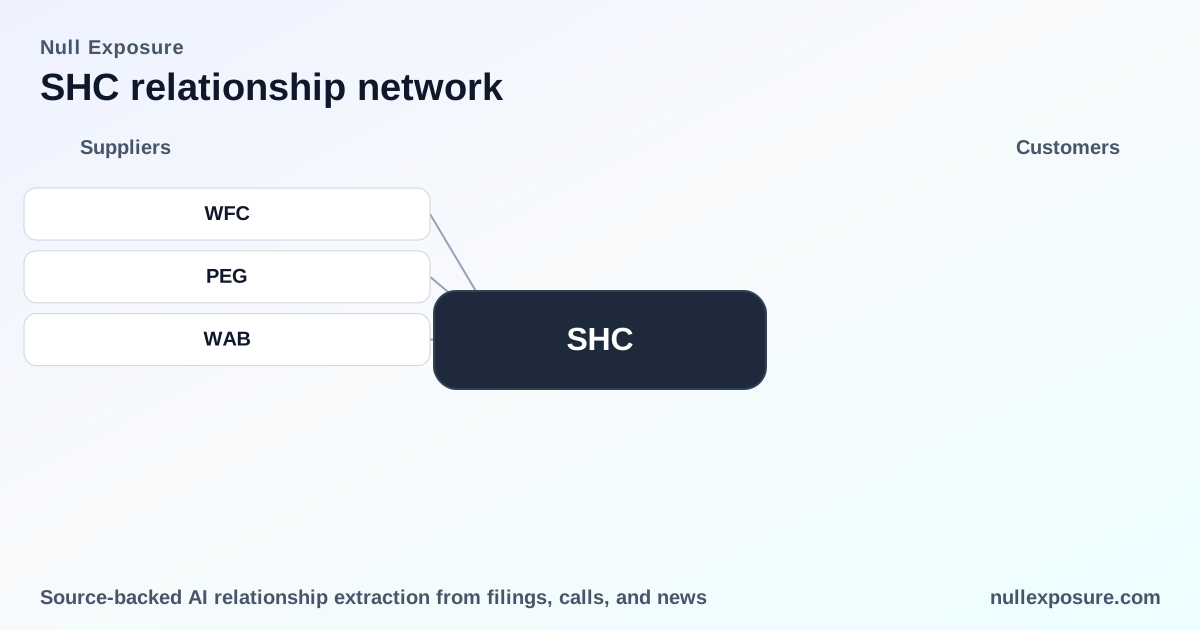
Wells Fargo Securities (underwriter — GlobeNewswire, March 4, 2026)
Wells Fargo Securities is acting as the underwriter for Sotera Health’s secondary offering of common stock announced March 4, 2026, which signals near-term equity issuance activity and potential dilution dynamics. According to the company press release on March 4, 2026, Wells Fargo Securities is the lead underwriter for that offering.
Wells Fargo Securities (duplicate press reference — GlobeNewswire, March 4, 2026)
A second news entry repeats that Wells Fargo Securities is serving as underwriter for the same secondary offering; investors should treat the press release as the controlling disclosure for the underwriting arrangement. The company filing/press release on March 4, 2026 lists Wells Fargo Securities in that role.
PSEG (strategic partner on cobalt development — Q4 2025 earnings transcript)
Sotera disclosed a cobalt development agreement with PSEG in its Q4 2025 earnings call transcript, indicating a strategic partnership to secure long‑dated access or co-development of Co‑60 feedstock for gamma sterilization. The earnings-call transcript (Q4 2025) reports that the team signed a cobalt development agreement with Westinghouse and PSEG and secured a long license renewal for an Ottawa facility.
Westinghouse (strategic partner on cobalt development — Q4 2025 earnings transcript)
Westinghouse appears alongside PSEG in a cobalt development agreement described during the Q4 2025 earnings call, which signals Sotera is pursuing vertically integrated or secured reactor-sourced Co‑60 supply. The transcript notes the cobalt development agreement with Westinghouse and PSEG and a 25‑year Class 1B license renewal for the Ottawa facility.
What the constraints and disclosures tell you about operational risk
Sotera’s public disclosures and the supplier‑relationship evidence frame a consistent operating regime: long-dated supplier commitments, sizeable minimum purchase obligations and regional supply concentration. Management states it “actively seeks to manage the risk of fluctuating prices through long‑term supply and service contracts,” and reports minimum purchase commitments of approximately $2.22 billion related primarily to Nordion‑sourced Co‑60 supplies through arrangements ranging up to 39 years. These disclosures are company-level signals about contracting posture and exposure, not relationship-level attributions unless the disclosure explicitly names a counterparty.
Key constraint-driven takeaways:
- Contract maturity and lock‑in: multi‑year to multi‑decade contracts convert price volatility into contractual commitments that impact near-term liquidity and long-run margin stability.
- Concentration by geography: the company highlights that while EO suppliers exist globally, the U.S. market has a single supplier relevant to the industry — a structural single‑source risk for North American operations.
- Large committed spend: the $2.2 billion of minimum purchase commitments indicates meaningful forward cash commitments that constrain capital allocation and increase the importance of counterparty performance.
Investment implications: value drivers and risks
Value drivers for investors are clear: validated sterility services command stickier demand and higher margin, institutional customers create repeatable throughput, and long-term Co‑60 access supports sustainable capacity. Financially, the stock trades with asymmetric signals — a trailing P/E of ~50 and a forward P/E around 14.9, EV/EBITDA near 13.2, and high institutional ownership (~86%), suggesting professional investors price a transition from near-term earnings compression to normalized cash generation.
Principal risks to monitor:
- Input concentration risk: a single U.S. EO supplier and concentrated Co‑60 sourcing can create acute operational interruption if a supplier issue or regulatory constraint surfaces.
- Regulatory and licensing exposure: sterilization facilities operate under strict regulatory regimes; the company’s recent 25‑year Class 1B license renewal for its Ottawa facility is positive, but license dependency remains a core risk.
- Capital/dilution dynamics: the announced secondary offering underwritten by Wells Fargo Securities introduces short‑term supply of shares that affects per‑share metrics and may reflect financing needs tied to growth or balance-sheet management.
How to act and what to monitor next
For investors and operators evaluating supplier relationships, focus on three actions: (1) validate the tenor and enforceability of long‑term purchase commitments, (2) monitor the execution and counterparty strength of Co‑60 development agreements with Westinghouse and PSEG, and (3) track EO supplier regulatory status and any regional substitution options. For a concise supplier-risk report and monitoring tools, visit https://nullexposure.com/.
Bottom line: Sotera’s business generates durable, contract-driven cash flow but is exposed to concentrated and long‑dated supplier risk that can create operational leverage in both directions. Investors should balance the predictability of service revenue against the material, multi‑year commitments for critical sterilant inputs and watch underwriter activity and partner developments for signals on capital strategy and supply security. For ongoing supplier intelligence and alerts, go to https://nullexposure.com/.