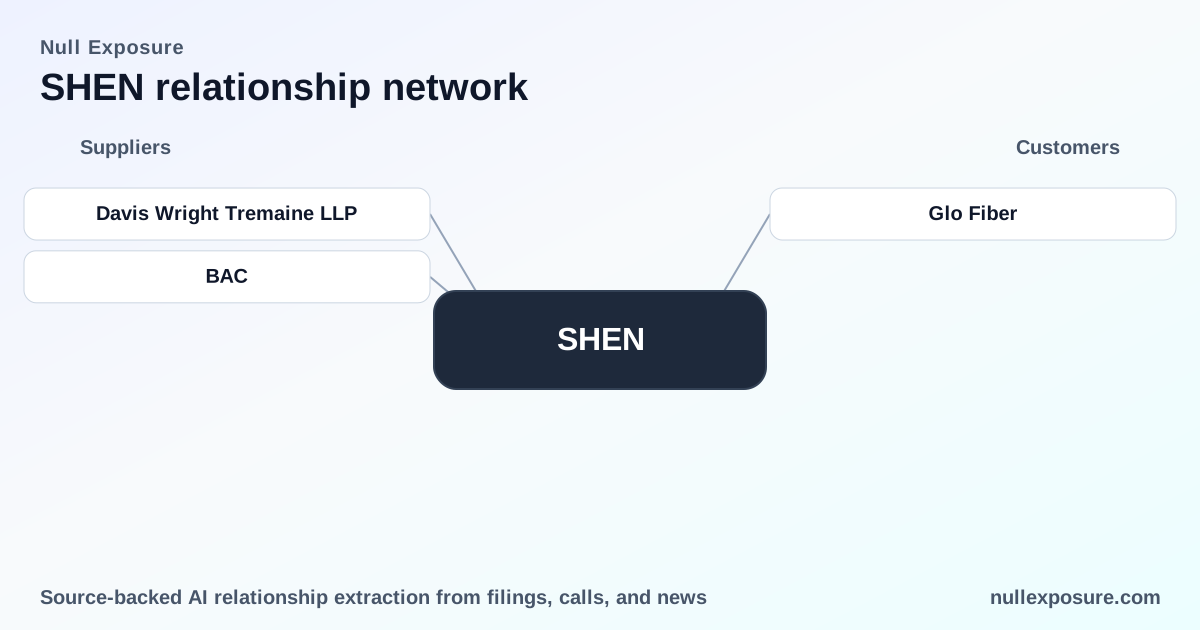
Shenandoah Telecommunications (SHEN): Supplier relationships that reveal capital strategy and operational leverage
Shenandoah Telecommunications Company (Shentel) operates as a regional broadband and telecom infrastructure owner-operator across the mid-Atlantic, monetizing through retail broadband subscriptions, tower-site leasing, and wholesale fiber/right‑of‑way contracts. The company actively crystallizes value from infrastructure via structured financing — notably a fiber-backed ABS issuance and a Bank of America liquidity facility — which compresses near-term cash volatility and converts long-lived network economics into financing capacity. For investors and supplier counterparties, Shentel is simultaneously a capital-intensive operator and an opportunistic securitizer that converts physical assets into financing while maintaining traditional service revenue lines.
Visit the Null Exposure homepage for deeper supplier intel: https://nullexposure.com/
How the recent supplier relationships map to Shentel’s business model
Shentel’s supplier and counterparty activity over FY2026 signals a clear operating posture. The use of specialized legal counsel for regulatory approvals and a structured liquidity funding note from a major bank are consistent with a company that funds growth and working capital through capital markets rather than pure internal cash flow. This combination affects contracting posture, counterparty risk, and supplier negotiation dynamics.
- Contracting posture: Actively leverages external capital markets and structured financings, which creates a preference for counterparties that can perform under securitization and assignment frameworks. Legal and banking relationships are critical to executing these transactions.
- Concentration and criticality: Shentel’s footprint is regionally concentrated in the mid‑Atlantic, and its physical network (fiber and towers) is a critical asset that underpins both retail revenues and wholesale monetization strategies.
- Maturity and cash profile: The company reports Revenue (TTM) of $357.9M and EBITDA of $109.5M, but EPS is negative at -$0.71 and profit margin is -11%, indicating operational pressure that drives repeated reliance on non‑operating financing solutions.
- Investor base: Institutional ownership is high at ~81%, which increases scrutiny on capital structure moves and supports access to bank and ABS markets.
These dynamics shape how suppliers should evaluate payment risk, contract assignment provisions, and counterpart credit — particularly for those supplying long‑lead network equipment or services.
Supplier relationships: the counterparties named in recent disclosures
Davis Wright Tremaine LLP — regulatory counsel for fiber ABS financing
Davis Wright Tremaine served as regulatory counsel for Shentel on a fiber-based asset-backed securitization transaction, supporting the legal and regulatory components required to securitize fiber cash flows and place securities into the market. According to a Davis Wright Tremaine news release in March 2026, the firm advised on regulatory approvals and documentation essential to the transaction. (Source: Davis Wright Tremaine LLP press release, March 2026 — https://www.dwt.com/about/news/2026/02/dwt-represents-shenandoah-telecommunications)
Bank of America — $25M delay-draw Liquidity Funding Note (LFN)
Shentel Issuer entered into a $25 million delay draw Liquidity Funding Note (the LFN) with Bank of America as part of the broader ABS structure that includes Class A‑2, Class B, and variable funding notes; the LFN provides committed short‑term liquidity to support the ABS and the issuer’s cash requirements. This facility was disclosed in Shentel’s FY2025/FY2026 earnings materials distributed via GlobeNewswire/ManilaTimes in late February 2026. (Source: GlobeNewswire/ManilaTimes press release of Shentel’s Q4 and full‑year 2025 results, Feb 2026 — https://www.manilatimes.net/2026/02/26/tmt-newswire/globenewswire/shenandoah-telecommunications-company-reports-fourth-quarter-and-full-year-2025-results/2285805)
Bank of America — confirmation in market press
The company also described the same $25 million LFN with Bank of America in a market disclosure circulated through The Globe and Mail in March 2026, reiterating the LFN’s role within the ABS structure and confirming the counterparty relationship with a major liquidity provider. (Source: The Globe and Mail/press release distribution of Shentel FY2025 results, March 2026 — https://www.theglobeandmail.com/investing/markets/stocks/SHEN/pressreleases/438211/shenandoah-telecommunications-company-reports-fourth-quarter-and-full-year-2025-results/)
What these supplier relationships mean for investors and operators
The roster of counterparties — a top-tier law firm for regulatory work and Bank of America as liquidity provider — indicates a deliberate capital strategy: convert predictable fiber cash flows into financing while retaining service operations. For investors and suppliers, that has several practical implications:
- Financial engineering is a core lever: The ABS transaction and the LFN show Shentel deploys securitization to access non-dilutive capital. That reduces immediate capex pressure but introduces structural complexity and priority-of-payments considerations for counterparties.
- Regulatory and documentation risk is real and managed: Hiring regulatory counsel signals the company is navigating approvals or compliance steps that are material to transaction execution; suppliers should expect detailed assignment, servicer, and default mechanics in contracts.
- Liquidity profile is actively managed: The $25M LFN is a committed source of liquidity tied to the ABS; this reduces near-term liquidity risk but creates counterparty exposure to the bank and the terms of the lending facility.
- Operational fragility vs. asset-backed resilience: While operating margins and EPS are under pressure (Profit Margin -11%, EPS -$0.71), EBITDA of $109.5M and gross profit of $227.7M provide a base to underwrite securitization structures and reassure capital providers.
If you need a supplier risk digest with counterparty scoring and contract clause highlights, see our coverage at https://nullexposure.com/ — updated intelligence for counterparties and investors.
Practical actions for suppliers and portfolio managers
Suppliers and investors should adjust diligence and contracting practices to account for Shentel’s capital posture:
- Require clear payment‑priority and assignment language in master agreements.
- Confirm whether receivables or revenue streams are pledged to securitization vehicles and how that affects invoicing and setoff rights.
- For large equipment suppliers, negotiate milestone-based payments and retain title or performance security until bank consents are secured.
These measures protect cash flow and legal recourse when a supplier’s counterparty is engaged in structured financing.
Final read and next steps
Shentel’s supplier relationships in FY2026 demonstrate a balanced but active capital strategy: monetize network economics with ABS deals while keeping operational services running. For investors and operators, the key takeaway is that infrastructure monetization reduces immediate capital strain but increases the importance of contract architecture and counterparty diligence. Monitor ABS documentation, bank facility covenants, and regulatory disclosures to anticipate shifts in payment priority or operational control.
Explore more supplier and counterparty intelligence at https://nullexposure.com/ — your next step for actionable diligence and contract defense.