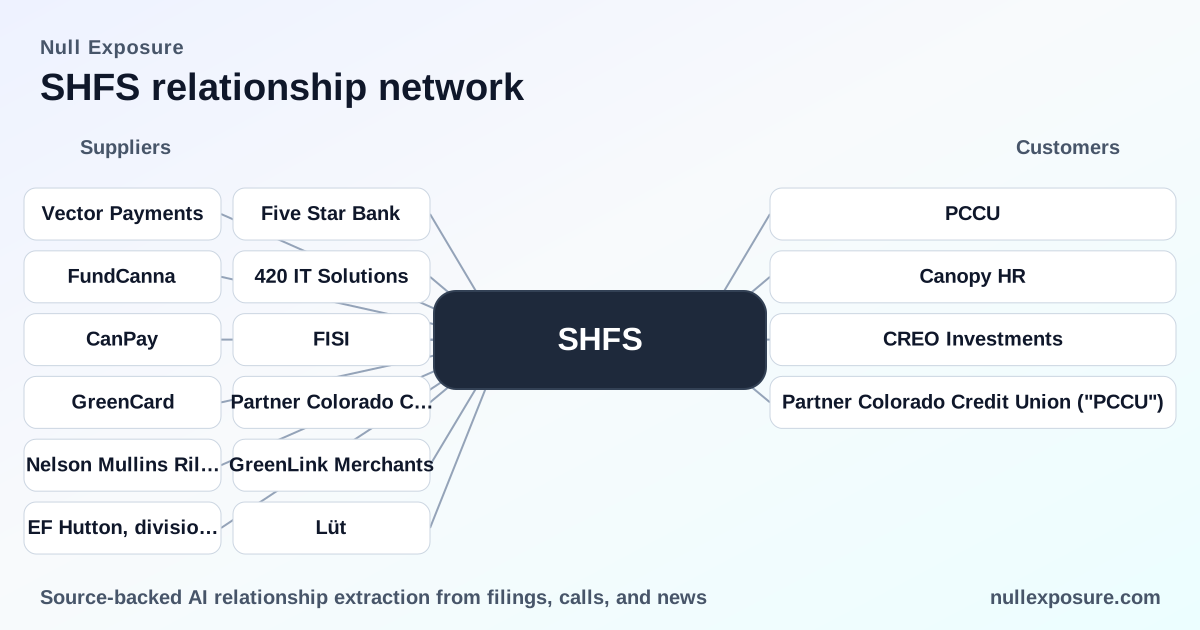
SHF Holdings (SHFS): The supplier and partner map investors need
SHF Holdings, doing business as Safe Harbor Financial, provides banking, lending and related financial services to institutions serving the legal cannabis industry and monetizes through interest income, loan servicing fees, transaction and payments fees, and referral/partner arrangements. The company operates as a niche financial services provider focused on reducing cash exposure for cannabis operators while extracting recurring fee and interest spread economics from long-running banking and lending relationships. For a concise partner-risk read on Safe Harbor and its supplier footprint, see https://nullexposure.com/.
Where SHF sits in the market: a quick investor snapshot
SHF is a small-cap, specialty financial provider with TTM revenue of $11.72 million and a market capitalization near $4.22 million, reporting negative GAAP earnings per share and compressed operating margins. The business model is concentrated on a handful of banking, payments and lending relationships that generate the bulk of fee and interest income; that concentration drives both scalability potential and single-counterparty risk.
What the supplier list reveals about SHF’s operating model
The relationships disclosed show a hybrid operating posture: SHF combines balance-sheet lending and interest capture with an outsourcer-style service model for partner bank relationships and a modular payments stack for customers. Key operating characteristics for investors:
- Contracting posture: SHF holds long-term structured contracts with at least one major counterparty (PCCU), including an Amended CAA extending terms through 2028 with automatic renewals, signaling multi-year dependency on partner banks for loan origination and servicing rights (company filing, Dec. 31, 2024).
- Role mix and criticality: SHF functions both as a lender/interest-earning principal and as a service provider that underwrites, services and monitors loans on behalf of partner banks, creating revenue that is fee-like and recurring (PCCU CAA disclosure).
- Concentration and spend visibility: The supplier/partner footprint reflects focused third-party spend consistent with a mid-tier supplier budget—documented company totals around $11.0 million, which aligns with the company’s modest scale and concentrated vendor reliance.
- Maturity and stage: Several supplier relationships are active and integrated (e.g., PCCU, Five Star Bank), while recent hires and assets (420 IT Solutions) point to a strategic build-out toward vertically integrated service delivery.
If you want a deeper vendor-risk read or to benchmark SHF’s partner concentration against peers, visit https://nullexposure.com/ for supplier-mapping tools.
Supplier-by-supplier: what every relationship tells investors
Below are the relationships disclosed in public filings and press coverage, each with a concise investor-oriented summary and source note.
-
Five Star Bank — SHF has formal agreements with Five Star Bank under which SHF’s financial institution clients pay interest on daily account balances as specified in those contracts; the company publicly announced a partnership with Five Star to expand access to cannabis banking nationwide in May 2023. (FY2024 10‑K; company press release, May 11, 2023)
-
420 IT Solutions — Safe Harbor executed a strategic hire and integrated the founders and core operating assets of 420 IT Solutions into its platform, bringing managed services and consulting capabilities focused on cannabis banking into SHF’s operating stack. (Sahm Capital release, Dec. 23, 2025)
-
Partner Colorado Credit Union (PCCU) — PCCU is both SHF’s largest stockholder and a deeply embedded counterparty: the companies settled a roughly $64.7 million deferred payable in 2023 via a combination of serviceable debt and stock, and executed an Amended CAA extending contractual terms through December 31, 2028 with automatic two‑year renewals, under which SHF performs underwriting, loan servicing and monitoring duties while PCCU earns monthly management fees. (Company press release, Mar. 30, 2023; company 10‑K disclosures, Dec. 31, 2024)
-
GreenLink Merchants — Listed as a payments partner supporting Safe Harbor clients, GreenLink is part of the expanded payments portfolio that reduces cash handling for cannabis operators. (MarketScreener coverage, Jan. 2026)
-
Lüt — Named in press coverage as a new payments partner, Lüt joins SHF’s payments suite to broaden bank-transfer based payment options for operators. (MarketScreener / Sahm Capital coverage, Jan. 2026)
-
Vector Payments — Vector is presented as a complementary payments provider in SHF’s portfolio, used to round out transaction coverage and cash reduction solutions for clients. (MarketScreener / Sahm Capital coverage, Jan. 2026)
-
FundCanna — FundCanna and SHF established a referral partnership enabling FundCanna to introduce clients to Safe Harbor for banking, and SHF to introduce qualified clients to FundCanna for working capital and equipment financing. (Yahoo Finance press release, 2025)
-
CanPay — Long‑standing pay‑by‑bank platform CanPay is included among SHF’s payment partners, increasing the company’s access to established bank-transfer payment rails for cannabis retailers. (MarketScreener coverage, Jan. 2026)
-
GreenCard — GreenCard is another payments partner added to SHF’s portfolio to expand payment choice for clients. (MarketScreener / Sahm Capital coverage, Jan. 2026)
-
Nelson Mullins Riley & Scarborough LLP — Served as legal advisor during the company’s SPAC/transaction activity and related corporate work in 2022. (MG Magazine press release, 2022)
-
EF Hutton, division of Benchmark Investments, LLC — Acted as placement agent to the company during capital transactions in 2022. (MG Magazine press release, 2022)
Investment implications and risk checklist
SHF’s partner map drives a clear investment thesis and an accompanying risk checklist:
- Thesis: SHF leverages partner banks and a modular payments ecosystem to deliver fee and interest income with low direct retail distribution cost—partnering rather than building every capability in-house is the company’s chosen scaling route.
- Upside drivers: Integration of 420 IT Solutions and expanded payments partners increase service depth and reduce client attrition risk while creating cross-sell channels for lending and deposit products. Payments partnerships broaden addressable service offerings and lower operational cash exposure for operators.
- Key risks: Single‑party concentration with PCCU (largest stockholder and contractual core) introduces counterparty and governance risk; small market capitalization and negative EPS amplify execution sensitivity; the business is dependent on maintaining long-term bank relationships to originate and service loans.
- Contracting signal: The presence of long‑term Amended CAA terms and automatic renewals with PCCU is evidence of multi‑year locked-in economics for core loan servicing activity, but that same lock-in centralizes counterparty exposure.
If you want a tailored vendor-risk score or a comparative peer map, explore the platform at https://nullexposure.com/ for structured partner intelligence.
Bottom line
SHF Holdings is executing a partner-first, fee-and-interest monetization strategy in a highly regulated vertical where access to compliant banking and diversified payments is the product. The business scales through partner integration (banks, payments platforms, managed services) rather than branch-level expansion, which preserves margin potential but concentrates exposure to a few critical counterparties—most notably PCCU and bank partners like Five Star. For investors, the balance of recurring fee streams and counterparty concentration defines both the upside and the principal risk set for SHFS.
For more supplier-focused diligence on SHFS and comparable financial-service providers, visit https://nullexposure.com/ for in-depth mapping and risk scoring.