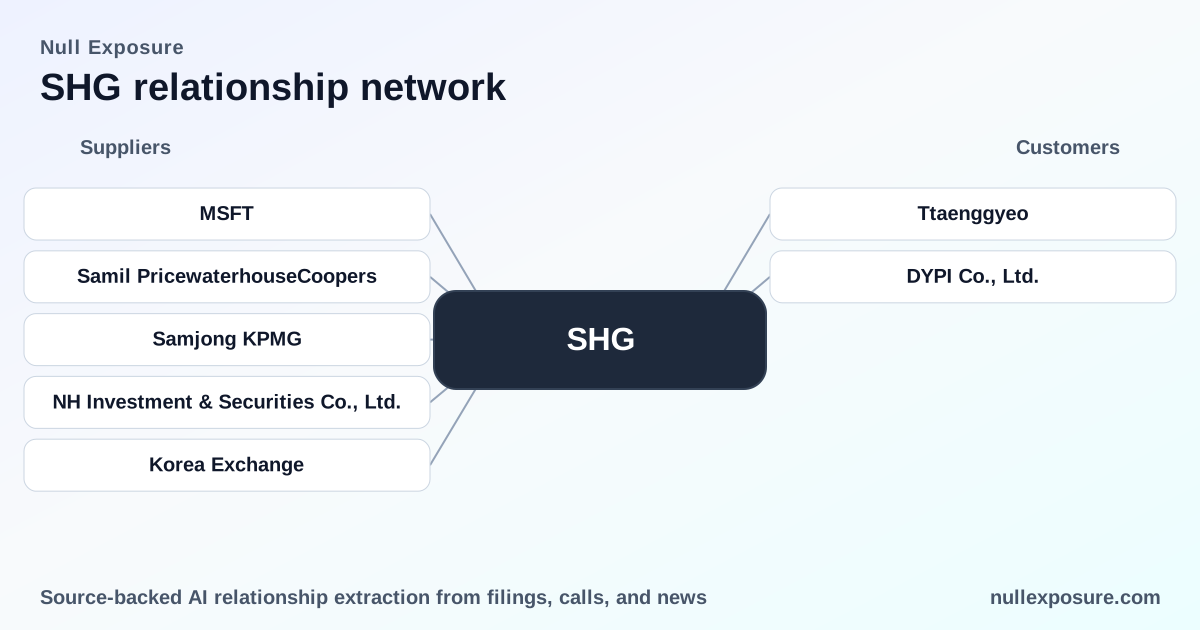
Shinhan Financial Group (SHG): Supplier Relationships That Shape Execution and Governance
Shinhan Financial Group is a South Korea–based financial holding company that generates revenue through retail and corporate banking spreads, fees from securities and wealth management, and insurance-related income. Operational execution combines legacy banking infrastructure with selectively integrated global technology and advisory partners, while capital returns and governance decisions are routed through strategic service contracts and market access arrangements. For investors, supplier relationships translate directly into execution risk, governance signals, and the pace of technology adoption. Learn more about how we analyze supplier footprints at https://nullexposure.com/.
Why supplier relationships matter for a bank holding company
Banks are service businesses built on third-party execution: core platforms, cloud providers, auditors, and securities houses underpin regulatory compliance, customer experience, and capital allocation. Supplier concentration and contract tenor influence operational resilience and regulatory optics; long-tenor audit relationships shape investor confidence; cloud and AI contracts determine speed of product rollout and cyber risk exposure; broker-dealer agreements determine the mechanics of buybacks and liquidity management.
From the available disclosures, Shinhan presents a mix of incumbents and strategic technology vendors. Company-level signals indicate diversified supplier engagement with no explicit constraints recorded in the supplied relationship inventory. This absence of recorded constraints is itself a signal: the disclosed supplier set contains traditional market vendors and a global cloud provider, suggesting a deliberate move toward modernizing operations while preserving conventional governance channels.
The full supplier list and what each relationship means for SHG
Microsoft — Azure OpenAI integrated into Shinhan Bank’s AI ONE (FY2025)
Shinhan Bank integrated Microsoft’s Azure OpenAI into its internal work support system called AI ONE, signaling an operational commitment to cloud-based generative AI for employee workflows and internal automation. According to BusinessKorea reporting (FY2025), this is a platform-level adoption that accelerates digital productivity and elevates vendor-dependency and data governance priorities (https://www.businesskorea.co.kr/news/articleView.html?idxno=242095). Key takeaway: cloud/AI adoption improves productivity but raises vendor concentration and regulatory oversight requirements.
Samil PricewaterhouseCoopers — appointed external auditor for FY2026–2028
Shinhan named Samil PwC as its external auditor for fiscal years 2026 through 2028, replacing the prior auditor and resetting the firm-level audit relationship and methodologies. The Globe and Mail’s press release notes that the three-year appointment will influence Shinhan’s audit approach and governance framework for that period (FY2026) (https://www.theglobeandmail.com/investing/markets/stocks/SHG/pressreleases/36839139/shinhan-financial-group-names-samil-pwc-as-external-auditor-for-20262028/). Key takeaway: a new Big Four affiliate audit engagement is a governance inflection that changes external assurance continuity and could affect investor confidence metrics.
Samjong KPMG — outgoing external auditor for FY2023–2025
Samjong KPMG served as Shinhan’s external auditor for fiscal years 2023–2025 and has been replaced for the 2026–2028 cycle, creating a discrete change in audit continuity and institutional knowledge. The Globe and Mail press notice identifies Samjong KPMG’s role through FY2025 as the predecessor (FY2026 announcement) (https://www.theglobeandmail.com/investing/markets/stocks/SHG/pressreleases/36839139/shinhan-financial-group-names-samil-pwc-as-external-auditor-for-20262028/). Key takeaway: auditor rotation resets independent oversight and could prompt changes in prior audit disclosures or internal control focus.
NH Investment & Securities Co., Ltd. — contract partner for a KRW 500 billion share repurchase (FY2026)
Shinhan contracted NH Investment & Securities to execute up to KRW 500,000 million of share repurchases under the announced buyback program, establishing an operational channel for capital return activity. MarketScreener reported the brokered repurchase arrangement as part of the 2026 buyback program (FY2026) (https://www.marketscreener.com/news/shinhan-financial-group-co-ltd-announces-an-equity-buyback-for-krw-500-000-million-worth-of-its-s-ce7e5adbdf81f224). Key takeaway: reliance on a domestic securities house for buyback execution concentrates settlement and market-impact risk through a single broker relationship.
Korea Exchange — listing venue referenced in buyback announcement (FY2026)
Shinhan’s shares trade on the Korea Exchange (KRX) and overseas markets, a fact referenced in release material tied to the KRW 500 billion share buyback announcement; the exchange is the liquidity venue for the program (FY2026) (https://www.theglobeandmail.com/investing/markets/stocks/SHG/pressreleases/68113/shinhan-financial-group-launches-krw-500-billion-share-buyback-for-cancellation/). Key takeaway: use of KRX anchors buyback visibility, regulatory compliance, and market-impact considerations under Korean exchange rules.
How these relationships inform operating model and business model constraints
- Contracting posture: Shinhan uses a mix of long-tenor governance contracts (three-year external auditor term) and flexible commercial execution agreements (cloud services and brokered buybacks), indicating a hybrid posture that balances continuity with agile service procurement.
- Concentration: Supplier concentration exists in two pockets — governance (outside audit rotates among Big Four affiliates) and market operations (buyback execution via a named domestic broker). The cloud/AI relationship introduces concentration to a global hyperscaler.
- Criticality: Auditors and the stock exchange are critical to regulatory compliance and investor signaling; cloud/AI providers are now critical to internal operations and productivity.
- Maturity: The auditor relationships and KRX listing are mature and institutional; the Azure OpenAI integration represents modernizing, early-stage operational transformation with evolving governance needs.
No supplier constraints were reported in the supplied relationship inventory; treat this absence as a company-level signal that Shinhan’s disclosed material supplier issues are limited to normal operational and governance transitions rather than explicit contractual restrictions.
Investment implications: what investors should watch now
- Governance and disclosure: The auditor change to Samil PwC is a material governance event. Expect updated audit approaches and potential restatements or clarified control testing in near-term filings.
- Technology risk-reward: Integration with Microsoft Azure OpenAI accelerates digital initiatives and product agility, but investors must price in elevated data governance, vendor lock-in, and cyber risk.
- Capital allocation mechanics: The NH Investment–executed buyback and KRX listing logistics indicate an active capital-return program that supports near-term per-share metrics but concentrates execution risk in a single broker.
- Regulatory footprint: Cross-border technology use plus domestic governance changes will attract regulatory attention; investors should monitor supervisory commentary and disclosures in FY2026 filings.
For a deeper read on supplier implications and how to quantify operational counterparties in financial analysis, visit https://nullexposure.com/.
Actionable next steps for investors and operators
- Monitor Shinhan’s FY2026 filings for audit opinion language and any changes in internal control disclosures tied to the auditor transition.
- Track implementation progress and governance documentation for AI ONE to assess operational impact and potential loss-event exposure.
- Watch the timing and execution metrics of the KRW 500 billion buyback—trade execution details through NH Investment will influence liquidity and price impact.
For continued coverage and supplier-mapping tools that help quantify partner concentration and operational risk, go to https://nullexposure.com/.
Bottom line: Shinhan’s supplier set blends traditional governance vendors with strategic technology partners; the balance strengthens product capability while concentrating certain execution and governance risks—a profile investors must price into valuation and operational due diligence.