SCHMID Group (SHMD) — Placement Agent Activity and What It Means for Suppliers and Investors
SCHMID Group designs and manufactures high-performance machinery for electronics, telecom and renewable-energy customers and monetizes through equipment sales, engineering services and aftermarket support; the company supplements operating cash with convertible-note financings executed through external placement agents. For investors and supplier partners, the pattern of capital raises and ownership structure directly shapes contracting leverage, payment certainty, and counterparty concentration. Visit https://nullexposure.com/ for more supplier-risk research.
Quick investor thesis
SCHMID generates revenue from complex capital equipment sales and recurring service but operates with negative EPS and EBITDA while maintaining a positive operating margin, requiring periodic financing to fund growth and working capital. The company uses third-party placement agents for conversion-note financings, which relieves near-term liquidity pressure but increases future dilution and strategic dependency on capital markets advisers.
The placement-agent relationship that shows up repeatedly
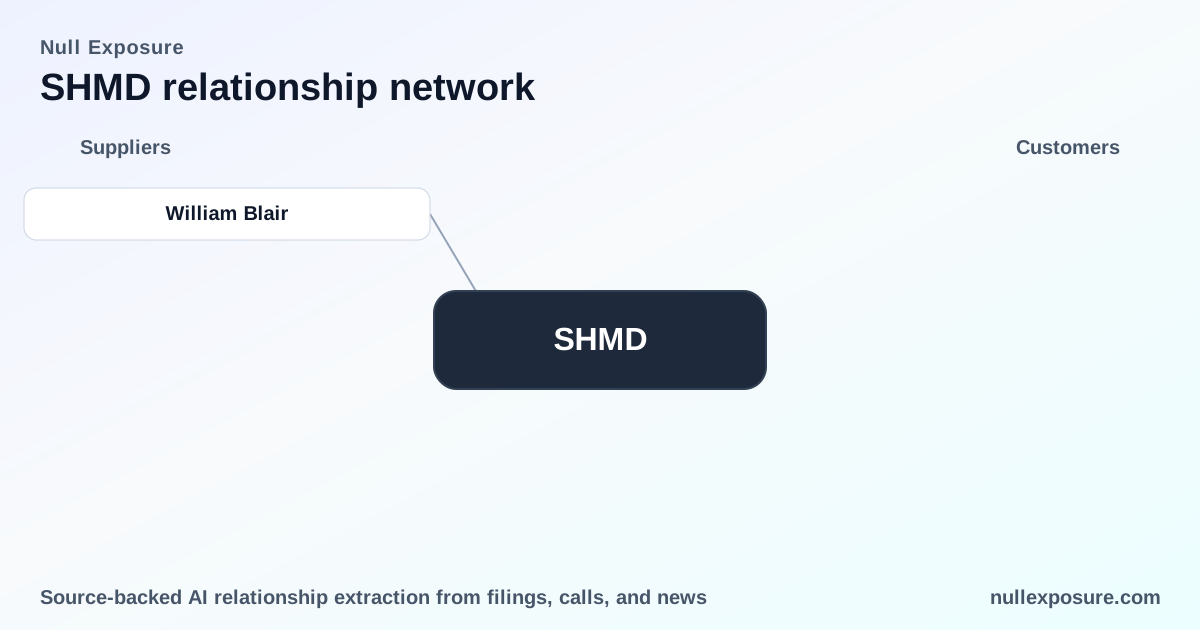
All sourced articles confirm William Blair acted as the sole placement agent for SCHMID’s recent convertible-note financings. That external placement posture signals active capital-markets engagement rather than reliance on bank debt or organic cash flow.
William Blair — Finance press mentions (QuiverQuant, Yahoo Finance, Sahm Capital)
-
According to a press release hosted on Yahoo Finance (March 10, 2026), William Blair acted as the sole placement agent in connection with the financing; the notice accompanied the company’s announcement of a tranche completion. https://finance.yahoo.com/news/schmid-group-n-v-announces-110700042.html
-
A QuiverQuant report (March 10, 2026) repeats that William Blair served as sole placement agent for the completion of a $15 million second tranche of convertible notes, underlining that the financing was staged. https://www.quiverquant.com/news/SCHMID+Group+N.V.+Completes+%2415+Million+Second+Tranche+of+Convertible+Notes+Financing
-
Another QuiverQuant item (March 10, 2026) covering the broader $30 million convertible-note and warrant financing also cites William Blair as sole placement agent, indicating the firm’s central role across the round. https://www.quiverquant.com/news/SCHMID+Group+N.V.+Secures+%2430+Million+Investment+Through+Convertible+Notes+and+Warrants+to+Enhance+Growth+Strategy
-
The transaction announcement posted on Sahm Capital’s site (January 21, 2026) similarly notes William Blair acted as sole placement agent for the USD 30 million convertible financing, reflecting the initial public communication of the round. https://www.sahmcapital.com/news/content/schmid-group-nv-announces-a-usd-30-million-convertible-notes-financing-2026-01-21
Each mention documents the same operational relationship from slightly different distribution channels; taken together they show a deliberate, agent-led approach to equity-linked financing.
What those relationships tell contract managers and suppliers
-
Contracting posture: SCHMID outsources capital-marketing functions to specialized advisers, signaling that management prioritizes access to investor networks and staged financings over bilateral bank credit. That makes the company capable of raising equity-linked capital quickly but introduces dilution and timing risk for suppliers dependent on payment continuity.
-
Concentration and control: Insider ownership registers at 72.19%, while institutional ownership is only 4.5% and the free float is limited (shares float ~15.53M of 55.6M outstanding). This is a founder/insider-controlled company with constrained market liquidity, making strategic decisions—like pursuing convertible notes—centrally directed.
-
Criticality for suppliers: Revenue of about $60.8M TTM and a small public float create scenarios where supplier payment terms can be materially affected by episodic capital raises. Suppliers with tight working-capital exposure should price in longer collections or require milestone-based security.
-
Maturity and financial posture: The company shows negative EBITDA (-$9.0M) and negative EPS (-$1.04) alongside a modest positive operating margin metric reported in the TTM figures. Operationally viable but financially stressed is an accurate characterization: SCHMID runs production capability and back-end services while relying on external financing to bridge cash gaps.
Valuation signals that matter to procurement and treasury
-
Market capitalization sits at roughly $362.5M with Price-to-Sales ~5.96 and EV/Revenue ~6.57, which prices future growth expectations into current equity value despite recent profitability headwinds. For suppliers, that valuation implies equity-based upside is present but not guaranteed; counterparty credit assessment should favor liquidity protections.
-
Low institutional ownership and a concentrated insider base reduce the likelihood of broad market discipline; covenant-light convertible instruments placed by William Blair shift negotiation leverage away from suppliers toward shareholder/issuer priorities.
Visit https://nullexposure.com/ to access deeper supplier-risk profiles and scenario playbooks for counterparties to growth-stage industrial technology firms.
Practical implications and risk mitigation for operators
- Require payment securities (letters of credit, escrowed milestone payments) when establishing or expanding supply contracts with SCHMID given periodic financing dependence.
- Negotiate adjustment clauses tied to issuance of equity-linked instruments to protect margin dilution risk and receivables exposure.
- Monitor placement-agent activity as a leading indicator of near-term cash injection events and potential dilution; William Blair’s recurring role signals that more tranches could follow.
Bottom line for investors and suppliers
SCHMID operates a capital-intensive manufacturing model that currently runs with operational capability but financial strain; the firm uses William Blair to execute convertible-note financings, which stabilizes liquidity at the expense of dilution and future equity complexity. High insider ownership and a thin public float amplify execution risk for counterparties who lack protective contracting. Evaluate supplier exposure through the lens of cash-flow timing, require contractual protections, and track placement-agent announcements as they directly precede changes in funding and payment capacity.
For a supplier-focused due diligence pack and tailored alerts on placement-agent activity, go to https://nullexposure.com/.
This analysis uses company disclosures and press notices from January–March 2026; the cited items above document the William Blair placement-agent relationship and the staged convertible-note financings that shape SCHMID’s near-term funding posture.