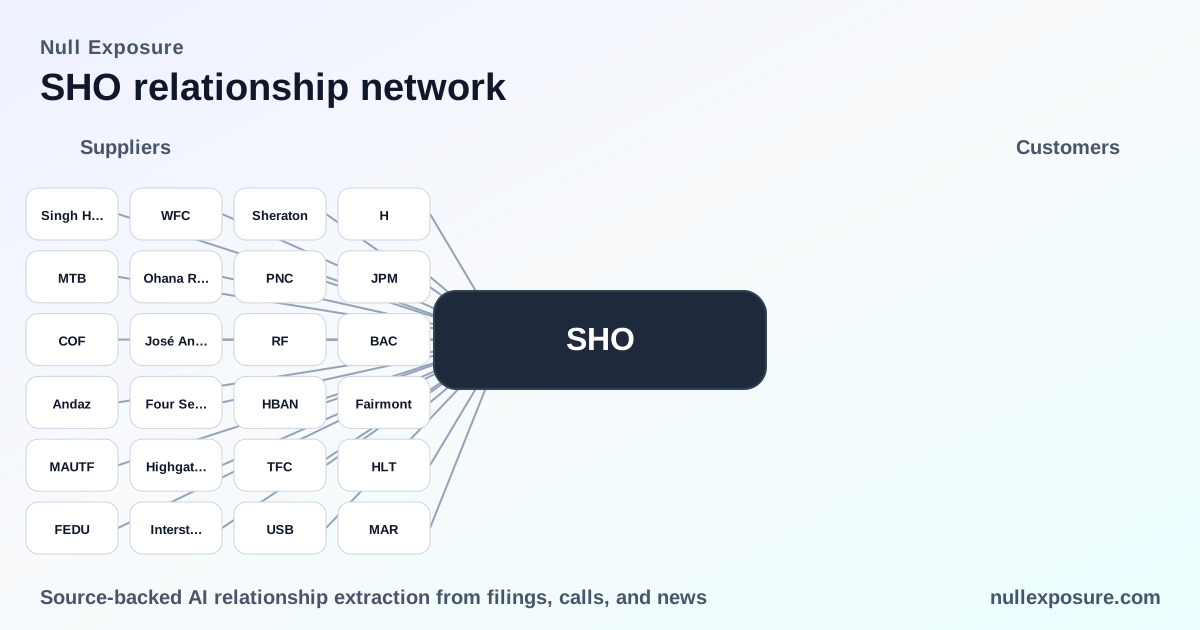
Sunstone Hotel Investors (SHO): Supplier map and what it means for investors
Sunstone Hotel Investors operates as an owner of upper‑upscale and luxury hotel real estate, leasing properties to a TRS lessee that engages third‑party operators and franchisors; the company monetizes via room revenues and ancillary streams captured at the real‑estate level, while paying usage‑based management and franchise fees to national operators and servicing banks that provide capital and liquidity. This ownership‑plus‑long‑term‑management model drives steady fee outflows but also preserves asset upside and portfolio flexibility for investors focused on cash flow and balance‑sheet durability. For a quick look at how Sunstone’s supplier web shapes risk and opportunity, see the company overview at https://nullexposure.com/.
If you evaluate supplier exposure for portfolio construction or counterparty risk, the next sections synthesize every relationship surfaced in public reporting and news, and translate company‑level contracting signals into investment implications. For a deeper dive into supplier relationships across your coverage set, visit https://nullexposure.com/.
How Sunstone structures its third‑party economics and why suppliers matter
Sunstone’s operating model separates property ownership from hotel operations: the TRS lessee contracts long‑term with third‑party hotel managers and signs license/franchise agreements with brand owners. Management and franchise fees are predominantly calculated as percentages of hotel revenues (usage‑based), and they represent a recurring, predictable cost line. At the same time, Sunstone’s access to capital is concentrated in a syndicated bank group that underpins refinancing flexibility and transaction execution.
- Contract posture: Long‑term management agreements and franchise licenses create durable operational dependencies but leave asset control at the REIT level.
- Concentration and counterparty profile: Sunstone relies on large global brands and major banks, which reduces operational execution risk but increases sensitivity to brand economics and lender syndicate terms.
- Criticality and maturity: Relationships are active and mature—fees and brand standards are embedded in contracts and the balance sheet.
- Spend profile: Reported aggregate basic/incentive management fees and franchise costs are material (in the $10m–$100m band), signaling meaningful ongoing payments to operators and franchisors.
These company‑level characteristics inform how to weigh counterparty concentration versus the diversification benefit of multiple large operators; see the full supplier list below for the underlying counterparties.
Full relationship map — every named counterparty in the reporting set
Below are concise, investor‑oriented summaries of each counterparty referenced in Sunstone’s public results and news coverage, with source notes.
-
Hyatt Hotels Corporation (Hyatt) — Sunstone acquired and is transitioning beachfront and urban assets under Hyatt brands, including the Confidante/Andaz Miami Beach reposition and the Hyatt Regency San Antonio Riverwalk acquisition; Hyatt will continue management under brand agreements and contributed key money in transactions (PR Newswire 2026; HospitalityNet 2026). (https://www.prnewswire.com/news-releases/sunstone-hotel-investors-to-acquire-hyatt-regency-san-antonio-riverwalk-302113576.html, https://www.hospitalitynet.org/announcement/41008101.html)
-
JPMorgan Chase Bank, N.A. (JPM) — JPMorgan is a joint lead and syndication agent on Sunstone’s unsecured credit facilities, forming part of a broad bank group that supports the REIT’s liquidity and refinancing activity (Yahoo Finance / press release 2026). (https://finance.yahoo.com/news/sunstone-hotel-investors-completes-1-120000696.html)
-
Bank of America, N.A. / BofA Securities, Inc. (BofA) — BofA participates as a joint bookrunner and syndication agent on Sunstone’s unsecured facilities, playing a central role in capital markets execution for the company (Yahoo Finance / HotelInvestmentToday 2026). (https://finance.yahoo.com/news/sunstone-hotel-investors-completes-1-120000696.html, https://www.hotelinvestmenttoday.com/Financials/REITS/Sunstone-refi-enhances-financial-flexibility)
-
Wells Fargo Securities, LLC / Wells Fargo Bank, N.A. (Wells Fargo) — Wells Fargo leads the unsecured facility syndicate and serves as administrative agent, anchoring the bank group that provides working capital and refinancing flexibility (Yahoo Finance 2026). (https://finance.yahoo.com/news/sunstone-hotel-investors-completes-1-120000696.html)
-
PNC Capital Markets LLC — Named among the joint leaders on the company’s unsecured credit facilities, supporting syndication breadth and lender diversification (Yahoo Finance 2026). (https://finance.yahoo.com/news/sunstone-hotel-investors-completes-1-120000696.html)
-
U.S. Bank National Association — Participates in the unsecured facility syndicate, contributing to Sunstone’s diversified lender base (Yahoo Finance 2026). (https://finance.yahoo.com/news/sunstone-hotel-investors-completes-1-120000696.html)
-
Truist Securities, Inc. (Truist) — Listed as a participant in the syndicated unsecured facility, reinforcing the multiple‑bank structure behind Sunstone’s liquidity (Yahoo Finance 2026). (https://finance.yahoo.com/news/sunstone-hotel-investors-completes-1-120000696.html)
-
Regions Capital Markets — Included in the loan syndicate supporting the company’s unsecured financing arrangements (HotelInvestmentToday 2026). (https://www.hotelinvestmenttoday.com/Financials/REITS/Sunstone-refi-enhances-financial-flexibility)
-
The Huntington National Bank — Named as a syndicate participant, adding regional bank coverage to the facility group (HotelInvestmentToday 2026). (https://www.hotelinvestmenttoday.com/Financials/REITS/Sunstone-refi-enhances-financial-flexibility)
-
Manufacturers and Traders Trust Company (MTB) — Acts as a documentation agent on issuance activity tied to the unsecured facility, reflecting back‑office roles in capital transactions (Yahoo Finance 2026). (https://finance.yahoo.com/news/sunstone-hotel-investors-completes-1-120000696.html)
-
Capital One, National Association — Identified as a documentation agent on Sunstone’s facility, providing transactional support on financing documents (Yahoo Finance 2026). (https://finance.yahoo.com/news/sunstone-hotel-investors-completes-1-120000696.html)
-
Ohana Real Estate Investors — Seller of the Montage Healdsburg to Sunstone for $265 million, a transaction that expanded Sunstone’s luxury resort exposure (HotelNewsResource 2026). (https://www.hotelnewsresource.com/article115401.html)
-
José Andrés Group — Named as culinary operator/partner for the Andaz Miami Beach reposition, reflecting how Sunstone sources guest‑facing services to enhance asset value and brand differentiation (LuxuryTravelMagazine 2026). (https://www.luxurytravelmagazine.com/news-articles/hyatt-to-debut-andaz-brand-in-florida-with-the-opening-of-andaz-miami-beach)
-
Four Seasons Hotels Limited — Listed among third‑party managers of certain Sunstone properties, signaling relationships with top‑tier luxury operators (MarketScreener 2026). (https://www.marketscreener.com/news/earnings-flash-sho-sunstone-hotel-investors-inc-posts-q4-affo-0-20-per-share-vs-factset-est-o-ce7e5cdfd88afe2c)
-
Highgate Hotels L.P. — Identified as a manager of one of Sunstone’s hotels, contributing to the operator diversification strategy (MarketScreener 2026). (https://www.marketscreener.com/news/earnings-flash-sho-sunstone-hotel-investors-inc-posts-q4-affo-0-20-per-share-vs-factset-est-o-ce7e5cdfd88afe2c)
-
Hilton Worldwide / Hilton (HLT) — Major brand partner and third‑party manager of several properties; Sunstone reports hotels operated under Hilton flags and specific joint‑venture transactions such as the remaining interest in Hilton San Diego Bayfront (MarketScreener; HotelNewsResource 2026). (https://www.marketscreener.com/news/earnings-flash-sho-sunstone-hotel-investors-inc-posts-q4-affo-0-20-per-share-vs-factset-est-o-ce7e5cdfd88afe2c, https://www.hotelnewsresource.com/article121114.html)
-
Interstate Hotels & Resorts, Inc. — Named among the third‑party managers active in the portfolio, reflecting additional operator variety (MarketScreener 2026). (https://www.marketscreener.com/news/earnings-flash-sho-sunstone-hotel-investors-inc-posts-q4-affo-0-20-per-share-vs-factset-est-o-ce7e5cdfd88afe2c)
-
Marriott International, Inc. / Marriott / Sheraton / The Bidwell Marriott Portland — Multiple Marriott subsidiaries operate several Sunstone hotels and franchise relationships, illustrating deep ties to the largest global loyalty ecosystem (HospitalityNet; PR Newswire 2017, 2024). (https://www.hospitalitynet.org/organization/17003843.html, https://www.prnewswire.com/news-releases/sunstone-hotel-investors-acquires-the-175-room-oceans-edge-hotel--marina-key-west-florida-300494704.html)
-
Singh Hospitality (Singh) — Local operator named as manager of a property under an independent arrangement, representing selective use of regional managers (PR Newswire 2017). (https://www.prnewswire.com/news-releases/sunstone-hotel-investors-acquires-the-175-room-oceans-edge-hotel--marina-key-west-florida-300494704.html)
-
Sage Hospitality Group — Listed among the third‑party managers, providing another mid‑market operator role in the portfolio (SEC disclosure excerpt reported 2024). (company filings summarized in MarketScreener 2026)
-
Hilton San Diego Bayfront (property) — Sunstone disclosed plans to acquire the remaining 25% JV interest, underlining direct portfolio consolidation in a flagship asset (HotelNewsResource 2026). (https://www.hotelnewsresource.com/article121114.html)
-
Andaz / Andaz Miami Beach (brand/property) — The Andaz Miami Beach reposition is a material asset relaunch that contributed to RevPAR outperformance and is central to Sunstone’s resort growth strategy (MarketBeat / MarketScreener 2026). (https://www.marketbeat.com/instant-alerts/sunstone-hotel-investors-nysesho-issues-quarterly-earnings-results-2026-02-27/, https://finviz.com/news/326079/sunstone-hotel-investors-inc-sho-a-bull-case-theory)
Investment implications: supplier risks and where to focus
Sunstone’s supplier map shows concentration with global brand managers and a diverse but bank‑led lender syndicate. That structure delivers operational scale and refinancing optionality, but also creates two observable risk vectors: (1) usage‑based fees that compress margins when RevPAR softens, and (2) lender syndicate terms that govern liquidity and covenant flexibility. Given reported fee levels (total management and franchise costs in the tens of millions), active monitoring of RevPAR trends and syndicate behavior is essential.
For investors who prioritize counterparty scrutiny, review management agreement expiries, brand standards that require capital spend, and the composition of the debt syndicate. For access to consolidated supplier intelligence and continuous monitoring, go to https://nullexposure.com/.
Bottom line and next steps
Sunstone’s reliance on top‑tier operators and a multi‑bank credit structure is a deliberate tradeoff: operational stability and brand demand at the cost of predictable, usage‑linked fee flows and dependence on syndicated credit markets. For income‑oriented investors, the model supports steady distributions when travel demand is healthy; for credit‑sensitive investors, the lender mix and fee mechanics warrant ongoing surveillance.
To track supplier developments and counterparty risk across your portfolio, start here: https://nullexposure.com/.