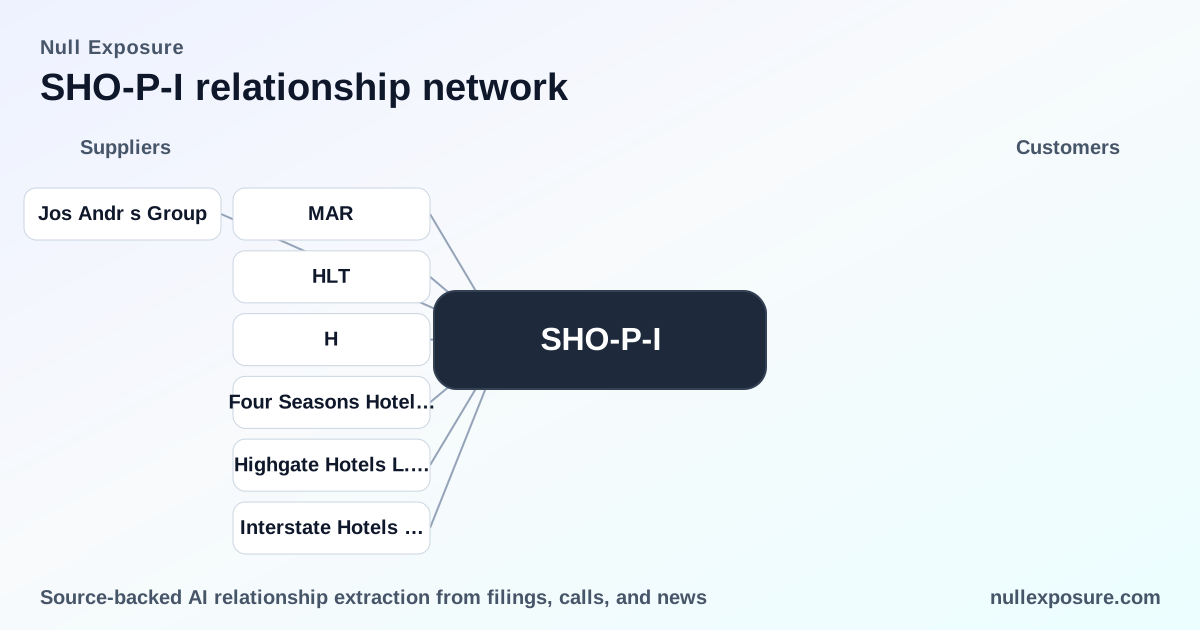
SHO-P-I Supplier Map: who runs the rooms, and why investors should care
SHO-P-I operates as a real-estate investment vehicle focused on branded upper-upscale and luxury hotels, monetizing through property ownership, leased/managed-hotel economics, and distributions tied to asset cash flow. The company outsources day-to-day operations to established hospitality managers, extracting returns as landlord and capital steward while relying on brand partners to drive occupancy, average daily rate (ADR) and guest experience.
Explore how these counterparty dynamics affect risk and valuation on the NullExposure homepage: https://nullexposure.com/
Why the roster of hotel managers matters for valuation and downside protection
The list of third-party managers attached to SHO-P-I is not a cosmetic detail; it defines the company’s operating posture. SHO-P-I’s business model is operator-agnostic at the asset level but brand-dependent at the revenue level — owners collect rent or fees and benefit from asset appreciation, while branded managers deliver the revenue performance that underpins cash flow. That structure produces several company-level signals:
- Contracting posture: The company uses long-term third-party management agreements rather than operating hotels directly, which reduces operational overhead but increases legal and brand dependency.
- Concentration and diversification: Management relationships are diversified across multiple global hotel brands, reducing single-counterparty concentration risk while focusing exposure on the luxury / upper-upscale segment.
- Criticality: Brand managers are critical to revenue realization because they control pricing, distribution and guest experience; changes in those agreements would have immediate cash-flow implications.
- Maturity: The roster of legacy brand partners signals a mature, institutional approach to hotel ownership favoring established operators over proprietary operating platforms.
Use this supplier map to inform contract review and scenario analysis: https://nullexposure.com/
Relationship-by-relationship: the complete counterparty roster and what each link means
Marriott International, Inc. — Marriott is among the subsidiaries acting as third‑party managers across SHO-P-I’s portfolio, representing a material operating channel for several properties and contributing branded distribution and loyalty-driven occupancy. According to a MarketScreener note dated March 10, 2026, Marriott subsidiaries are listed as third-party managers for multiple hotels (FY2026 reporting context).
Hilton Worldwide — Hilton is identified as an affiliate third‑party manager on the company’s roster and contributes to branded positioning and premium ADR at properties it manages. MarketScreener’s March 10, 2026 coverage lists Hilton as one of SHO-P-I’s management partners (FY2026).
Hyatt Hotels Corporation — Hyatt manages two of SHO-P-I’s hotels, providing chain-level sales, marketing and revenue-management expertise that feed into asset performance. MarketScreener’s March 10, 2026 article references Hyatt’s management role (FY2026).
Four Seasons Hotels Limited — Four Seasons appears on the manager list and supplies ultra‑luxury branding and operations for select properties, reinforcing SHO-P-I’s exposure to the high‑ADR luxury end of the market. MarketScreener’s March 10, 2026 note includes Four Seasons among third‑party managers (FY2026).
Highgate Hotels L.P. — Highgate is named as a third‑party manager, supplying institutional hotel management capabilities across relevant assets in the portfolio. MarketScreener’s March 10, 2026 piece lists Highgate alongside other managers (FY2026).
Interstate Hotels & Resorts, Inc. — Interstate operates as another third‑party manager on the roster, supporting SHO-P-I’s geographically diversified footprint with third-party operational expertise. MarketScreener’s March 10, 2026 coverage includes Interstate in the manager list (FY2026).
Jos Andrés Group — The company is partnering with a hospitality operator for signature dining and experiential offerings; an SEC filing dated February 27, 2026 states that a resort within SHO-P-I’s portfolio will introduce Bazaar Meat by Jos Andrés Group and open a members‑only beach club later in the year (SEC exhibit filed FY2026).
Hilton San Diego Bayfront — As a named example of SHO-P-I’s branded, high-ADR assets, Hilton San Diego Bayfront illustrates the type of marquee properties in the portfolio that drive valuation and stability. An InsiderMonkey blog post (March 10, 2026) references Hilton San Diego Bayfront among notable properties owned across the company’s holdings (FY2026).
What investors should extract from the supplier list
The counterparty map drives three investment conclusions that affect valuation and downside planning:
- Revenue sensitivity to brand performance: Because SHO-P-I relies on well-known managers to run hotels, revenue and FFO are directly tied to those brands’ ability to sustain ADR and occupancy. Investors must price in brand-level volatility into cash-flow forecasts.
- Operational leverage with limited fixed-cost exposure: Outsourced management reduces SHO-P-I’s direct operating risk and capital intensity, concentrating risk in contract terms (management fees, incentive fees, termination rights) rather than payroll or operations.
- Resilience via diversification across top-tier brands: The presence of multiple blue‑chip managers reduces single-counterparty operational concentration while preserving the premium that branded assets command in the market.
Key diligence steps follow from these takeaways: review management agreements for termination triggers, incentive fee structure and brand standards; stress-test ADR and occupancy under different management scenarios; and quantify any revenue-sharing arrangements that shift upside away from the landlord.
Risk and opportunity checklist for portfolio managers
- Risk: Contractual exposure — termination or re-franchising costs create valuation volatility.
- Risk: Brand concentration in luxury/upper-upscale — economic downturns that hit travel can compress ADRs more sharply in this segment.
- Opportunity: Upside from asset repositioning and F&B partnerships — collaborations like the Jos Andrés Group rollout unlock ancillary revenue and enhance guest proposition.
- Opportunity: Fee and lease negotiation — institutional owners can improve margins by renegotiating management or lease economics as market conditions normalize.
Next steps for analysts and operators
For buy-side analysts and asset managers, the practical next move is a focused contract review and scenario modeling of counterparty disruptions. For sourcing and operations teams, prioritize properties where management agreements are up for renewal or where rebranding can unlock ADR premiums.
For a centralized, searchable view of supplier relationships and to incorporate these counterparty signals into your diligence workflow, visit NullExposure: https://nullexposure.com/
Close diligence with a prioritized action list: verify the dates and terms of the management agreements, quantify termination and transition costs, and model revenue under alternative operator scenarios. For an investor-grade supplier map and ongoing monitoring, start with NullExposure: https://nullexposure.com/