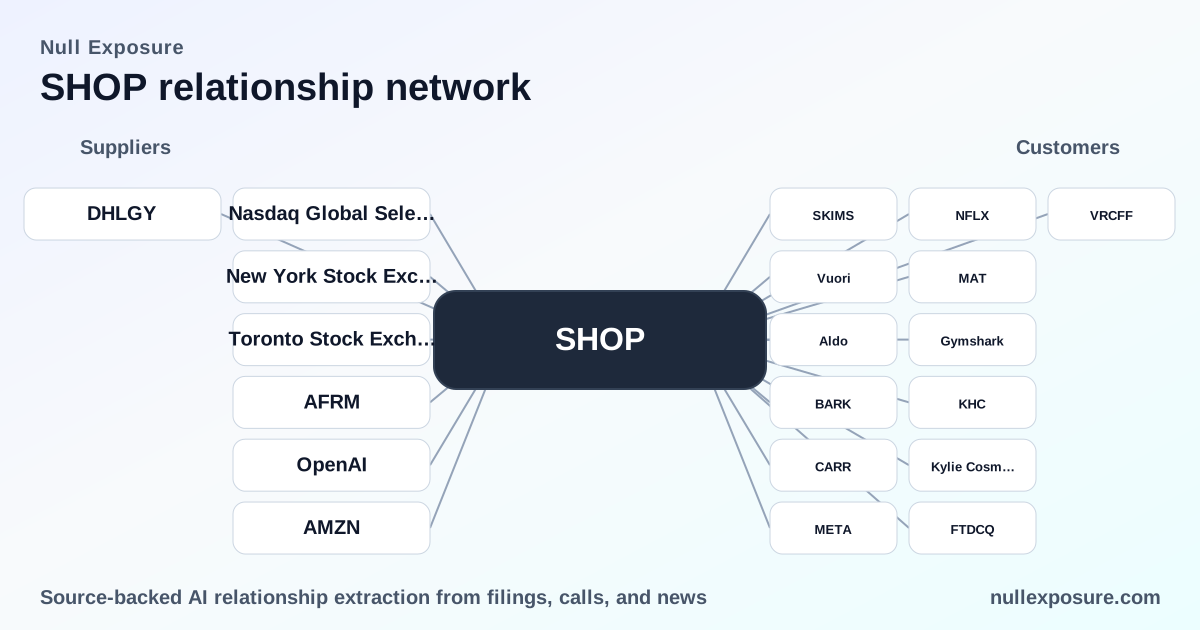
Shopify’s supplier footprint: who matters to the commerce platform and why investors should care
Shopify operates as a commerce and services platform that monetizes through subscriptions, merchant solutions and transaction-related fees, while extending its economics via embedded financial services and logistics partnerships that capture payments and fulfillment value. For investors assessing supplier relationships, the story is not just vendor names—it's how those partners reinforce Shopify’s checkout control, scale distribution, and financial-services expansion, and where fixed contractual commitments create leverage and risk. For a consolidated view of Shopify’s partner exposures and implications, visit https://nullexposure.com/.
Quick orientation: the suppliers on the map and how they plug into Shopify’s model
Below I walk through each publicly documented supplier or partner mention, explain the role in plain English, and cite the source so you can follow the trail. These relationships are a mix of capital-markets moves, payments and finance partners, AI/content integrations, and logistics providers that materially affect Shopify’s customer experience and cost structure.
Nasdaq Global Select Market (Nasdaq)
Shopify is moving its U.S. listing from the New York Stock Exchange to the Nasdaq Global Select Market, a corporate-markets decision that can affect liquidity, index membership dynamics and investor constituency. A Betakit report on March 10, 2026 covered the transfer and noted the company will remain listed on the TSX.
Source: Betakit, March 10, 2026.
New York Stock Exchange (NYSE)
The company’s voluntary transfer away from the NYSE is the counterparty to the Nasdaq move and signals a shift in Shopify’s U.S. listing strategy that investors should treat as a governance and investor-relations event.
Source: Betakit, March 10, 2026.
Toronto Stock Exchange (TSX)
Shopify will continue trading under the ticker SHOP on the TSX, keeping its Canadian listing intact while changing its U.S. venue; this maintains its dual-market footprint for Canadian institutional holders.
Source: Betakit, March 10, 2026.
Affirm (AFRM)
Shopify expanded its agreement with Affirm for Shop Pay Installments, deepening Shopify’s embedded payments and buy-now-pay-later capabilities and extending transaction-driven revenue potential. This strengthens Shopify’s financial-services monetization in checkout flows.
Source: Sahm Capital, January 5, 2026.
OpenAI
Shopify has partnered with AI platforms such as OpenAI to enable browsing and purchasing within AI chat experiences while explicitly retaining control of the checkout layer—this preserves Shopify’s role as the commerce conductor even as shopping migrates into conversational interfaces.
Source: Sahm Capital, February 27, 2026.
Amazon fulfillment (AMZN)
Strategic integration with Amazon fulfillment services is referenced as a way Shopify lowers merchants’ fulfillment barriers and improves delivery scale, which can increase merchant retention but also exposes Shopify to third-party logistics availability and pricing dynamics.
Source: Sahm Capital, February 1, 2026.
DHL (DHLGY)
DHL is listed alongside Amazon as a logistics partner that reduces cross-border and last-mile friction for Shopify merchants, effectively outsourcing portions of fulfillment while enabling faster global reach.
Source: Sahm Capital, February 1, 2026.
What these supplier ties reveal about Shopify’s operating model and constraints
Shopify’s supplier profile reveals a platform that is strategically integrated and increasingly contractually committed. Several company-level signals are explicit in public disclosures:
-
Contracting posture and spend commitments: Company filings disclose that during the year ended December 31, 2024, Shopify entered agreements that include an annual minimum unconditional purchase obligation of $200 million, and the minimum fixed and determinable portion of unconditional purchase obligations over the next two years, as of December 31, 2025, was $251 million. That level of committed spend signals meaningful fixed-cost exposure and a predictable procurement baseline for third-party services.
Source: Company disclosure for year ended Dec 31, 2024 / as of Dec 31, 2025. -
Service-provider engagement: Shopify engages third-party security experts and consultants to assess and enhance cybersecurity risk management, indicating reliance on external specialists for critical operational controls rather than full internalization of those capabilities. This is a company-level operational choice consistent with platform-scale vendors.
Source: Company disclosure on third-party security engagements. -
Scale and concentration dynamics: Partnerships with large logistics providers and a major BNPL partner are consistent with a focused supplier set where a small number of large partners provide critical capabilities—fulfillment scale, payment orchestration, and AI interface—reducing friction for merchants but creating concentration risk in key flows.
-
Criticality and maturity: The OpenAI integration highlights Shopify’s priority to retain checkout control even as front-end discovery moves into AI experiences; the Nasdaq/TSX listing moves reflect corporate maturity and investor positioning. Together, these relationships show Shopify balancing platform control with ecosystem interoperability.
Investment implications: risk, optionality and monitoring priorities
Shopify’s supplier relationships create a mix of embedded revenue optionality and operational commitments that investors must monitor.
-
Revenue upside through embedded finance: The Affirm extension increases transaction economics and gives Shopify a lever to grow payments revenue, which is higher margin than subscription fees. Watch merchant adoption rates for Shop Pay Installments and related payment volumes. Source: Sahm Capital, Jan 5, 2026.
-
AI distribution without losing checkout economics: Integrations like OpenAI expand buyer discovery channels while Shopify’s insistence on controlling the checkout preserves transaction flow ownership and fee capture. This is a structural advantage if Shopify sustains checkout exclusivity. Source: Sahm Capital, Feb 27, 2026.
-
Fulfillment partnerships lower merchant barriers but introduce supplier dependency: Amazon fulfillment and DHL broaden merchant logistics options and accelerate scale, but they also raise exposure to third-party pricing and capacity shocks that could affect merchant economics. Source: Sahm Capital, Feb 1, 2026.
-
Contractual spend commitments raise fixed-cost operational risk: The disclosed minimum purchase obligations ($200M annual, $251M over two years as of Dec 31, 2025) create downside pressure on margins if merchant revenue growth slows; investors should track whether those obligations compress operating leverage. Source: Company disclosure for FY2024–FY2025.
For a concise monitoring checklist and supplier-risk dashboard you can act on, check the research hub at https://nullexposure.com/.
Final takeaways and what to watch next
- Shopify is executing a platform-first strategy that leverages large payments and logistics partners to increase merchant scale while preserving checkout economics through AI integrations.
- Committed third-party spend is non-trivial, creating fixed-cost exposure that amplifies cyclical revenue risk if merchant volumes slow.
- Market structure moves (NYSE → Nasdaq) and continued TSX listing are corporate governance actions that influence investor composition and liquidity rather than product strategy, but they matter for valuation comparables.
For investors, the critical next data points are merchant transaction growth tied to Shop Pay Installments, the degree to which AI discovery channels convert without bypassing Shopify’s checkout, and any changes to fulfillment contracts or cost pass-throughs. For a consolidated briefing and ongoing monitoring, return to https://nullexposure.com/ for updated supplier intelligence and actionable summaries.
Bold summary: embedded finance and AI integrations are Shopify’s primary growth levers; committed supplier spend is the primary operational risk.