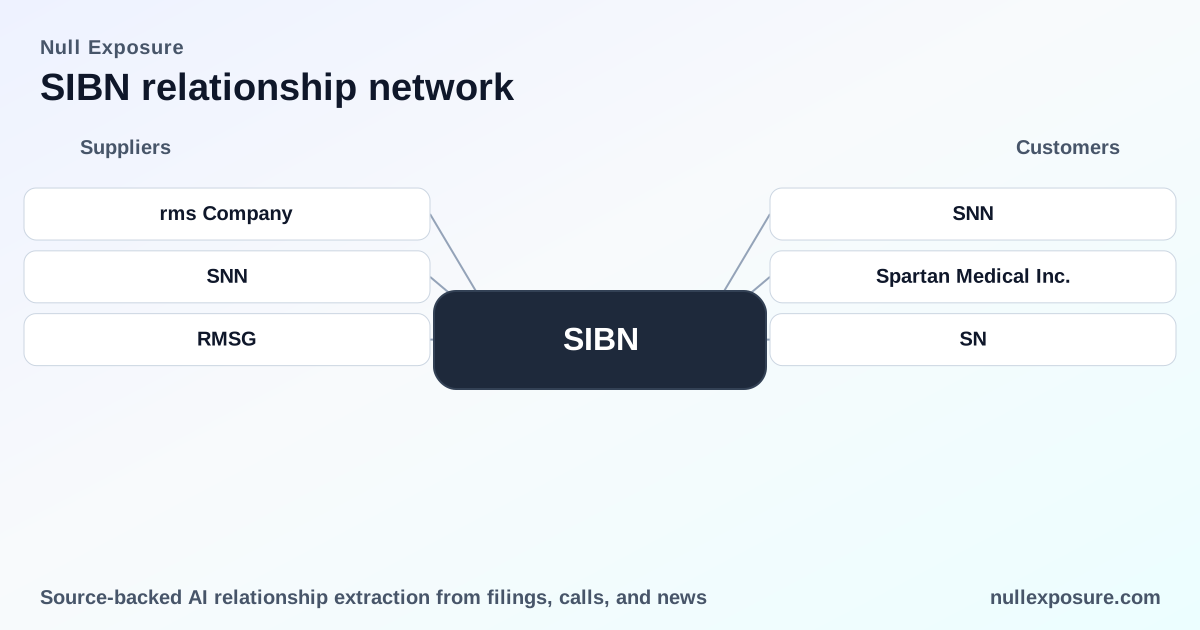
Si-Bone (SIBN) — supplier relationships that shape the operational runway
Si-Bone sells implantable sacropelvic devices and monetizes through direct device sales to hospitals and trauma centers, supplemented by third-party distribution partnerships. The company outsources substantially all manufacturing and relies on a small set of external manufacturers for its flagship iFuse product family, while extending market reach through strategic distribution deals — a business model that converts product design and clinical differentiation into recurring device revenue but concentrates operational risk in supplier execution and channel partnerships. Learn more about supplier risk intelligence at https://nullexposure.com/.
Snapshot: how supplier structure feeds the P&L
Si-Bone reported TTM revenue of $200.9M and gross profit of $159.9M, but is operating at a loss on the bottom line (EBITDA negative $16.6M and diluted EPS -$0.44). Institutional ownership is unusually high at ~97.8%, reflecting concentrated investor interest in a growth-at-a-reasonable-price medical device story. The company’s outsourced manufacturing model reduces fixed-capex intensity and keeps capital requirements modest, but translates operating leverage into dependence on external manufacturers and distribution partners for product availability and growth execution.
Supplier relationships — what the filings and press disclose
rms Company (10‑K, FY2024)
The FY2024 10‑K states that rms Company is the only supplier for the iFuse‑3D and iFuse TORQ / TORQ TNT implants, creating a sole-source dependency for those product lines. According to the FY2024 10‑K filing, this exclusivity is explicit and operationally material to device availability.
RMS / RMSG — Manufacture and Supply Agreement (10‑K, FY2024)
Si‑Bone disclosed that it entered an exclusive Manufacture and Supply Agreement with RMS in February 2024, replacing a prior Manufacturing, Quality and Supply Agreement; the agreement governs production terms and supersedes earlier arrangements. This is documented in the FY2024 10‑K and establishes RMS as the formal manufacturing partner under contract.
Smith+Nephew partnership (news report, Mar 2026)
In March 2026, Si‑Bone announced a strategic commercial partnership with Smith+Nephew to distribute iFuse TORQ and TORQ TNT across Level 1 and Level 2 trauma centers nationwide, extending the company’s trauma-channel reach through an established orthopedics network (reported on Yahoo Finance, March 10, 2026).
Company-level constraints and what they reveal about the operating model
The filings and extracted contract language present consistent company-level signals:
- Long-term contracting posture with fixed pricing through 2026 and an initial multi‑year term: filings indicate prices are fixed under the agreement through 2026, and the referenced agreement has a three‑year initial term with automatic one‑year renewals and specified early-termination clauses. This is a company-level disclosure from the FY2024 filing and signals commercial price stability through the near term.
- Outsourced manufacturing as core operational model: the company states it outsources substantially all manufacturing of its implants and instruments, positioning third-party manufacturers as operationally central while limiting direct manufacturing capital spend.
- Supplier role and classification: third parties are explicitly described as manufacturers and, in other contexts, service providers (payment processing and similar services are handled by third parties).
- Spend and purchase commitments are modest on the balance sheet: outstanding purchase commitments totaled approximately $0.4M as of December 31, 2024, which indicates relatively low contractual spend exposure in dollar terms versus company revenue, though not necessarily low strategic exposure for key components.
These constraints collectively paint a structure where operational criticality is high but absolute contractual spend is low, creating a concentrated supply risk that is operationally important despite its small direct dollar commitment.
What investors and operators should read into this
- Concentration risk is real and actionable. The FY2024 filing names rms Company / RMS as the exclusive supplier for key implants, making RMS performance and continuity directly consequential to Si‑Bone’s product availability and quarterly revenue cadence.
- Contract structure provides near‑term stability but limited insulation. Fixed pricing through 2026 and a multi‑year initial term reduce short‑run price volatility, yet automatic renewals and early-termination provisions mean continuity is governed by contract mechanics rather than permanent vertical integration.
- Commercial distribution risk is being diversified. The Smith+Nephew partnership is an important commercial de‑risking move: it expands go‑to‑market reach into trauma centers and leverages a well‑established orthopedics sales footprint, reducing reliance on Si‑Bone’s internal or existing channels for that segment (news, Mar 2026).
- Operational leverage vs. vendor dependence. Outsourcing minimizes capex and manufacturing overhead, which is appropriate for a niche device maker, but operational continuity depends on vendor quality, capacity, and compliance. Given the company’s modest purchase commitments (~$0.4M), the real exposure is supply continuity for mission‑critical components, not large single‑vendor spend.
If you want a deeper supplier-risk briefing, visit https://nullexposure.com/ for tailored supplier analytics and contract intelligence.
Practical next steps for due diligence
- Obtain and review the full Manufacture and Supply Agreement language for termination rights, quality KPIs, capacity commitments, and price reset mechanics; these clauses govern how disruptive a supplier event would be.
- Monitor RMS operational health and regulatory posture (inspection history, capacity expansions, or recalls) because RMS is described in filings as the production backbone for key implants.
- Track commercial adoption and metrics tied to the Smith+Nephew roll‑out, such as hospital placements, procedure volume growth, and channel economics, to quantify distribution upside and timing.
- Review contingency planning: inventory buffers, dual‑sourcing options for non‑proprietary parts, and contractual purchase commitments that could accelerate or constrain flexibility.
Key takeaways for investors and operators
- Single-source manufacturing for flagship implants elevates operational risk even as contract terms give near‑term price and supply stability.
- Outsourced manufacturing reduces capital intensity but concentrates strategic dependence; absolute committed spend is small relative to revenue, yet product-critical components create asymmetric risk.
- The Smith+Nephew partnership materially improves commercial distribution for trauma centers and reduces go‑to‑market risk while leaving manufacturing concentration intact.
Want a supplier-risk scorecard and contract-level visibility for this issuer? Visit https://nullexposure.com/ to request a detailed supplier intelligence pack.
This supplier map changes how you balance operational vs. commercial risk in Si‑Bone: the company has secured near‑term manufacturing contracts and expanded distribution partnerships, but investors must treat supplier continuity and the terms of those agreements as first‑order valuation sensitivities.