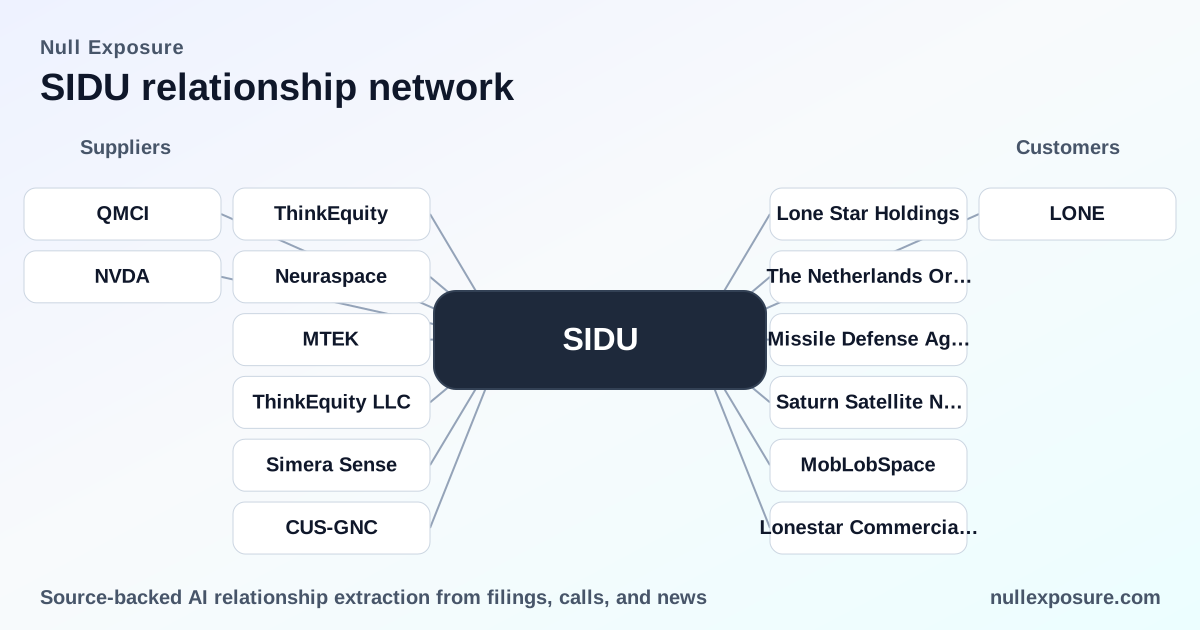
Sidus Space: a supplier map and what investors should price in
Sidus Space designs, builds and flies small satellites and monetizes through a mix of hardware sales, hosted payload services, in-orbit data collection/analytics and recurring mission services. The firm leverages third‑party manufacturers and platform partners for payload integration and launch operations, and repeatedly taps capital markets to fund growth—making supplier relationships and placement-agent arrangements equally material to the equity thesis and risk profile. For investors evaluating counterparties, the combination of small revenue, negative margins and active capital raises creates heightened supplier and financing sensitivity.
Learn more about supplier intelligence at https://nullexposure.com/
How Sidus runs the business and where suppliers fit in
Sidus operates as a vertically integrated small-sat provider: internal design and mission management are combined with outsourced manufacturing, software integration and third‑party payloads. Revenue remains modest (Revenue TTM $3.6M) while margins and EBITDA are negative, so Sidus relies on external capital to sustain production and constellation deployment. That funding dependence amplifies the importance of placement agents and financial services relationships, while operational partners (payload integrators, STAM/LEOP providers, AI/edge vendors) determine time-to-orbit and data product quality.
- Capital intermediation is a core service relationship: repeated placement-agent arrangements indicate a recurring need to access equity markets.
- Manufacturing and launch support are critical operational dependencies: suppliers that provide bus-level hardware, launch integration and early-operations services directly affect revenue realization.
- Data and edge compute partners increase product value but introduce vendor concentration and integration risk.
If you track supplier risk or vendor concentration for portfolio due diligence, these are the live levers: capital partners, mission operations providers, payload vendors and compute/AI partners. Explore more supplier profiles at https://nullexposure.com/
The partner list, one-by-one
Below I cover every named relationship surfaced in public reporting and news for Sidus in the provided results, with a concise, investor‑facing summary and the relevant source.
-
ThinkEquity — ThinkEquity has acted as Sidus’ sole placement agent on multiple December 2025 offerings (a best‑efforts public offering and a registered direct offering that together targeted roughly $41M gross before fees). This confirms Sidus’ reliance on equity raises and a concentrated capital‑markets provider relationship. (Sidus press releases and investor filings, Dec 22–26, 2025; The Globe and Mail coverage, FY2025.)
-
Neuraspace — Neuraspace will provide Space Traffic Management and LEOP (Launch and Early Orbit Phase) support to Sidus, enhancing LizzieSat constellation operations and reducing operational risk during early mission phases. (SiliconCanals report relaying Sidus announcement, FY2024.)
-
Maris‑Tech Ltd. (MTEK) — Maris‑Tech’s advanced video/AI payload is scheduled to fly on Sidus’ LizzieSat‑4 mission, marking an integration milestone that underscores Sidus’ role as a payload host and its strategy to monetize edge‑AI imaging. (Company integration announcement reported via Sahm Capital, Jan 26, 2026; Maris‑Tech referenced as Nasdaq: MTEK.)
-
Simera Sense — Sidus entered a partnership to integrate hyperspectral imaging payloads with in‑orbit processing and AI analytics, indicating a move to higher‑value Earth‑intelligence services rather than raw images alone. (Sahm Capital coverage of the Simera Sense deal, Feb 11, 2026; FY2026.)
-
CUS‑GNC — Sidus implemented CUS‑GNC’s SpacePilot autonomous navigation software on LizzieSat‑3 to enable optimized maneuvers, pointing to reliance on third‑party guidance, navigation and control software for bus autonomy. (TS2 Tech coverage of LS‑3 commissioning, Dec 2025; FY2025.)
-
QuoteMedia — QuoteMedia supplies market data for Sidus’ investor site and financial pages, a standard investor‑relations relationship that supports public disclosure and market access. (Sidus investor site pages indicating “Market Data powered by QuoteMedia”, FY2025.)
-
NVIDIA — Sidus highlighted the use of NVIDIA Jetson AGX Orin Industrial (quoted as delivering 248 TOPS of AI performance) for an in‑orbit compute module (the 248Vi), signaling adoption of commercial AI compute hardware for edge processing on future deliveries. (TS2 Tech technology specs referenced by Sidus, FY2025 coverage.)
What the constraints reveal about Sidus’ contracting posture
The extracted constraints read as company‑level signals for procurement and operational posture:
-
Licensing activity is present in the ecosystem. One excerpt explicitly references a license agreement involving Aurea Alas Limited for radio frequency spectrum rights, which signals that spectrum licensing and third‑party license arrangements are part of Sidus’ operating environment (excerpt in company filings). This implies the company must manage spectrum access as an operating risk and contractual item.
-
Sidus relies on third‑party manufacturers. Filings note reliance on a limited number of suppliers and manufacturers, which increases vendor concentration risk for critical components and assembly.
-
Supplier relationships are active and transactional. The constraint labelled “active” and the existence of monthly payments (the $24,643/month example) imply ongoing operational contracts with modest recurring cash outflows—consistent with a growth‑stage industrial company managing working capital.
-
Spend profile is small-to-mid for many suppliers. The inferred spend band (100k–1m) and the explicit monthly payment example suggest many vendor contracts sit at manageable absolute sizes for counterparties, but they remain critical relative to Sidus’ modest revenue base.
Collectively, these constraints point to a company with active supplier dependencies, concentrated manufacturing partners, spectrum/licensing obligations and ongoing monthly commercial commitments—all while operating with limited internal cash generation.
Investment implications and a short risk checklist
-
Financing risk: Repeated equity offerings and the use of a single placement agent increase dilution and execution risk; monitor placement terms and fees (reports note a 7% cash fee in one filing). (Sidus investor releases and filings, Dec 2025–Jan 2026.)
-
Operational dependency: Mission success hinges on third‑party providers for LEOP, autonomy and payload integration (Neuraspace, CUS‑GNC, Maris‑Tech, Simera). A supplier failure would delay revenue realization and increase cash burn.
-
Technology upside: Adoption of edge AI (NVIDIA Jetson, Simera Sense, Maris‑Tech payloads) enhances product differentiation and potential margin expansion if Sidus can commercialize processed data products.
-
IR and disclosure: QuoteMedia’s role is standard but reinforces that investor communications are consolidated through third‑party market data services.
For a deeper supplier‑level diligence workflow, visit https://nullexposure.com/ — we map counterparties, contract types and cash‑flow exposure to help prioritize operational risk.
Bottom line: where to focus your diligence
Sidus is a growth‑stage aerospace operator whose investor thesis depends on execution across three axes: capital raises, reliable manufacturing/LEOP partners, and commercial traction for higher‑value data services. Key monitoring points for both investors and operators are placement‑agent terms, the health and exclusivity of manufacturing and LEOP contracts, and the pace at which AI/edge payload partnerships convert into recurring revenue. If capital access tightens or a critical supplier fails to deliver, the downside is rapid given negative margins and low revenue scale.
For active due diligence on Sidus’ supplier exposures and to see the primary documents behind these summaries, go to https://nullexposure.com/ — we maintain curated relationship dossiers and constraint signals for investor use.