SIFCO Industries (SIF): Supplier Relationships, Constraints, and What Investors Should Know
SIFCO Industries manufactures forged and machined components for aerospace and energy customers and monetizes through contract manufacturing, aftermarket spares and engineering-led machining services. The company’s revenue comes from volume production runs and repeat program work with aerospace and power-generation OEMs and tier suppliers, while margins depend on capacity utilization, raw-material pass-through, and the stability of a largely small-business supplier base. For investors and operators assessing counterparty risk, the combination of a modest market cap (~$41m) and a geographically concentrated, small-supplier network is the central underwriting consideration. Learn more about supplier intelligence and counterparty signals at https://nullexposure.com/.
How SIFCO’s supplier footprint shapes cashflow and risk appetite
SIFCO’s operating model requires reliable access to high-quality metals and machining inputs. Company disclosures note that many of SIFCO’s suppliers are small companies with limited financial resources and manufacturing capabilities, and that suppliers are located principally in North America. These are not abstract facts: they translate into a supplier posture that is fragmented, regionally concentrated, and operationally critical.
- Contracting posture: SIFCO generally maintains multiple sources for raw materials, which reduces single-vendor dependency for core metals inputs and lowers the probability of a single-point supply shock.
- Concentration: Despite multiple sourcing, the supplier base is skewed to small businesses, which increases counterparty fragility during demand shocks or commodity price swings.
- Criticality: Inputs are critical—high-quality metals and precision components directly affect on-time delivery and margin realization.
- Maturity: The supplier network’s maturity is mixed; many vendors have limited capital and scale, which elevates supplier credit and capacity risk even as program relationships provide recurring revenue for those vendors.
These characteristics create a risk/return trade-off: diversified sources reduce catastrophic risk, but the financial health of small suppliers is the single largest operational vulnerability for SIFCO.
Legal advisory relationships: Carnelutti law firm tied to a legacy acquisition
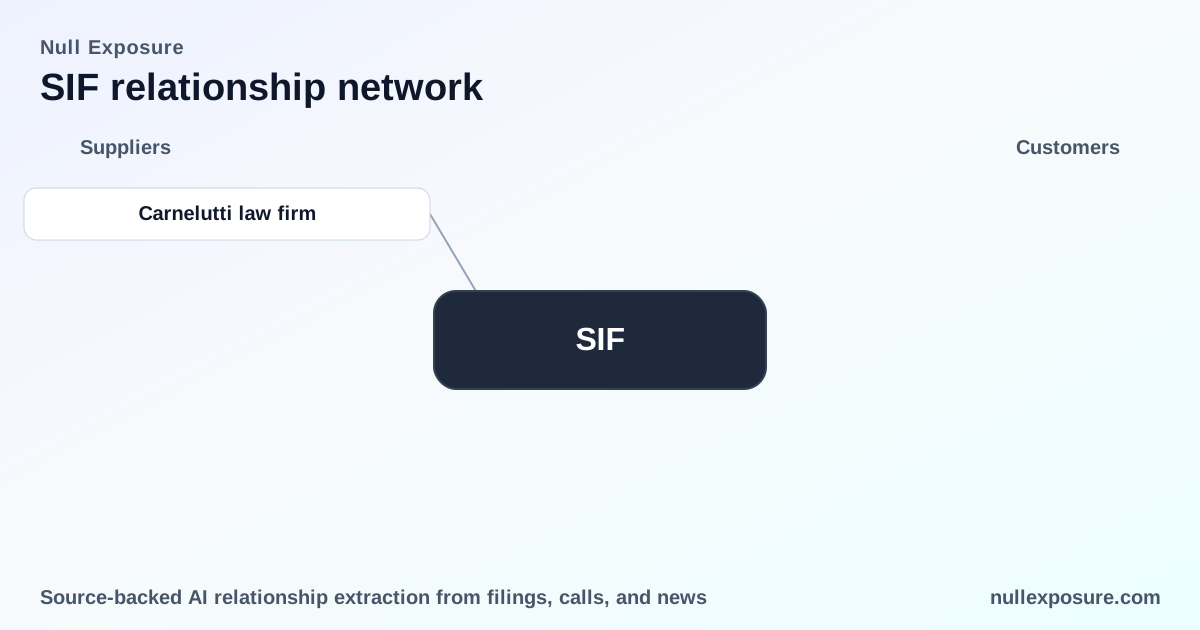
SIFCO engaged external legal counsel for cross-border activity: SIFCO was advised by the Carnelutti law firm in connection with its acquisition of Italy’s Cblade in 2015, while the seller’s legal advisor was Gianni Origoni Grippo Cappelli & partners. This is a transactional, advisory relationship tied to an M&A event rather than an ongoing production supplier engagement. (Source: Bebeez report, March 30, 2015: https://bebeez.eu/2015/03/30/us-forged-components-specialist-sifco-buys-italys-cblade/.)
Why the advisory engagement matters for suppliers coverage
A law firm engagement for a cross-border acquisition signals SIFCO’s willingness to use external specialist advisors when expanding geographic exposure. That transaction-level behavior supports a strategic view that SIFCO will use external expertise to manage integration risk when acquiring foreign capabilities, but it does not change the underlying supplier risk profile tied to small, North American vendors.
Company-level constraints that guide supplier evaluation
The disclosures and constraint signals from SIFCO provide actionable company-level intelligence for investors and procurement teams:
- Small-business counterparty bias: Evidence excerpts directly state many suppliers are small with limited financial resources and manufacturing capabilities. This is a structural characteristic and a primary diligence focus for credit and operations teams.
- North American geographic concentration: Suppliers of materials are located principally in North America, which reduces geopolitical risk but raises exposure to regional industrial cycles and localized supply disruptions.
- Active multi-sourcing stance: SIFCO reports having multiple sources for its raw materials and not depending on a single supplier, which is a deliberate contracting posture to manage supply risk.
These constraints should be read as signals of operational pragmatism—SIFCO mitigates single-vendor risk through multiple sourcing, but the collective small size of those vendors increases systemic vulnerability during demand shocks or commodity dislocations.
Practical implications for investors and procurement operators
For investors assessing SIFCO’s supplier relationships and operational resilience, focus on three priorities:
- Supplier credit monitoring: Because suppliers are often small, track vendor payment performance, receivables stress and any near-term capacity constraints that could impair deliveries.
- Concentration for specific commodities: Even with multiple sources, certain alloys or specialty forgings could be concentrated; quantify exposure by input and by program.
- Contract terms and flexibility: Review SIFCO’s supplier contracts for lead times, price adjustment clauses, and contingency manufacturing options that preserve margin during raw-material inflation.
For procurement teams, prioritize dual-sourcing of critical alloys and accelerate qualification of geographically diverse vendors to lower time-to-recover from a localized supplier failure.
For deeper supplier intelligence and tailored counterparty scoring, visit https://nullexposure.com/.
Relationship coverage: concise, transaction-level statements
- Carnelutti law firm — SIFCO retained Carnelutti as legal counsel in connection with its acquisition of Italy’s Cblade in 2015; this was a transactional advisory engagement rather than a production supply agreement (Bebeez, March 30, 2015).
Risk-adjusted investor takeaways
- Operational risk centers on supplier fragility: The predominance of small suppliers with limited resources elevates counterparty credit risk even as SIFCO’s multi-sourcing reduces single-vendor exposure.
- North American sourcing reduces geopolitical tail risk but concentrates industrial-cycle exposure: Regional concentration simplifies logistics but links performance to North American aerospace and energy demand cycles.
- M&A and advisory behavior indicates pragmatic expansion strategies: The Carnelutti engagement demonstrates SIFCO uses external advisors for cross-border deals, which supports disciplined integration but does not materially alter supplier network fragility.
If you are modeling downside scenarios for SIFCO, stress test supplier defaults and delayed deliveries as first-order effects on revenue and margin. For a prioritized, actionable view of SIFCO’s counterparties and credit posture, explore our analyses at https://nullexposure.com/.
Bottom line
SIFCO’s business is predictable at the order-level—contract manufacturing for aerospace and energy—but execution risk is driven by a small, North American supplier base that is operationally critical and financially vulnerable. Investors should weigh the company’s multi-sourcing stance against supplier-scale fragility and monitor vendor health as a leading indicator of operational performance. For ongoing supplier intelligence and tailored counterparty risk assessments, visit https://nullexposure.com/.