Sify Technologies: owning India’s AI-ready data center stack and monetizing through colocation, cloud and managed ICT services
Thesis: Sify Technologies operates as an integrated ICT and data‑center operator that monetizes through long‑term colocation contracts, cloud and managed services, and increasingly through a dedicated data‑center subsidiary, Sify Infinit Spaces Limited (SISL), which is being positioned for an IPO and strategic partnerships that lock in power and hardware supply. Revenue is recurring and capital‑intensive; growth is being driven by AI/infrastructure demand and by securing long‑dated power and financing arrangements. Learn more on the platform at https://nullexposure.com/.
How Sify makes money and why the supplier map matters
Sify’s commercial model is straightforward: it sells space, connectivity, and managed ICT services to enterprise and hyperscale customers, while SISL develops and operates hyperscale campuses that require significant upfront capital and long‑term operating commitments. Key monetization levers are floor‑space leases, power purchase agreements, and value‑added managed services tied to GPU infrastructure. The supplier relationships documented below trace the company’s strategy to lock power inputs, certify AI readiness with GPU partners, and secure capital markets and advisory capacity for SISL’s planned public listing.
If you are evaluating Sify as a supplier or counterparty, use this research as a starting point — and visit https://nullexposure.com/ for the full supplier relationship dossier.
Operating model signals investors and procurement teams should note
- Contracting posture: long‑term and capital‑backed. PPAs for 231 MW and engagement letters for sustainability‑linked financing indicate multi‑year procurement and financing commitments rather than spot purchases.
- Concentration and governance: elevated insider ownership and low institutional float. Company data shows ~40% insider ownership and only ~2.3% institutional ownership, which concentrates control and influences strategic decision‑making.
- Criticality: essential infrastructure with high switching costs. Data‑center colocation, liquid‑cooling GPU pods and long‑dated PPAs make Sify a critical provider for customers requiring AI compute and enterprise cloud continuity.
- Maturity: revenue scale with margin complexity. Reported TTM revenue is material, operating margin is positive (0.0672), yet EPS is negative (-0.26) and profit margin is slightly negative (-3.62%), signaling an operational business with financial noise from financing, expansion or non‑recurring items.
The relationships you need to know — what each partner contributes
For clarity and due diligence, each named relationship below is summarized in plain English with the original public source.
-
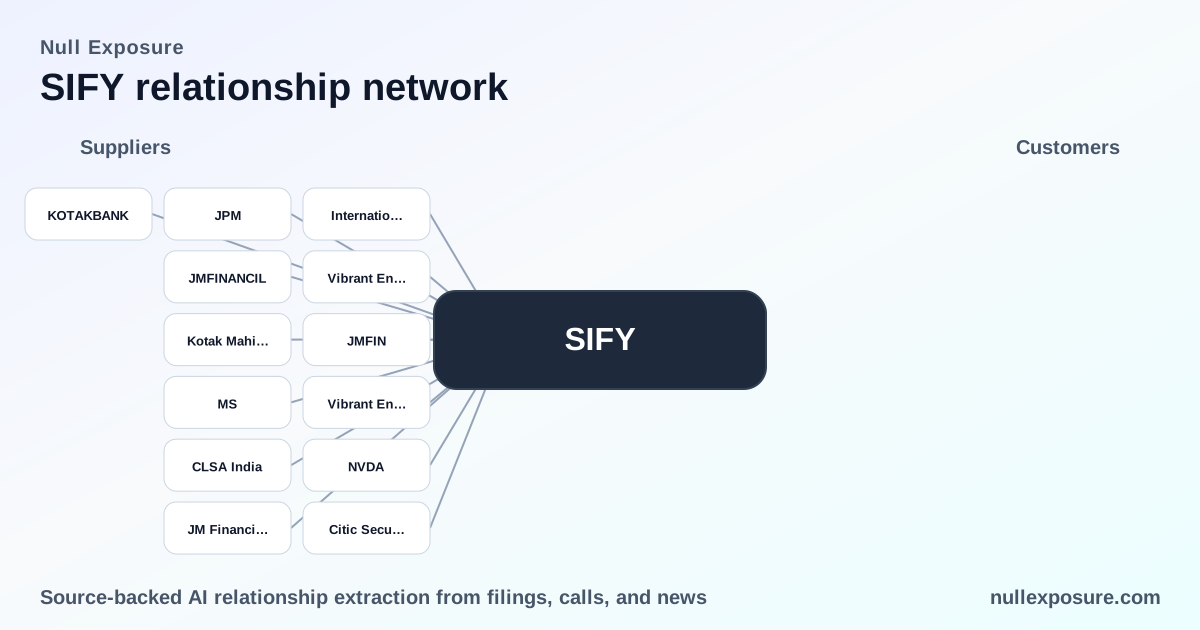
International Finance Corporation (IFC)
Sify Infinit Spaces Limited signed an engagement letter with the IFC for Sustainability‑Linked Financing advisory services to support SISL projects, signaling institutional advisory on ESG financing — according to the IFC pressroom release in March 2026. -
Vibrant Energy Holdings
Sify executed power purchase agreements for a combined 231 MW of solar and wind capacity with Vibrant Energy Holdings to supply its hyperscale data centers, showing Sify’s strategy to secure renewable power for scale operations — reported by pv‑magazine India and DatacenterDynamics in 2022. -
Vibrant Energy (alternate naming in press)
The company’s public statements also refer to Vibrant Energy as the counterparty for the 231 MW PPA at an investment of approximately INR 1,250 crore to power new hyperscale centers, reinforcing the same long‑term power commitment — reported by etn.news and SaurEnergy in 2022. -
JM Financial (and JM Financial Ltd./JM Financial Ltd. listings)
JM Financial is listed among the book‑running lead managers appointed for the SISL public offering, indicating investment bank placement and deal execution capacity for the IPO — according to contemporaneous news reports around the DRHP filing in FY2025. -
CLSA India
CLSA India is named as a book‑running lead manager for the SISL IPO, providing equity capital markets distribution support — reported by Business Today and DRHP coverage in FY2025. -
JP Morgan India / JPMorgan Chase & Co.
JP Morgan’s local unit appears in the list of bookrunners for the SISL IPO, representing international investment bank placement and syndication capability for the offering — reported in FY2025 coverage by ThePrint and Business Today. -
Kotak Mahindra Capital / Kotak Mahindra Capital Co.
Kotak Mahindra Capital is a local bookrunner on the SISL offering, which gives Sify domestic capital markets execution capability for SISL’s fundraising — noted in multiple FY2025 press articles. -
Morgan Stanley / Morgan Stanley India / Morgan Stanley India Company
Morgan Stanley and its India unit are appointed as book‑running lead managers to SISL’s IPO, giving Sify access to global distribution and institutional placement — covered by ThePrint and DRHP reporting in FY2025. -
Citic Securities Co.
Citic Securities is included among the bookrunners for SISL’s offering, indicating an Asia‑regional placement partner for the transaction — referenced in FY2026 press coverage surrounding IPO plans. -
CLSA India (duplicate listing captured in multiple sources)
(Already captured above as a bookrunner; Business Today and other FY2025 reports list CLSA India among the lead managers to the issue.) -
NVIDIA / Nvidia (DGX‑Ready partnership and GPU deployments)
Sify has become an NVIDIA DGX‑Ready Data Center partner, certified for liquid cooling and able to colocate NVIDIA DGX systems; Sify has also deployed NVIDIA H200 GPUs for at least one large national bank customer — per NVIDIA certification reports and Sify press releases in FY2024–FY2025 and a Globenewswire release in Oct 2025.
What these relationships imply for risk and procurement
- Power and sustainability risk: Long‑dated PPAs with Vibrant/Vibrant Energy Holdings materially reduce power‑price and supply risk for hyperscale builds and demonstrate proactive mitigation of a core cost input.
- Capital markets and execution: The party list of global and local bookrunners (JM Financial, CLSA, JP Morgan, Kotak, Morgan Stanley, Citic) signals that SISL is being prepared as a standalone capital market vehicle to de‑risk balance sheet growth via an IPO.
- Technology lock and competitive differentiation: NVIDIA DGX‑Ready certification and GPU deployments are strategic differentiators that position Sify to capture AI workloads and high‑value customers requiring liquid cooling and validated GPU infrastructure.
For procurement or credit teams, these are actionable signals: long‑term contracted power, strategic hardware certification, and active capital markets preparation reduce certain operational risks, while concentrated ownership and negative EPS introduce governance and profitability considerations.
If you want a consolidated supplier dossier or a quick comparative analysis for underwriting, visit https://nullexposure.com/ for subscription access and deeper link maps.
The bottom line for investors and operators
Sify is executing a clear strategy to convert its ICT platform into a scalable, AI‑ready hyperscale provider through SISL — anchored by renewable PPAs, NVIDIA certification, and global bookrunner engagement for an IPO. The model is capital‑intensive and operationally critical, with upside driven by AI demand and downside concentrated in financing and governance execution. For teams evaluating counterparty risk, procurement leverage, or investment exposure, these supplier relationships materially change Sify’s risk profile and create both runway and obligations that should be factored into valuation and contract terms.
Learn more about supplier risk mapping and get the full relationship audit at https://nullexposure.com/.