SIGA Technologies: supplier relationships, operating posture, and what investors need to know
SIGA Technologies is a commercial-stage pharmaceutical company that monetizes by selling its antiviral product portfolio—most notably oral tecovirimat (TPOXX®)—through direct commercial channels in the U.S. and through partner-led promotion and distribution internationally. The company runs a lean, asset-light operating model: it outsources manufacturing to contract manufacturing organizations (CMOs) and extends geographic reach via promotional partners, while investor outreach is managed through external communications firms. For a concise vendor map and supplier-risk profile, visit https://nullexposure.com/.
Operational profile in one line: SIGA sells an approved antiviral product, relies on third-party manufacturing, and uses partner agreements to commercialize outside the U.S.
How SIGA runs the business: outsourcing is the backbone
SIGA’s operating model is defined by outsourcing and partner reliance. According to company filings, “SIGA does not have a manufacturing infrastructure and does not intend to develop one for the manufacture of TPOXX®. SIGA relies on and uses third parties known as Contract Manufacturing Organizations (CMOs) to procure commercial raw materials and supplies, and to manufacture TPOXX®.” The filings also note CMOs operate under cGMP controls for pharmaceutical manufacturing and related functions.
This posture creates distinct business-model characteristics:
- Contracting posture: Outsourced, long-term reliance on CMOs rather than captive manufacturing.
- Concentration risk: A small number of qualified CMOs are likely critical to supply continuity—this is a structural supplier concentration that investors should monitor.
- Criticality: Manufacturing is mission-critical; any CMO disruption would directly affect product availability and revenue.
- Maturity: SIGA is commercial-stage with an approved product and established sales; the firm’s scale is moderate (Market Cap roughly $391 million and Revenue TTM ~$94.6M), but manufacturing remains externally sourced.
These company-level constraints—outsourced manufacturing and reliance on third-party service providers—are explicit in corporate disclosures and shape both operational risk and capital allocation.
Counterparties you should factor into your model
Below are every relationship surfaced in recent public materials, summarized plainly with source context.
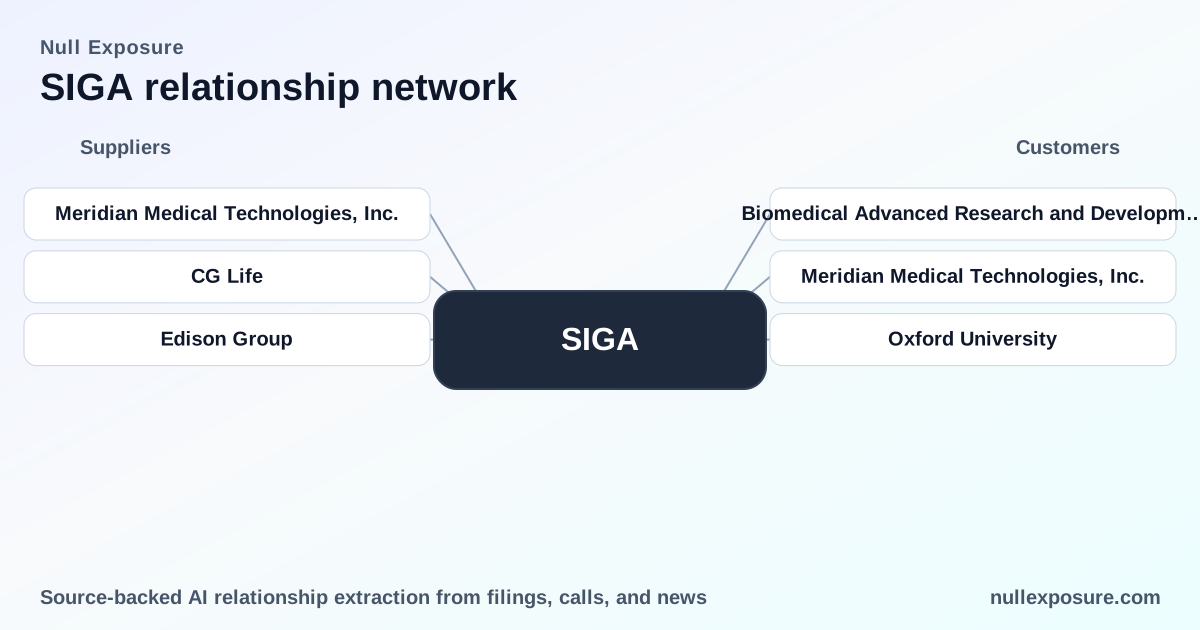
Meridian Medical Technologies, Inc.
SIGA entered an international promotion agreement with Meridian in June 2019, under which Meridian promotes oral tecovirimat (TPOXX®) in markets outside the United States. This is a commercial-distribution partnership that expands SIGA’s addressable international market without requiring SIGA to build its own overseas sales force. Source: GlobeNewswire press release (January 10, 2022) — https://www.globenewswire.com/news-release/2022/01/10/2363875/9738/en/SIGA-Technologies-Receives-Approval-from-the-European-Medicines-Agency-for-Tecovirimat.html
CG Life
CG Life is listed as a media/contact point for investor communication in SIGA’s Q2 2025 business update materials; the reference functions as an investor-relations/communications engagement supporting disclosure and outreach around quarterly results. Source: GlobeNewswire press release (July 29, 2025) — https://www.globenewswire.com/news-release/2025/07/29/3123132/9738/en/SIGA-to-Host-Business-Update-Call-on-August-5-2025-Following-Release-of-Second-Quarter-2025-Results.html
Edison Group
Edison Group is likewise named in the same Q2 2025 press release as an investors/media contact, indicating SIGA’s use of external IR/communications advisors for investor events and media management. This is a non-operational but material communications relationship that supports transparency and market access. Source: GlobeNewswire press release (July 29, 2025) — https://www.globenewswire.com/news-release/2025/07/29/3123132/9738/en/SIGA-to-Host-Business-Update-Call-on-August-5-2025-Following-Release-of-Second-Quarter-2025-Results.html
What these relationships mean for investors
The Meridian agreement is a substantive commercial extension: partner-led promotion outside the U.S. reduces SIGA’s capital requirements to enter international markets while shifting execution risk to the promoter. For revenue modeling, treat international sales as partner-executed with potential lag and margin sharing.
The CG Life and Edison Group mentions are operationally immaterial to product supply but important to market signaling: professional investor communications can improve disclosure cadence and market access, which is relevant for liquidity and investor sentiment assumptions.
On the supply side, the company-level disclosure that SIGA “does not have a manufacturing infrastructure” creates an ongoing supply-chain dependency: the firm’s production continuity depends on CMO performance, regulatory compliance of those CMOs, and raw materials access. For scenario analysis, model both a base case where CMOs perform and a stress case that assumes temporary manufacturing disruption or capacity constraints.
Financial and governance signals to layer on top
Key financial datapoints that influence supplier-risk sensitivity:
- Market capitalization ~ $391M and Revenue TTM ~$94.6M, implying mid-market scale where single-supplier shocks are more consequential than for large-cap peers.
- Gross profit ~$44.9M and EBITDA ~$24.3M—SIGA shows positive EBITDA but also relies on third-party vendors that impact margins.
- Insider ownership is substantial (insiders ~43%), which signals concentrated internal control and could influence counterparty negotiation posture.
These figures indicate a company with positive unit economics but with outsized supplier exposure relative to scale, so investors should price counterparty risk into valuation multiples and downside scenarios.
If you want an operational vendor map and continuous monitoring of SIGA’s counterparty exposures, consider a focused supplier-risk review at https://nullexposure.com/.
Investment takeaways and next steps
- Primary risk: third-party manufacturing concentration; verify the number, geographic diversity, and regulatory track records of SIGA’s CMOs in diligence.
- Commercial upside: Meridian’s international promotion deals extend reach without fixed-cost expansion, improving capital efficiency.
- Market signaling: active use of IR/PR firms (CG Life, Edison Group) indicates a deliberate investor communications strategy to support liquidity and narrative management.
For deeper supplier analytics or to commission a bespoke counterparty risk brief tailored to SIGA’s manufacturing and promotion partners, visit https://nullexposure.com/. For ongoing alerts on supplier changes or fresh partner agreements, sign up at https://nullexposure.com/ and integrate supplier intelligence into your investment workflow.
Bold final takeaway: SIGA operates an asset-light commercialization model that scales via promotional partners and relies critically on external CMOs—investors should treat supplier continuity and partner execution as first-order risks when valuing the business.