Sprott Inc. (SII): the counterparty map investors should know
Sprott Inc. is a publicly traded asset manager that monetizes through management and performance fees on resource-focused funds and trusts, plus income from listed securities and dividends; the firm’s financial profile (Revenue TTM ~$285m, Profit Margin ~23.6%, Market Cap ~$3.79bn) reflects a fee-driven model with material sensitivity to capital markets flows and product distribution. For counterparty and operational risk assessment, the company’s relationships with underwriters, exchanges and depositaries are equally important to evaluate alongside headline financials. Explore more on counterparty exposure and supplier intelligence at https://nullexposure.com/.
Why supplier relationships matter for an asset manager like Sprott
Sprott’s business is distribution- and market-access intensive: product launches, at-the-market (ATM) programs, cross-border shareholder servicing and dividend executions all rely on a small set of specialized counterparties. That creates a profile where contracting posture is focused on short-to-medium term fee agreements with capital markets intermediaries, concentration is concentrated in a handful of agents and exchanges, and criticality is high for a narrow set of counterparties that enable fund capital raises and share liquidity. No formal supplier constraints were captured in the available data; treat that absence as a company-level signal that contractual constraints were not disclosed in the scraped relationship set rather than proof there are none. For a deeper supplier map, visit https://nullexposure.com/.
Who Sprott deals with — agents, listing venues and clearing houses
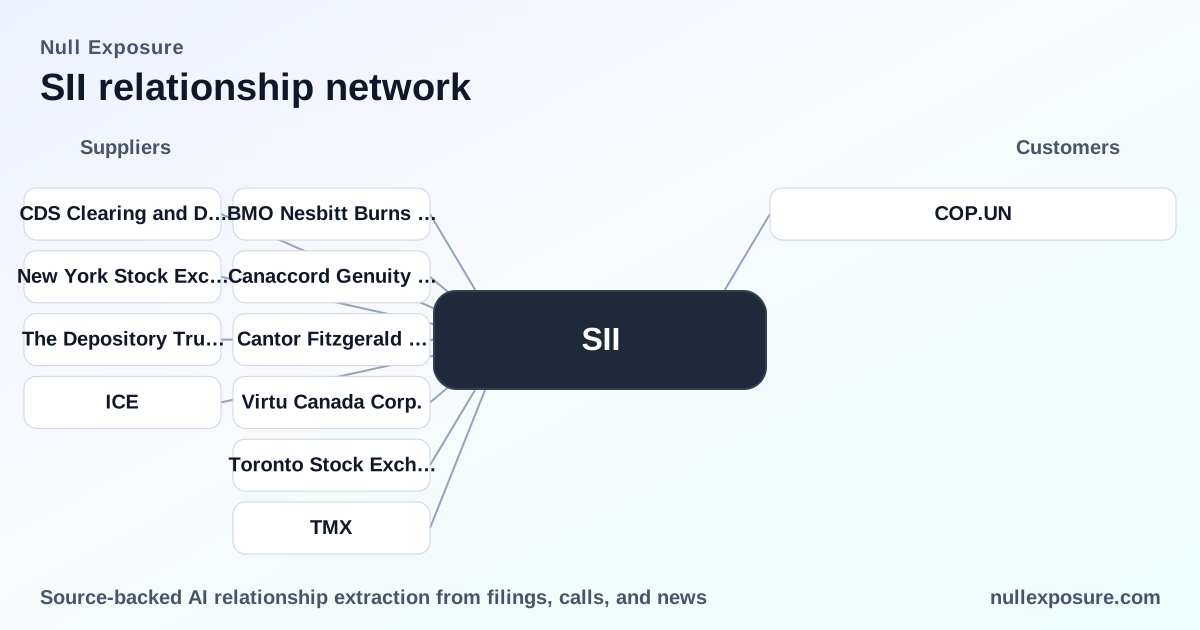
Below are each relationship listed in the available results, with a plain-English summary and source note.
-
BMO Nesbitt Burns Inc. — Listed as one of the Agents under an amended and restated sales agreement covering an ATM program for a Sprott-managed Trust; BMO participates in equity distributions under that program. Source: InvestingNews coverage of the Sales Agreement (published March 10, 2026, https://investingnews.com/sprott-physical-uranium-trust-updates-its-at-the-market-equity-program/).
-
Canaccord Genuity Corp. — Identified as an Agent alongside BMO, Cantor and Virtu for Sprott’s ATM Program, providing underwriting and distribution services for at‑the‑market equity issuances. Source: InvestingNews (March 10, 2026, https://investingnews.com/sprott-physical-uranium-trust-updates-its-at-the-market-equity-program/).
-
Cantor Fitzgerald Canada Corporation — Recorded as an Agent on the amended Sales Agreement for the ATM Program, serving as a distribution counterparty on Canadian equity placements for the Trust. Source: InvestingNews (March 10, 2026, https://investingnews.com/sprott-physical-uranium-trust-updates-its-at-the-market-equity-program/).
-
Virtu Canada Corp. — Named as one of the Agents in the Sales Agreement completing ATM Program distributions; Virtu’s role supports execution and secondary-market liquidity for issuances. Source: InvestingNews (March 10, 2026, https://investingnews.com/sprott-physical-uranium-trust-updates-its-at-the-market-equity-program/).
-
Toronto Stock Exchange — The company’s common shares are listed on the Toronto Stock Exchange under the ticker SII, confirming Canadian primary market access and regulatory listing obligations. Source: GlobeNewswire press release (Feb 18, 2026, https://www.globenewswire.com/news-release/2026/02/18/3240557/35318/en/Sprott-Inc-Declares-Fourth-Quarter-2025-Dividend.html).
-
Toronto Stock Exchange (TMX entry) — A duplicate listing reference noting the Toronto Stock Exchange and its market identifier (TMX) in the context of listing disclosures; reinforces dual-listed posture. Source: GlobeNewswire press release (Feb 18, 2026, https://www.globenewswire.com/news-release/2026/02/18/3240557/0/en/Sprott-Inc-Declares-Fourth-Quarter-2025-Dividend.html).
-
CDS Clearing and Depositary Services Inc. (CDS & Co.) — Used to route dividends in Canadian dollars for Canadian resident shareholders and beneficial holders whose intermediaries are CDS participants, indicating reliance on Canada’s central securities depository for retail and brokered flows. Source: GlobeNewswire dividend notice (Feb 18, 2026, https://www.globenewswire.com/news-release/2026/02/18/3240557/35318/en/Sprott-Inc-Declares-Fourth-Quarter-2025-Dividend.html).
-
CDS Clearing and Depositary Services Inc. (CDS & Co.) — duplicate — Reiterates the same dividend routing arrangement for Canadian participants, confirming consistent shareholder servicing mechanics. Source: GlobeNewswire (Feb 18, 2026, https://www.globenewswire.com/news-release/2026/02/18/3240557/0/en/Sprott-Inc-Declares-Fourth-Quarter-2025-Dividend.html).
-
New York Stock Exchange — Sprott’s common shares are listed on the New York Stock Exchange under SII, providing U.S. market liquidity and regulatory visibility. Source: GlobeNewswire (Feb 18, 2026, https://www.globenewswire.com/news-release/2026/02/18/3240557/35318/en/Sprott-Inc-Declares-Fourth-Quarter-2025-Dividend.html).
-
The Depository Trust Company (Cede & Co.) — Identified as the U.S. depositary route for dividend payments to shareholders outside Canada, indicating use of DTCC rails for U.S. beneficial ownership and dividend settlement. Source: GlobeNewswire (Feb 18, 2026, https://www.globenewswire.com/news-release/2026/02/18/3240557/35318/en/Sprott-Inc-Declares-Fourth-Quarter-2025-Dividend.html).
-
New York Stock Exchange (ICE entry) — A secondary reference to the NYSE in the press release that includes exchange market identifiers; reinforces listing and cross-border operational posture. Source: GlobeNewswire (Feb 18, 2026, https://www.globenewswire.com/news-release/2026/02/18/3240557/0/en/Sprott-Inc-Declares-Fourth-Quarter-2025-Dividend.html).
-
Toronto Stock Exchange (earlier notice) — A prior GlobeNewswire release (Feb 13, 2026) confirming the company’s dual listing and public market schedule for quarterly results, supporting continuity of disclosure obligations. Source: GlobeNewswire (Feb 13, 2026, https://www.globenewswire.com/news-release/2026/02/13/3238006/35318/en/Sprott-Announces-Date-for-2025-Fourth-Quarter-Results-Webcast.html).
-
New York Stock Exchange (earlier notice) — The Feb 13, 2026 release also references the NYSE listing in connection with investor communication about earnings schedule and webcasts. Source: GlobeNewswire (Feb 13, 2026, https://www.globenewswire.com/news-release/2026/02/13/3238006/35318/en/Sprott-Announces-Date-for-2025-Fourth-Quarter-Results-Webcast.html).
What the counterparty map implies for investors — focused analysis
-
Capital-raising and distribution concentrated in a small set of agents. The ATM program uses four named Agents (Cantor, Virtu, BMO, Canaccord), which means execution risk and pricing are concentrated across those intermediaries; monitoring agent relationships is critical for forecasting near-term equity issuance capacity. (InvestingNews, Mar 10, 2026.)
-
Dual-listing and depositary rails reduce settlement risk but add regulatory surface area. NYSE and TSX listings alongside DTCC and CDS routing mean Sprott can serve both U.S. and Canadian holders efficiently, but also must manage compliance in two jurisdictions. (GlobeNewswire releases, Feb 13 & Feb 18, 2026.)
-
Operational criticality is high but typical for the sector. Clearing houses and exchanges (CDS, DTC/Cede & Co., TSX, NYSE) are standard backbone partners; disruptions there would be systemic rather than idiosyncratic to Sprott. (GlobeNewswire dividend and webcast notices, Feb 2026.)
For operational due diligence, prioritize monitoring agent appointments, ATM program updates and any changes to depositary arrangements — each is a short-path lever on Sprott’s ability to raise and distribute capital. Learn how to translate this supplier map into investment signals at https://nullexposure.com/.
Final takeaways and actions for investors
- Key strength: Sprott’s access to major distribution agents and dual exchange listings supports liquidity and capital-raising capacity.
- Key risk: Concentration in a small set of agents for ATM activity creates execution dependency; changes in those relationships will have immediate capital-market implications.
- Actionable checklist: track agent appointment notices, ATM program amendments, and depositary/ exchange disclosures ahead of quarterly dividends and capital raises.
For a consolidated view of Sprott’s supplier footprint and to integrate this with counterparty monitoring workflows, visit https://nullexposure.com/.