SIM Acquisition Corp. I (SIMA): Sponsor-heavy SPAC with underwriting economics under renegotiation
Thesis — SIM Acquisition Corp. I operates as a purpose-built SPAC that monetizes by completing an initial business combination and releasing trust cash to a target; value for equity holders depends on deal execution and residual trust economics rather than operating cash flow. The company’s immediate economics are dominated by sponsor arrangements, administrative service fees, and a recently renegotiated underwriting commission with Cantor Fitzgerald that shifts fixed fees to a variable, deal-dependent structure. Investors and operators evaluating supplier relationships should treat SIMA as a transaction- and sponsor-driven vehicle where contract terms, short-term funding, and counterparty incentives determine value capture.
If you want a faster read on supplier risk and economics, see the firm overview at https://nullexposure.com/.
Quick company snapshot: what SIMA is and the financial footing
SIM Acquisition Corp. I trades on NASDAQ under SIMA and is listed as a shell/special-purpose acquisition company with a market capitalization near $329 million and 23.0 million shares outstanding. The entity’s public information identifies it as a SPAC focused on acquiring targets across intellectual property and technology-sensitive jurisdictions, principally the U.S., Europe and Israel. There are effectively no operating revenues or EBITDA — value is realized only through an initial business combination or liquidation of trust assets.
Key balance and governance signals: the sponsor has provided short-term loans to cover IPO expenses, the sponsor’s affiliates provide administrative services for a recurring fee, and underwriting economics have been renegotiated to align fees with transaction proceeds rather than a fixed deferred commission.
Explore deeper supplier and counterparty intelligence at https://nullexposure.com/.
The Cantor Fitzgerald relationship: underwriting economics restructured
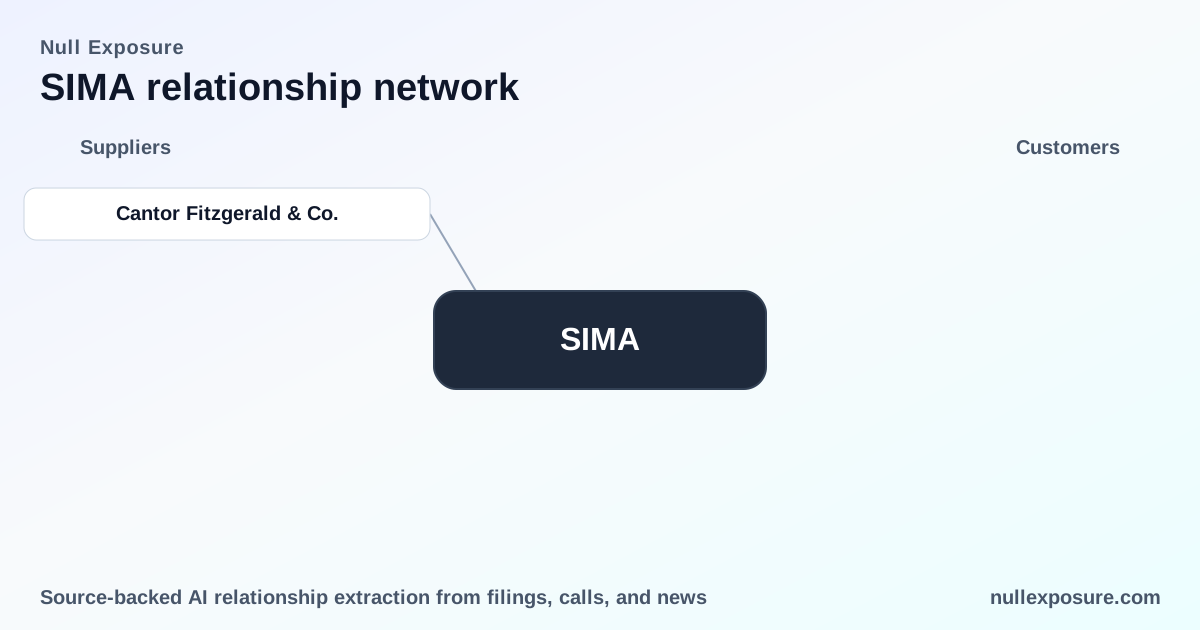
Cantor Fitzgerald & Co. — On January 28, 2026 SIMA reached an agreement with Cantor Fitzgerald to change the IPO underwriting economics: the prior fixed deferred commission of $10.95 million was replaced with a reduced, variable fee equal to 1.5% of the cash released from the SPAC’s trust at closing, with Cantor allowed to revert to the original fixed fee if the reduced amount is unpaid and with a portion of any future break-up or termination fees directed to satisfy the obligation. This shifts underwriting compensation from a guaranteed deferred liability to a contingent, deal-dependent payment tied to closing proceeds. The Globe and Mail summarized this arrangement in a press release-style report in March 2026.
Source: The Globe and Mail press release referencing the January 28, 2026 agreement (reported March 10, 2026).
Supplier and service-provider relationships reflected in filings
The filings and prospectus language disclose a compact set of recurring supplier relationships that drive cash burn and execution risk:
- Sponsor/affiliate administrative services — SIMA pays an affiliate of its Sponsor $10,000 per month for office space, utilities and secretarial and administrative support under an Administrative Services Agreement; the filings record $60,000–$70,000 paid for the year ending December 31, 2024. This is an ongoing, contractually documented operating expense that persists until the business combination or liquidation, and it represents the primary recurring outsourcer relationship disclosed in corporate filings.
- Sponsor promissory financing — the Sponsor agreed on January 29, 2024 to loan SIMA up to $300,000 (non-interest bearing) to cover IPO-related expenses, payable on the earlier of December 31, 2024 or completion of the IPO. This is a short-term, sponsor-provided working capital facility rather than a commercial credit line.
These supplier arrangements are described directly in company filings and the IPO documentation (FY2024–FY2025 filing disclosures).
What the constraints say about operating posture and business model
Taken together, the constraint signals in SIMA’s filings present a clear operating profile:
- Contracting posture: short-term and sponsor-dependent. The company uses sponsor loans and monthly admin agreements rather than long-duration vendor contracts, indicating low contractual lock-in but high dependency on sponsor support. The promissory note is explicitly short-term and non‑interest bearing.
- Concentration: high counterparty concentration. A small set of counterparties (the Sponsor and underwriting bank) handle funding, administration and execution; single-counterparty events could materially affect the SPAC’s path to a combination.
- Criticality: administrative services are operationally critical for day-to-day compliance and deal diligence; while economically modest, the services are essential to keeping the SPAC market-ready and capable of closing a business combination.
- Maturity: early-stage, transaction-driven. The entity is in an active pre-combination phase with zero operating revenue and a business model that will materially change once a target is acquired or trust assets redistributed.
These characteristics underscore that supplier risk at SIMA is less about scale of spend and more about alignment and enforceability of short-duration sponsor and underwriting arrangements.
Financial and strategic implications for investors and operators
- Cost structure is low but concentrated. Monthly admin fees and limited sponsor loans imply modest cash burn, but the underwriting economics and potential break-up fee allocations are the levers that will determine net proceeds at closing.
- Underwriting renegotiation improves alignment with deal outcomes. Replacing a fixed deferred commission with a 1.5% variable fee tied to trust cash improves cash-flow symmetry for the SPAC if deal proceeds are constrained, while Cantor retains a fallback to the original fee structure — a compromise that reduces immediate cash pressure but preserves underwriter downside protection.
- Sponsor dependence creates execution risk. The sponsor provides both operational support and short-term liquidity; if sponsor incentives diverge from minority shareholders, execution quality and timeline could be affected.
- Geographic focus on U.S., Europe and Israel broadens deal sourcing but increases cross-border diligence needs. The SPAC’s stated jurisdictional priorities require active legal and IP diligence pipelines, which in turn make administrative and advisory relationships more strategically important despite their small nominal spend.
Midway call-to-action: if you are benchmarking supplier contracts or underwriting economics across SPACs, compare contract language and fee structures at https://nullexposure.com/.
Bottom line and recommended monitoring
SIMA is a sponsor-centric SPAC where contract terms—not operating revenues—determine investor outcomes. The Cantor Fitzgerald underwriting amendment shifts risk back toward contingent, deal-dependent payments and reduces immediate fixed liabilities, which is structurally positive for trust preservation but leaves potential reversion to the original fee in certain circumstances. Investors should monitor: (1) whether the reduced fee is paid at closing or the underwriter reverts to the original fee; (2) any additional sponsor financing or forgiveness arrangements; and (3) the emergence of material administrative or advisory contracts beyond the current sponsor affiliate relationship.
Final call-to-action: for a focused review of SPAC supplier agreements and underwriting economics, visit https://nullexposure.com/.
In short: SIMA’s value is execution risk plus contractual economics. For investors and operators, the critical work is reading the fine print of underwriting and sponsor agreements — the dollars at closing will be decided as much by those clauses as by target selection.