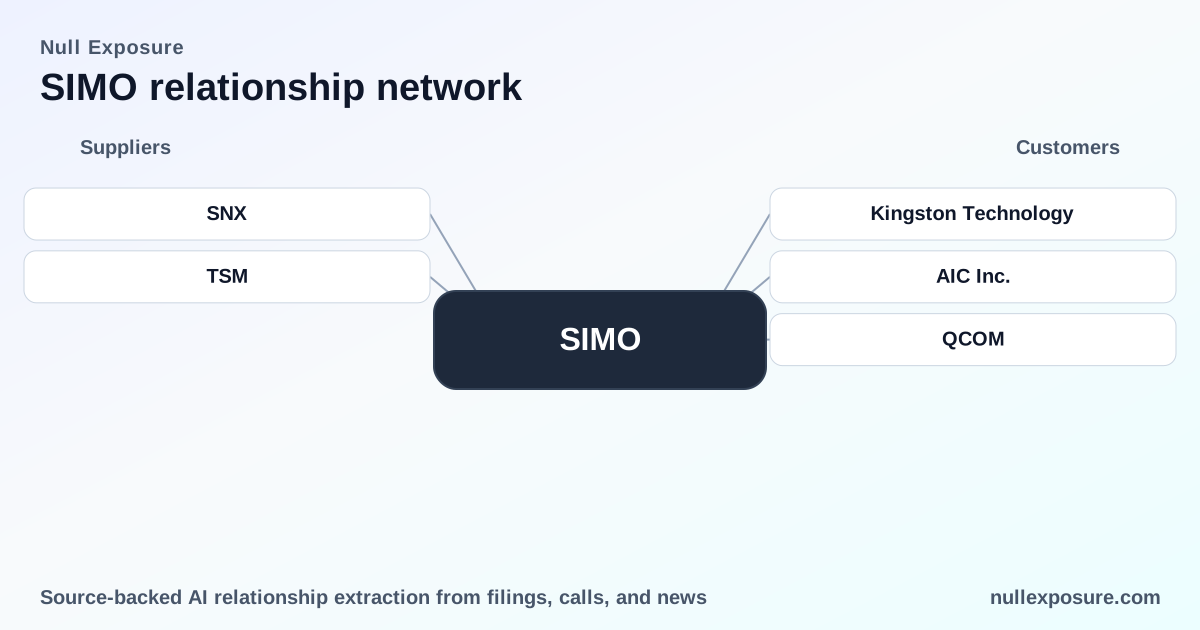
Silicon Motion Technology (SIMO): Supplier Relationships and Operational Signals
Silicon Motion designs and sells NAND flash controllers for SSDs and embedded storage; it monetizes through controller licensing and sales to OEMs and distributors, plus ancillary firmware and support services that generate recurring aftermarket revenue. The company’s economics lean on steady HSD revenue growth, mid-teens profit margins, and distribution and foundry relationships that determine capacity and go-to-market reach. For a fast read on supplier exposures and what they mean for investment and operational diligence, see Null Exposure’s supplier view: https://nullexposure.com/.
How Silicon Motion makes money and why suppliers matter
Silicon Motion’s product is a semiconductor controller that sits at the heart of SSD and embedded storage devices. Revenue derives from chip sales to module makers and OEMs, licensing and software integration, and value-added services. With RevenueTTM of $885.6M and a Profit Margin of 13.9%, SIMO demonstrates a profitable, scale-sensitive business where manufacturing cadence and distribution channels directly impact top-line timing and gross margins. The company’s foundry and distribution partnerships are not peripheral — they are structural to delivery, capacity, and market share.
If you want an operational scoreboard and supplier risk profile fast, visit Null Exposure for the full supplier map: https://nullexposure.com/.
Supplier relationships that change the picture
Below are the supplier relationships surfaced in our review, each summarized plainly with source attribution.
TD SYNNEX: distribution added to widen reach
Silicon Motion appointed TD SYNNEX as a distribution partner inside its SIMO Alliance Program to expand channel reach and provide broader commercial access to enterprise and industrial customers. According to a press release reported by AIJourn on March 10, 2026, the relationship positions TD SYNNEX to aggregate and distribute SIMO controller solutions across its global IT channels (https://aijourn.com/simo-appoints-td-synnex-as-distribution-partner/).
TSMC: foundry node for controller production
Silicon Motion’s controller production uses TSMC’s process technology; a TechPowerUp report notes a controller produced on TSMC’s 12 nm node supporting multi-channel NAND and LPDDR4/DDR4 DRAM. This confirms reliance on TSMC for critical wafer manufacturing choices that affect cost, power, and performance characteristics (TechPowerUp, reported in connection with product announcements and historical FY2020 product coverage — https://www.techpowerup.com/273613/silicon-motion-launches-pcie-4-0-nvme-ssd-controllers).
What these relationships mean for investors and operators
- Distribution scale via TD SYNNEX is a gross-revenue lever. Partnering with one of the world’s largest IT distributors accelerates customer access, shortens sales cycles for channel buyers, and improves inventory turnover at the module and OEM level. For investors, this is a revenue-multiplier instrument rather than a margin driver; for operators, it reduces the sales burden but increases dependency on distributor terms and stocking practices.
- Foundry dependence on TSMC is a strategic constraint. Production choices (e.g., 12 nm) shape cost curves and product positioning versus rivals that leverage leading-edge nodes. TSMC’s capacity planning and node economics therefore feed directly into SIMO’s gross margin trajectory and product roadmaps.
Company-level operating constraints and strategic signals
There are no explicit contractual constraints surfaced in the reviewed supplier summaries. Treat that absence as a company-level signal rather than evidence of no risk: institutional relationships and foundry reliance carry implicit operating constraints that influence strategy.
- Contracting posture: SIMO operates as a design-focused supplier that outsources wafer production and leverages distribution partners. Contracts with foundries and large distributors likely include volume, lead-time, and pricing terms that constrain flexibility.
- Concentration: Foundry concentration is meaningful. Reliance on advanced nodes from a dominant foundry creates single-source exposure that is common in semiconductor supply chains.
- Criticality: Controllers are mission-critical components for SSD OEMs. Substituting controller designs requires integration work and firmware validation; therefore, SIMO’s products are sticky for customers who value performance and firmware support.
- Maturity: Silicon Motion is an established supplier with profitable margins and institutional ownership (~82.6% institutions). Market capitalization (~$4.28B) and stable margins indicate a mature competitive position; growth is execution- and capacity-linked rather than nascent-market-driven.
Risk factors you should weigh now
- Foundry capacity and node economics. TSMC’s capacity allocation and pricing decisions directly affect gross margins and product timeliness.
- Distributor terms and channel inventory. TD SYNNEX provides reach but introduces dependency on distributor stocking decisions, payment terms, and channel returns.
- Product-cycle exposure. Controller demand ties to cyclical end-markets (PCs, datacenters, consumer devices); end-market swings will feed through to revenue volatility despite healthy operating margins.
Investment takeaways
- Positive: clear go-to-market scale and profitable unit economics. SIMO’s distribution expansion and stable margins support a growth-with-profitability thesis.
- Negative: concentrated manufacturing exposure and channel dependencies. Foundry reliance and distributor terms are first-order operational risks that can compress margins during supply tightness or inventory corrections.
If you want to benchmark SIMO’s supplier exposures against peers or map contract-level risk across the supply chain, start your analysis with Null Exposure: https://nullexposure.com/.
Practical next steps for diligence teams
- Validate the scope of the TD SYNNEX agreement: territories, exclusivity, target inventory levels, and payment terms.
- Confirm wafer supply arrangements with TSMC: node commitments, capacity allocation, and any migration roadmaps to smaller nodes.
- Model sensitivity of gross margin to foundry price increases and distributor discounting to stress-test earnings.
Final recommendation
Silicon Motion is a strategic supplier in the SSD controller market with clear revenue levers via distribution and strong manufacturing partnerships that determine execution risk. For investors, the trade-off is between executable growth through channel expansion and concentrated operational dependence on foundry capacity. Operational diligence focused on the TD SYNNEX contract economics and TSMC wafer commitments will materially change valuation assumptions and execution risk profiles.
For deeper supplier intelligence and to map these relationships into an investment-grade risk model, visit Null Exposure: https://nullexposure.com/.