Scienjoy (SJ) supplier relationships: what investors need to know
Scienjoy Holding Corporation operates mobile live-streaming platforms in China and monetizes its audience through in-platform commerce and platform services tied to user engagement and advertising on its apps. For investors and operators evaluating counterparty risk and vendor leverage, the most relevant supplier signals are the company's use of external financial advisers, investor-relations support and related‑party service arrangements that underpin capital-markets activity and day‑to‑day operations.
If you are screening supplier risk for portfolio allocation or vendor due diligence, start with the public filings and press releases that name these providers and quantify material fees. For a concise supplier intelligence summary and deeper supplier mapping, visit https://nullexposure.com/.
Investor‑relations and PR contacts in the record — two press releases, same contact set
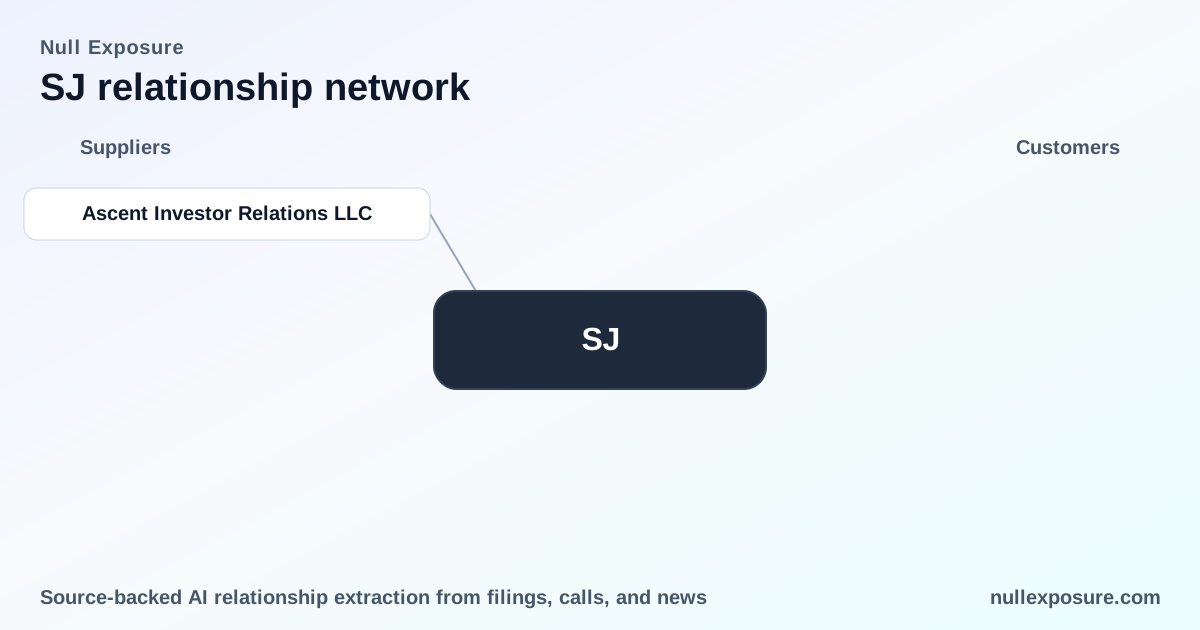
- Scienjoy’s FY2025 investor‑relations contact list identifies Denny Tang (CFO) as the company contact and lists Ascent Investor Relations LLC (Tina Xiao) as the external IR resource for U.S. media and investors. This is published in the company’s nine‑month FY2025 results release. According to the company press release distributed on March 10, 2026, the release provides direct contact details for investor inquiries including the Ascent IR address and phone. (PR News Asia / company release, March 10, 2026)
- The same investor‑relations information was reproduced in a Yahoo Finance release on March 10, 2026, again naming Ascent Investor Relations LLC and providing the listed contact details for investor and media inquiries. This confirms the company’s active use of an external US‑based IR firm for distribution and investor communications. (Yahoo Finance press release, March 10, 2026)
Takeaway: Scienjoy uses an external IR firm for market communications, with the CFO retained as the primary company contact; this is a standard capital‑markets support relationship that is visible in multiple press distribution channels.
What the public evidence says about Scienjoy’s supplier posture
Public excerpts and filing language portray Scienjoy as outsourcing critical capital‑markets and transactional tasks to external advisers, while also relying on related‑party arrangements for operational services.
- The company’s filings reference paid engagements with financial advisers and underwriters for IPO and M&A‑related services, including arrangements that convert part of fees into shares in certain transactions. The language implies transactional, commission‑style compensation for at least some advisers. (Company filing excerpts covering IPO and business‑combination periods)
- Historical fee evidence is mixed: small periodic payments for specific services are documented (e.g., amounts in the tens of thousands to third‑party providers), while underwriting arrangements include a deferred fee equal to 3.50% of IPO gross proceeds — cited as $2,012,500 — which places some supplier spend in the $1m–$10m band. This indicates a mix of routine low‑value vendors and episodic higher‑value capital‑markets spend. (IPO underwriting disclosure)
- Related‑party supply is explicit: the company pays Oriental Holdings Limited (wholly owned by insiders) for office space and related services as part of a monthly payment arrangement. That is a clear related‑party operational supplier exposure disclosed in filings. (Company filing language on office space payments)
These constraints generate five practical signals for investors and operators:
- Contracting posture: Scienjoy relies on external advisers for strategic finance, IR and transactional work rather than keeping those functions fully in‑house.
- Spend profile: Routine operating vendor spend is small, but capital‑markets events create episodic multi‑million dollar obligations to underwriters and advisers.
- Concentration and criticality: Related‑party suppliers provide operational services (office space), elevating the governance and control risk profile; capital‑markets advisers are critical during financings and transactions.
- Maturity: Supplier relationships are largely transaction‑driven and episodic rather than long‑standing commodity contracts.
- Disclosure transparency: Vendor names and fee terms are disclosed in filings and press releases, enabling direct verification during diligence.
For an operational supplier map and to compare Scienjoy’s supplier posture against sector peers, see https://nullexposure.com/.
Why these supplier signals matter to investors
- Governance and conflict risk: The presence of related‑party suppliers for core office services creates potential conflicts that require contract scrutiny and benchmarking to market rates.
- Liquidity and cost volatility: Deferred underwriting fees and transaction‑based adviser payments introduce episodic cash outflows that can materially affect near‑term liquidity and capital allocation during fundraising or M&A.
- Negotiation leverage: High insider ownership (reported at ~60%) and low institutional ownership reduce external shareholder pressure on supplier contracting terms, which can lead to less favorable terms for minority investors unless specifically negotiated.
- Continuity risk: External IR and advisory relationships are critical during periods of investor scrutiny; loss or degradation of those providers can impair market access and message discipline.
Practical due‑diligence checklist for operators and investors
- Request copies of the latest adviser and underwriter engagement letters, including fee schedules and any equity‑based compensation clauses.
- Validate related‑party transactions (Oriental Holdings Limited) against market rates and confirm board approval and independent valuation where available.
- Quantify annual supplier spend and isolate episodic capital‑markets fees to understand peak cash needs.
- Confirm retention terms, notice periods and replacement options for the IR firm and lead advisers to assess operational continuity risk.
Final assessment and next steps
Scienjoy’s supplier footprint is transaction‑oriented and capital‑markets dependent, with a combination of small operational vendors, related‑party service provision and higher‑value underwriting/advisory fees during financings. Investors should prioritize review of adviser engagement terms and related‑party agreements to understand episodic cash obligations and governance implications.
For a structured supplier risk report and ongoing monitoring of Scienjoy’s supplier disclosures, start a supplier‑focused review at https://nullexposure.com/. If you want a bespoke supplier map and red‑flag analysis for SJ, contact our research team through the Null Exposure homepage: https://nullexposure.com/.