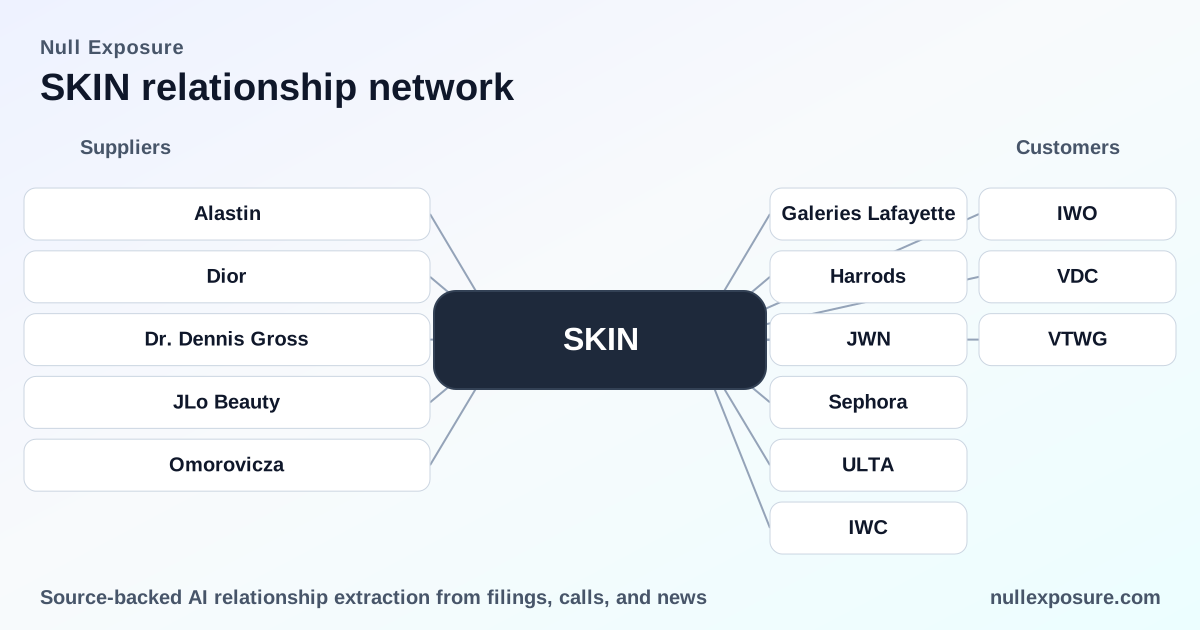
Beauty Health Co (SKIN) — supplier relationships and what they mean for investors
Beauty Health Co (SKIN) designs, develops, manufactures, markets and sells aesthetic products and technologies and monetizes through device sales, recurring consumables and co-branded booster partnerships that drive both product attachment and premiumization. With FY‑TTM revenue of $300.8M and slim operating margins, the company’s supplier posture—particularly manufacturing and logistics relationships and strategic brand collaborations—directly affects gross margin and growth levers. For a concise view of supplier exposure and partner signaling, see https://nullexposure.com/.
How partner names translate into commercial strategy
Beauty Health has positioned its consumer-facing product portfolio to capture both the professional aesthetic channel and prestige consumer attention through booster partnerships with established skincare houses and celebrity brands. These tie-ups function as marketing and product-attachment drivers that increase per-unit revenue and clinic/shop conversion without materially increasing fixed manufacturing capacity.
- Booster partnerships with prestige and celebrity skincare brands expand addressable market and create higher-margin add-ons for devices and treatments.
- Manufacturing and logistics relationships remain central to margin stability: the company sources components from China, has recorded contract termination costs, and relies on freight carriers for global distribution.
If you want deeper supplier intelligence on SKIN, visit https://nullexposure.com/ to review the full supplier map.
Partner roster — plain-English summaries (every reported relationship)
Beauty Health lists a set of booster and prestige brand partners that signal marketing strategy more than supply-of-core-components. All five of the relationships below are cited in a March 2026 profile of the company.
Alastin
Beauty Health has a booster partnership with Alastin, leveraging Alastin’s clinical reputation to position booster products alongside Beauty Health treatments and devices. According to a ChiefMarketer profile published March 10, 2026, the company highlighted Alastin among its key booster partners.
Dior
Beauty Health cites a prestige tie with Dior as part of its booster mix, using the prestige brand association to elevate in‑clinic and retail perception of its booster offerings. The ChiefMarketer article (March 10, 2026) lists Dior as a named prestige partner.
Dr. Dennis Gross
The company works with clinical-focused brands such as Dr. Dennis Gross to populate its booster lineup, reinforcing a clinical aesthetic narrative for providers and consumers. This relationship is mentioned in the same ChiefMarketer profile dated March 10, 2026.
JLo Beauty
Beauty Health uses celebrity-branded products like JLo Beauty in its booster program to capture mainstream consumer interest and broaden retail appeal beyond traditional medical spas. The ChiefMarketer piece (March 10, 2026) cites JLo Beauty among the company’s booster partners.
Omorovicza
Omorovicza is named as a prestige, spa-oriented booster partner that complements Beauty Health’s higher-end treatment positioning in select markets. This partnership appears in the ChiefMarketer company profile from March 10, 2026.
Operational constraints that shape supplier risk and negotiating posture
Beauty Health’s supplier constraints are visible in SEC-filed disclosures and the company’s public commentary. These company-level signals define contracting posture, concentration, criticality and maturity.
- Concentration — China sourcing for components. The company explicitly states it sources components in China and “does not have substantial alternatives” to those suppliers, which creates concentration risk for critical components and bargaining leverage that skews toward suppliers located in APAC. (Company filing: year ended December 31, 2024.)
- Contracting posture — active optimization and termination costs. During the year ended December 31, 2024, Beauty Health recorded approximately $8 million of contract termination costs tied to concluding a relationship with a third‑party manufacturing partner in China, indicating an active restructuring of manufacturing arrangements rather than a passive renewal posture. (Company filing: FY2024 disclosure.)
- Criticality and logistics dependency — global freight reliance. The company is dependent on commercial freight carriers to deliver products domestically and internationally, making logistics capacity and cost a direct margin lever and an operational risk vector. (Company filing: FY2024 disclosure.)
- Spend scale and timing — mid‑range supplier commitments. The company’s commercial commitments table (Dec 31, 2024) shows $30.2 million in purchase-of‑inventory, service and other commitments and a total contractual obligation of $619.2 million, indicating multi‑year capital and interest commitments alongside meaningful near‑term purchase spend in the $10M–$100M band. This points to suppliers that are significant but not majority‑revenue drivers—large enough to influence pricing and fulfillment priorities. (Company filing: Payments Due by Fiscal Period table, as of December 31, 2024.)
What investors and operators should prioritize
Beauty Health’s supplier footprint and booster partner roster create a dual focus for investors and operators: protect supply continuity while extracting margin lift from branded boosters.
- Protect supply continuity: Given the China concentration and recent manufacturing reorganization (the $8M termination charge), prioritize verification of alternate sources and transition timelines when assessing downside scenarios.
- Manage logistics cost risk: Freight dependence increases sensitivity to global shipping rates and capacity; margin forecasts must embed potential uplift in cost of goods sold driven by logistics.
- Monetize brand partnerships: The booster partnerships with Alastin, Dior, Dr. Dennis Gross, JLo Beauty and Omorovicza are marketing and revenue-per-treatment multipliers; quantify attach‑rate elasticity to forecast incremental revenue from these relationships.
For a centralized review of these supplier signals and to track changes over time, visit https://nullexposure.com/.
Final takeaways and the next catalyst calendar
Beauty Health’s supplier story is twofold: (1) marketing partnerships that lift revenue per treatment via premium boosters and (2) manufacturing and logistics exposures that control margin volatility. The company’s FY2024 disclosures provide concrete evidence of restructuring costs and concentrated component sourcing that investors must model into downside scenarios. Monitor near-term updates on manufacturing re‑contracts, freight contracts and any new multi‑year supply agreements with APAC or domestic manufacturers as the next catalysts.
To track SKIN supplier exposures and vendor dynamics on an ongoing basis, go to https://nullexposure.com/.