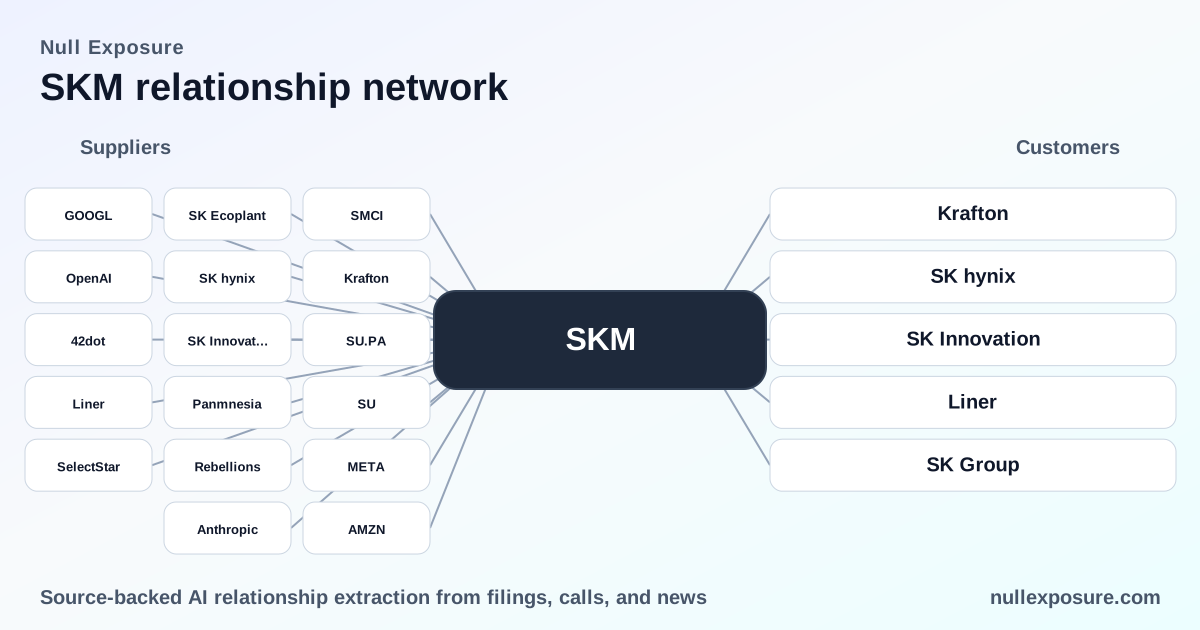
SK Telecom (SKM) — Supplier footprint and what it means for operators and investors
SK Telecom is a Korea-headquartered wireless and digital services operator that monetizes through core mobile subscriptions, enterprise digital transformation services, and an expanding AI infrastructure and services stack anchored on its A. (Adot) platform and AI data center (AIDC) projects. The company leverages strategic supplier partnerships and MOUs to move from connectivity into full-stack AI hosting, model integration and operation, capturing higher-value enterprise and cloud-adjacent revenue streams. For investors and operators, the supplier map defines SKT’s capital intensity, vendor concentration, and execution risk for its AI-native transition. Learn more about how we map supplier exposure at https://nullexposure.com/.
Big-picture investment thesis in one paragraph
SK Telecom transitions from a traditional telco to a vertically integrated AI infrastructure and services provider by contracting hyperscalers for scale, specialist vendors for hardware and facilities, and domestic partners for sovereign AI capability. Revenue will progressively shift from low-margin connectivity to higher-margin AI services and AIDC operations, while capital and operational execution hinge on a small set of critical suppliers and internal SK Group affiliates that provide end-to-end capabilities.
How SKT is buying its way into AI: patterns that matter
SKT sources three categories of supply: hyperscaler strategic partners for cloud/hyperscale operations; hardware and facilities vendors for AIDC build-out; and domestic ecosystem partners for model, data and chip sovereignty. This procurement posture signals a hybrid contracting strategy—MOUs and joint ventures for strategic rollout, plus commercial supplier agreements for equipment and engineering. The result is higher project complexity and concentrated supplier criticality but also faster leverage of third-party expertise.
- Contracting posture: emphasis on MOUs and joint projects (strategic, not just spot procurement).
- Supplier concentration: a small number of hyperscalers and infrastructure vendors are critical to AIDC timelines.
- Operational criticality: hardware, MEP design and hyperscaler cloud services are mission-critical to deliver AIDC cost and performance targets.
- Maturity and scale: SKT is moving from pilot ecosystems to validated AIDC construction (groundbreaking and validation milestones cited in 2025–2026).
Explore supplier risk scoring and relationship timelines at https://nullexposure.com/.
Supplier-by-supplier map (each relationship in the source set)
Below I walk through every supplier relationship referenced in the available coverage; each entry is a short, source-backed summary investors can use to prioritize diligence.
Supermicro
SKT signed an MOU where Supermicro will supply high-performance AI servers for SKT’s AIDC projects, positioning Supermicro as the primary hardware vendor for server stacks. According to SK Telecom press materials and related coverage from March 2026, Supermicro is a named supplier in the AIDC MOU (news release, 2026-03-04 — https://news.sktelecom.com/en/2706 and https://intellectia.ai/news/stock/sk-telecom-unveils-ai-infrastructure-vision-at-aidc-conference).
Schneider Electric
Schneider Electric is contracted under the same MOU to design and construct mechanical, electrical and plumbing (MEP) infrastructure for AIDC builds, making it critical to facility uptime and efficiency. The role is documented in SK Telecom’s March 2026 MOU announcement (news release, 2026-03-04 — https://news.sktelecom.com/en/2706 and related reporting — https://intellectia.ai/news/stock/sk-telecom-unveils-major-ai-transformation-strategy).
AWS / Amazon Web Services
SKT has a joint hyperscale AIDC project with AWS—SKT announced establishment plans and a Ulsan AIDC groundbreaking (progress update through September 2025), which makes AWS a strategic cloud and operations partner for SKT’s hyperscale ambitions. This relationship was discussed on SKT’s 2025 Q2 earnings call and in company updates (earnings call excerpt, 2025 Q2 — skm-2025q2-earnings-call; press update on progress — https://news.sktelecom.com/en/2706).
Krafton
Krafton is integrating gaming-derived AI capabilities into SKT’s K-AI model development and will serve as a service implementation partner for gaming and content use cases. SK Telecom documented this integration in a company release highlighting collaborative AI pilot programs (company news, FY2025 — https://news.sktelecom.com/en/2407).
SKT integrates Google’s Gemini model into its A. platform, reflecting multi-model support and relationships with major AI model providers. Coverage of model integrations was reported in March 2026 summaries of SKT’s platform strategy (news coverage — https://www.mexc.com/news/614355).
OpenAI
OpenAI’s ChatGPT is listed among the major models SKT has integrated into its A. platform, indicating SKT’s strategy to aggregate leading models for enterprise and consumer services (model integration noted in SKT platform coverage, March 2026 — https://www.mexc.com/news/614355).
Anthropic
Anthropic Claude is also integrated into SKT’s A. platform, underscoring a multi-vendor model approach that reduces single-model dependency for customers (integration noted in March 2026 reporting — https://www.mexc.com/news/614355).
Facebook (Meta)
Historical partnership elements persist: SKT’s prior partnership with Facebook granted exclusive Oculus distribution rights in Korea and demonstrates SKT’s longer-term device and services relationships in consumer channels (reported in a 2021 Korea JoongAng Daily article summarizing the 2019 partnership — https://koreajoongangdaily.joins.com/2021/02/01/business/tech/SK-Telecom-Oculus-Facebook/20210201171700656.html).
SK Group affiliates: SK Ecoplant, SK hynix, SK Innovation
SKT is leveraging SK Group affiliates for end-to-end AIDC value-chain solutions—construction, cooling, semiconductors and energy—positioning the conglomerate as a vertically integrated supplier ecosystem for AIDC cost-efficiency (reported at MWC26 and company briefings, March 2026 — https://finviz.com/news/326472).
Panmnesia
Panmnesia will implement a CXL-based AI rack architecture for SKT, with plans to validate and commercialize the design within the year, signaling SKT’s interest in next-generation memory and interconnect designs for AI efficiency (reported in March 2026 coverage — https://intellectia.ai/news/stock/sk-telecom-unveils-major-ai-transformation-strategy and https://intellectia.ai/news/stock/sk-telecom-unveils-ai-infrastructure-vision-at-aidc-conference).
Rebellions
Rebellions provides domestic NPU accelerators that SKT integrates with its A. phone and sovereign AI stack, supporting SKT’s drive toward Korean full-stack AI capability from silicon to software (company news, FY2026 — https://news.sktelecom.com/en/2624 and FY2025 ecosystem notes — https://news.sktelecom.com/en/2407).
42dot, Liner, SelectStar
These domestic partners support data collection, pilot studies, and service implementation across SKT’s AI ecosystem; SKT lists them among its pilot and implementation partners for commercializing AI services (SK Telecom ecosystem announcement, FY2025 — https://news.sktelecom.com/en/2407).
What the relationship map implies for investors and operators
- Execution risk is concentrated: a handful of hyperscalers and infrastructure vendors are mission-critical to SKT’s AIDC roadmap, elevating project delivery and vendor-performance risk.
- Sovereignty and vertical integration are strategic priorities: domestic chip supplier Rebellions and in-group construction/energy partners reduce foreign dependency and support differentiated product offerings.
- Capital intensity and margin mix will shift: as SKT invests in AIDC construction and server hardware, capital expenditures will rise while long-term revenue is expected to shift toward higher-margin AI hosting and services.
Note on constraints: the source set contains no explicit supplier constraint excerpts, which functions as a company-level signal that no contract-level restrictions were surfaced in the collected coverage; operational signals above derive from the supplier relationships and public SLAs rather than named contractual constraints.
If you want a structured exposure report or vendor risk scorecard for SK Telecom’s supplier set, start here: https://nullexposure.com/. For operator-focused diligence frameworks and scenario modeling, see our methodology and contact options at https://nullexposure.com/.
Final takeaways and action points
- SK Telecom is executing a deliberate shift into AI infrastructure through concentrated, high-stakes supplier relationships. Hyperscaler partnerships and MEP/server vendors will determine AIDC cost-efficiency and timeliness.
- Domestic partners and internal SK Group capabilities materially reduce foreign dependency and support sovereign AI ambitions.
- For investors building exposure models or operators evaluating vendor risk, prioritize delivery timelines from Supermicro/Schneider and contractual commitments with AWS and other model providers.
To commission a deep-dive supplier exposure analysis for SK Telecom or to map supplier concentration across a telecom portfolio, visit https://nullexposure.com/.