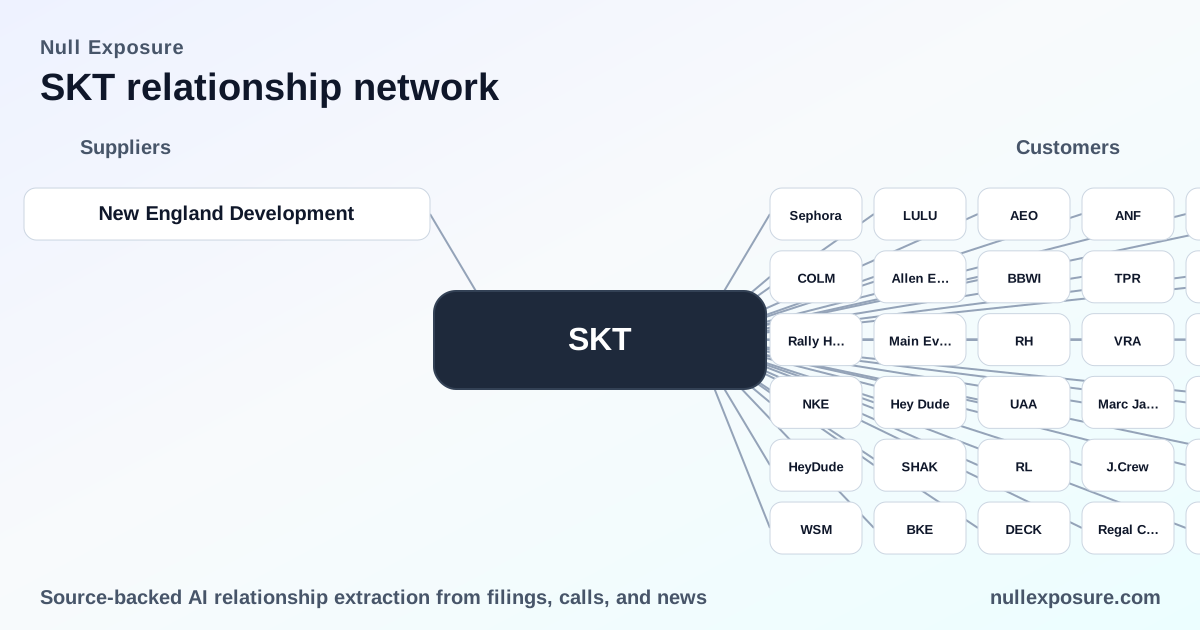
Tanger Factory Outlet Centers (SKT): Outlet REIT operations, supplier exposures, and what the Asheville deal tells investors
Tanger Factory Outlet Centers operates and monetizes a portfolio of outlet shopping centers through property ownership and leasing: the company collects recurring rental income from retail tenants across its 38 centers, realizes value through acquisitions, dispositions and portfolio optimization, and returns capital to shareholders via dividends. Revenue is driven by occupancy, lease economics and selective asset transactions; value accrual is sensitive to retail demand and capitalization-rate movements. For a structured view of supplier and counterparty relationships that affect operating continuity and strategic execution, see https://nullexposure.com/.
Business model in plain language Tanger is a real-estate investment trust that turns physical retail real estate into a recurring cash business. The company owns interests in 38 outlet centers and monetizes those assets primarily through leasing and property operations; top-line rental revenue of roughly $595 million (TTM) backs an EBITDA of $320 million and funds a dividend program (yield ~3.3%). Market participants price Tanger as a mature retail REIT with a market capitalization near $4.09 billion, a trailing P/E of 36.0, and an EV/EBITDA of ~16.9—metrics that reflect both growth expectations and sensitivity to interest rates and cap-rate compression.
Key financial anchors
- Market capitalization: $4.09B
- Revenue (TTM): $595.1M
- EBITDA: $320.1M
- Dividend yield: 3.33%
- EV/EBITDA: 16.93 These figures provide the baseline for assessing how supplier relationships—services, construction, facilities management, and tenant credit—feed into operating performance.
How the operating model shapes supplier relationships Tanger’s contracting posture is typical of an owner-operator REIT: contracts with third-party suppliers (construction, property management, janitorial, security, marketing and tenant improvement vendors) are mission-critical, recurring, and often regional in scope. The company’s value depends on tight coordination between asset-level contractors and corporate leasing/asset management. Because revenue is occupancy-driven, supplier performance has a direct line to tenant retention and sales-per-square-foot, which then affects rent collection and re-leasing economics.
At the company level, three structural signals stand out:
- Concentration of exposure to outlet retail: owning 38 centers gives scale, but the portfolio remains concentrated within a single retail format—this is a strategic strength in expertise and a concentration risk in cycles that impact outlet shopping.
- Counterparty and governance profile: institutional ownership exceeds 90%, which supports stable governance and access to capital, but also means activism or blockholder strategy can move outcomes quickly.
- Maturity and capital posture: Tanger is a mature public REIT with a regular dividend and a history of asset-level transactions; that model drives predictable procurement (ongoing services) alongside episodic, transaction-driven procurement (capex, redevelopment, acquisitions).
If you are modeling vendor exposure or supplier concentration for SKT assets, begin with those company-level dynamics and then layer in asset-specific procurement cycles. For structured supplier mapping for REITs, visit https://nullexposure.com/ for more details.
Concrete recent supplier/counterparty interactions Tanger’s most visible recent counterparty transaction involved an asset purchase from New England Development. A March 10, 2026 Business North Carolina report noted that Tanger acquired Asheville Outlets from New England Development for $70 million in an all-cash deal, a direct operator-to-operator asset transfer that expands Tanger’s footprint and signals active portfolio management. (Business North Carolina, March 10, 2026: https://businessnc.com/tanger-buys-asheville-mall-for-70-million/)
What that relationship implies for operators and suppliers The Asheville acquisition is instructive because it is an example of how Tanger executes on portfolio growth via asset purchases from other development/owner operators. For suppliers and service providers this pattern means:
- Incremental opportunity: acquisitions generate immediate demand for local property management, tenant-fit contractors and facilities vendors.
- Integration demand: newly acquired assets will be folded into Tanger’s operating playbook, which creates short windows where procurement decisions (vendor selection, service-level harmonization) are effectively re-sourced.
- Execution risk: acquisitions raise short-term capex and integration budgets; third-party contractors who can deliver reliability during transitional phases capture outsized value.
Risk factors to monitor from a supplier/counterparty perspective
- Tenant health and foot traffic: outlet operators depend on consumer discretionary spending; supplier revenue (property services, maintenance) is highly correlated with center occupancy and tenant solvency.
- Interest rates and cap-rate movement: REIT valuations and transaction activity respond to rate cycles; slower transaction markets compress acquisition volume and related supplier demand.
- Operational concentration: sourcing regional vendors for 38 centers creates dependency on a repeatable supplier base—any systemic failure in a category (e.g., HVAC contractors during a weather event) has asymmetric operational impact.
- Liquidity and access to capital: Tanger’s ability to transact (buy or sell assets) is a driver of episodic supplier revenue; institutional backing is a mitigating factor, but transaction cadence is cyclical.
Actionable due diligence steps for investors and operator-partners
- Request the lease roll and tenant concentration by center to assess how supplier revenue exposure maps to tenant risk across markets.
- Review recent capex programs and the vendor list used for asset-level improvements—repeat vendors are strategic suppliers worth qualifying for scale contracts.
- Track acquisition/disposition cadence and integration plans (as with Asheville) to anticipate procurement spikes and transitional service needs. For a structured supplier risk and relationship mapping service tailored to real estate portfolios, see https://nullexposure.com/.
Bottom line Tanger runs a scale-oriented, outlet-focused REIT model that monetizes through leasing and active portfolio management. The Asheville Outlets purchase from New England Development is a concrete example of the firm’s transaction-driven growth strategy and creates clear, short-term opportunities and integration demands for suppliers. Investors and operator-partners should focus diligence on tenant health, vendor concentration, and Tanger’s transaction cadence—these are the levers that convert property performance into sustainable cash flow.