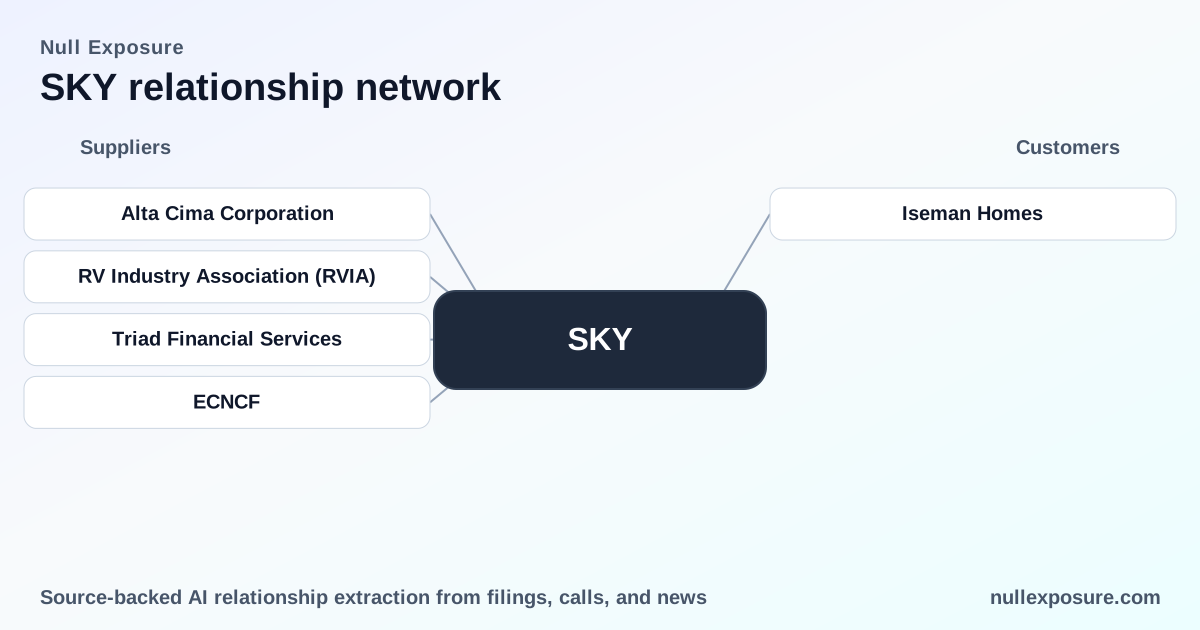
Skyline Corporation (SKY): Supplier and partner relationships that shape capital allocation
Skyline Champion Corporation manufactures and distributes factory-built homes across North America and monetizes through home sales, retail partnerships, and financing arrangements that earn interest and ancillary fees. The business combines manufacturing gross margins with retail floor-plan financing and targeted joint ventures to extract value across production, distribution and credit. For investors evaluating supplier and partner counterparty risk, the mix of service providers, quality-control partners, and financing joint ventures defines both operational resilience and balance-sheet exposure. For a concentrated view of counterparties and actionable signals, visit https://nullexposure.com/.
Why the relationship map matters for investors
Skyline is a capital-intensive, seasonal residential-construction operator with $2.64B in trailing revenue, $308M EBITDA, and a market capitalization around $4.44B (latest quarter 2025). The company runs two linked profit engines: factory-built product margins and captive/partner financing (floor plans and industrial bonds), which create both operating leverage and credit exposure. Key metrics — $106.1M outstanding on floor plan agreements and a $1.6M reserve for repurchase losses at March 29, 2025 — indicate that financing arrangements are material to working capital and risk monitoring.
How Skyline contracts and manages suppliers — what the constraints tell investors
The public disclosures describe a hybrid contracting posture: long-term repurchase commitments coexist with short-term floor-plan loans and inventory cycles. Evidence shows some homes are subject to repurchase up to 24 months or longer, while floor-plan loans are generally payable at sale or within two years. Inventory is managed tightly — typically one to three weeks of raw materials at plants — which drives operational efficiency but increases sensitivity to supply disruptions.
Company-level signals from filings:
- Contract maturity mix: A combination of long-term repurchase exposure and short-term trade/finance obligations produces a rolling credit profile rather than a single-term cliff.
- Concentration and criticality: Components are available from a variety of vendors, indicating low single-supplier dependency; transportation is outsourced to independent drivers, adding operational flexibility.
- Materiality: Historical repurchase losses are small relative to revenue (reserve $1.6M), signaling immaterial past repurchase impact but warranting monitoring as volumes change.
- Active financing exposure: The company had $106.1M in floor-plan outstanding and $12.4M under industrial revenue bonds at March 29, 2025, placing supplier/finance relationships in the >$100M spend band and on the active relationship register.
These constraints imply moderate credit exposure, low supplier concentration, and a capital structure that leans on short-to-medium term financed inventory — a profile that benefits from economic stability but is sensitive to interest-rate and retail demand cycles.
The supplier and partner map — concise profiles investors should track
Alta Cima Corporation — ongoing home-center services after acquisition
Skyline acquired Factory Expo Home Center locations and Alta Cima will provide ongoing services to support those home centers, aiming to streamline customer and employee experience. According to a CityBiz report in March 2026, Alta Cima is operationally embedded in post-acquisition retail services (https://www.citybiz.co/article/291178/skyline-champion-acquires-factory-expo-home-center-locations/).
RV Industry Association (RVIA) — quality-control inspectors at manufacturing sites
The RV Industry Association places inspectors at Skyline manufacturing sites to support quality controls already in place, reinforcing product standards and regulatory compliance; this is a quality-assurance partnership referenced in an industry feature from RV-Pro (FY2024) (https://rv-pro.com/features/the-heart-of-a-champion/).
Triad Financial Services — joint-venture financing for retail customers
Champion Financing, a joint venture with Triad Financial Services, is a functioning originator/servicer that supports retail financing for home buyers and continues to produce satisfactory results, according to Skyline’s Q4 FY2025 earnings call transcript summarized by InsiderMonkey (FY2025) (https://www.insidermonkey.com/blog/skyline-champion-corporation-nysesky-q4-2025-earnings-call-transcript-1542436/).
ECN Capital — collaborative financing partner referenced in earnings commentary
Skyline publicly acknowledged collaboration with ECN Capital alongside Triad, indicating multiple financing partners support the company’s credit distribution and risk-sharing strategy; this was noted in the same FY2025 earnings-call transcript coverage (https://www.insidermonkey.com/blog/skyline-champion-corporation-nysesky-q4-2025-earnings-call-transcript-1542436/).
What these relationships say about capital and operational risk
Collectively, these partners address distinct operational vectors:
- Retail and distribution: Alta Cima integration signals a direct play on retail footprint and customer-facing operations, reducing distribution friction and supporting margin capture at point-of-sale.
- Quality and compliance: RVIA inspection presence reduces warranty and reputational risk while supporting resale value in a market sensitive to quality.
- Financing and credit: Triad and ECN participation demonstrates a deliberate strategy to offload and share retail credit risk while retaining financing revenue; the $106.1M floor-plan exposure and the repurchase mechanics described in filings make joint-venture performance and counterparty creditworthiness central to downside protection.
Key takeaway: Skyline’s partner mix is intentionally diversified across services, quality oversight and finance, which lowers single-point failure risk but concentrates balance-sheet sensitivity in the financing channel.
For a deeper counterparty and exposure map, explore neutral third-party intelligence at https://nullexposure.com/.
Investment implications and risk management checklist
Investors should prioritize a handful of monitoring vectors:
- Track Champion Financing performance metrics: delinquency, loss rates, and the JV’s capital commitments relative to retail volumes. The earnings-call commentary underscores this as a business driver.
- Watch floor-plan outstanding levels and the pace of paydowns — the company’s $106.1M floor-plan balance is a direct funding line that expands in down cycles.
- Monitor repurchase reserves and trends; the $1.6M reserve at March 29, 2025 is small, but repurchase program terms can extend exposure beyond typical loan durations.
- Assess integration execution with Alta Cima for retail synergies and post-acquisition cost curves.
- Observe RVIA and quality control outcomes to guard against warranty accruals that would pressure margins.
Mid-analysis action: if you evaluate supplier counterparty risk for portfolio allocation, start with the financing relationships and retail integration points at https://nullexposure.com/.
Conclusion — what to watch and next steps
Skyline blends manufacturing margins with distributed financing and retail channels; its supplier and partner structure reduces single-supplier concentration while centralizing material exposure in financing arrangements. For investors, the critical signals are JV performance (Triad, ECN), floor-plan balances, repurchase terms, and retail integration outcomes with Alta Cima. Monitor these lines to anticipate stress in earnings or working capital needs.
If you want a concise counterparty risk scorecard and notification setup for Skyline counterparties, begin here: https://nullexposure.com/. For ongoing monitoring and portfolio-grade supplier analysis, sign up via https://nullexposure.com/ to receive structured intelligence and alerts.