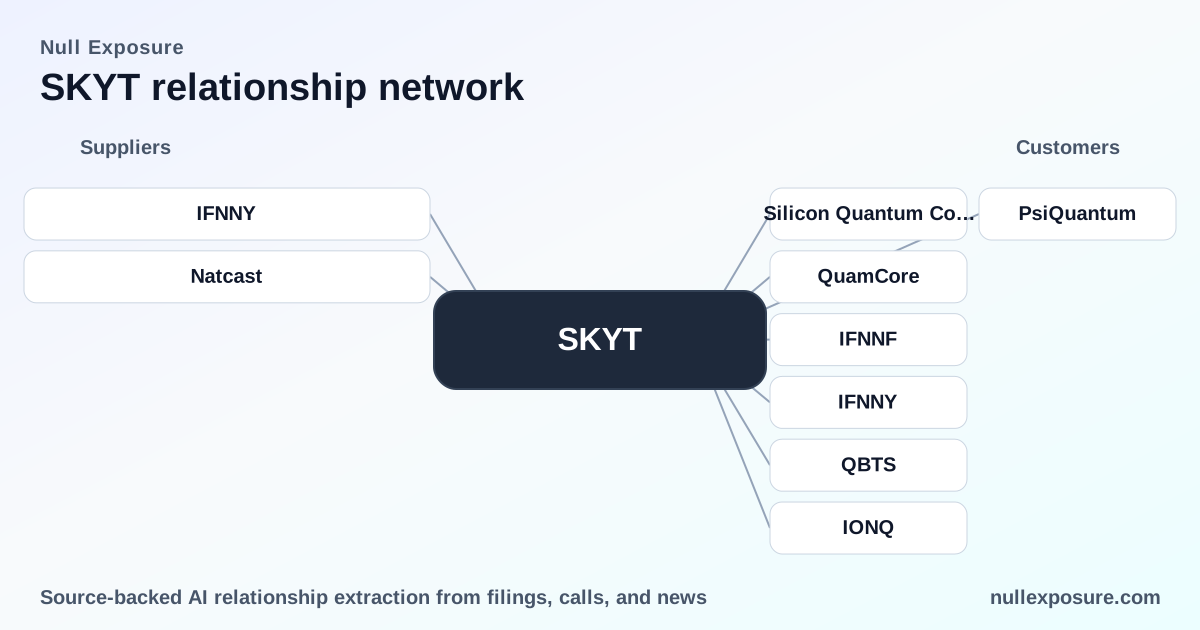
SkyWater Technology (SKYT) — Supplier relationships, capital posture, and what investors should watch
SkyWater is a U.S.-based specialty foundry that monetizes capacity and engineering services by manufacturing integrated circuits for third parties, selling wafer fabrication time, advanced packaging and test services, and related engineering support. The company’s financial profile shows growing revenue, elevated operating leverage demands, and concentrated capital spending tied to semiconductor tool purchases and facility investments — all of which make supplier relationships a direct driver of throughput, margins, and execution risk. For a concise vendor-risk and opportunity scorecard, visit https://nullexposure.com/.
Two recent supplier-linked items that change the operational picture
SkyWater’s supplier and counterparty footprint is not extensive publicly, but two items in the news and filings deserve investor attention because they reflect where capacity and human capital are coming from.
SkyWater’s acquisition of Infineon’s Austin 200mm fab
SkyWater purchased Infineon Technologies’ 200mm manufacturing facility on East Ben White Boulevard in Austin, a move that shifts capacity and physical assets onto SkyWater’s balance sheet and reduces reliance on external 200mm capacity providers. According to a Statesman report in March 2026, SkyWater closed on that Infineon facility acquisition as part of its capacity expansion strategy (Statesman, Mar 10, 2026).
Senior sales hire coming from Natcast, bringing partnership experience
SkyWater appointed a new Senior Vice President of Sales and Solutions Engineering who previously led strategic partnership development at Natcast, a hire the company expects will accelerate operational scaling and commercial partnerships. The background and expected role were reported in a March 2026 industry article (Intellectia, Mar 10, 2026).
For deeper context on SkyWater’s relationships and counterparty constraints, see https://nullexposure.com/.
What each reported relationship means for investors
Infineon Technologies — SkyWater purchased Infineon’s Austin 200mm fab, transferring a discrete manufacturing asset into SkyWater’s operating footprint and expanding its onshore capacity for 200mm production. This is an asset-level relationship with direct implications for capacity and capital allocation (Statesman, March 2026).
Natcast — A senior commercial executive joining SkyWater last reported employment at Natcast, bringing partnership-development experience that SkyWater expects to deploy in scaling sales and solutions engineering. This is a talent-and-network relationship that supports go-to-market expansion (Intellectia, March 2026).
Company-level constraints and what they signal about operations
SkyWater’s public disclosures and risk language produce three actionable operating signals for investors:
- Critical supplier dependence: The company discloses dependence on a limited number of third-party suppliers for key components and capital equipment used in manufacturing, and explicitly lists the risk that supplier disruption could prevent timely deliveries and cause cancellations or lost market share. This is a company-level materiality signal that makes supplier continuity a core operational risk (company disclosures, Dec 2024).
- Capital spending concentrated in tools and installations: Contractual commitments related to semiconductor tool purchases and installation are highlighted in the company’s capital expenditures discussion, with reported contractual commitments outstanding of $24,979 and $7,910 as of December 29, 2024 and December 31, 2023, respectively, expected to be paid from cash and operating cash flows. That history shows ongoing multiyear capex timing and cash allocation to equipment (company disclosures, Dec 2024).
- Spend-band implications: Constraint modeling places supplier spend in both the $1m–$10m and $10m–$100m bands, suggesting that individual contracts or program phases are economically meaningful to SkyWater’s operations but not necessarily single-line items that dwarf the balance sheet. These bands are consistent with capital-equipment purchases and multi-year installation programs rather than routine consumables (company disclosures).
These are company-level signals; they should guide how investors evaluate vendor concentration, contingency plans, and capex pacing rather than implying any one supplier is the cause unless the company names that supplier explicitly.
How supplier posture affects financial and strategic outcomes
SkyWater’s monetization through contract fabrication makes supplier continuity and capital availability direct levers on revenue growth and gross margin. The financial profile shows $442.1M revenue TTM and a positive profit margin of 26.9% on a trailing basis, while operating margin dynamics and EBITDA (reported at $31.8M) are sensitive to ramp timing and utilization. The company’s high beta (3.52) and the contrast between trailing PE (~11.4) and forward PE (~185) indicate market pricing reflects both recent performance and significant short-term uncertainty around growth and profitability. Supplier-driven delays or capex overruns would translate quickly into utilization shortfalls and margin pressure.
Key operational implications:
- Capacity acquisitions (the Infineon fab) accelerate onshore output but require capital and integration work that leans on third-party equipment and contractors.
- Senior hires from specialist vendors (Natcast) strengthen sales and partnerships, which is necessary to fill new capacity but does not by itself remove execution risk tied to equipment supply.
- Contractual capex commitments imply multi-period cash outflows; investors should track capex cadence against revenue ramps.
If you want a structured vendor-risk table and real-time monitoring, start here: https://nullexposure.com/.
Monitoring checklist for investors and operators
Focus on forward-looking, supplier-centric milestones that convert capacity into booked work and margin:
- Announcements of equipment delivery dates and installation milestones for the Austin 200mm facility.
- Signed multi-year wafer contracts or anchor customers for the newly acquired capacity.
- Supplier diversification actions or long-lead tool prepayments that reduce single-source exposure.
- Progress on hiring and organizational changes that connect sales to newly available capacity (commercial ramp metrics).
- Quarterly disclosure of contractual commitments and capex guidance versus actual cash spend.
A concise set of metrics tracked across these items will separate execution-risk from structural growth.
Bottom line: near-term execution, medium-term optionality
SkyWater’s business is capacity-driven: buying, integrating, and operating fabs while selling that capacity to external customers. The recent Infineon facility acquisition and the Natcast-linked hire are complementary — one provides additional brick-and-mortar supply, the other supplies the commercial leadership to fill it. However, supplier concentration and capital-equipment commitments are material operational constraints that directly affect utilization, revenue realization, and margin expansion.
For investors weighing risk-adjusted upside, the central questions are whether SkyWater can (1) execute installations and tool integrations on schedule, (2) convert new capacity into long-term wafer contracts, and (3) diversify supplier concentration enough to avoid single-point disruptions. If you want ongoing coverage tailored to vendor exposure and counterparty risk, visit https://nullexposure.com/.
Appendix: sources referenced in this commentary include a March 10, 2026 Statesman report on the Infineon facility purchase and a March 10, 2026 industry notice on SkyWater’s executive hire from Intellectia; company disclosure language on supplier dependence and capital commitments is drawn from the company’s December 2024 filings.