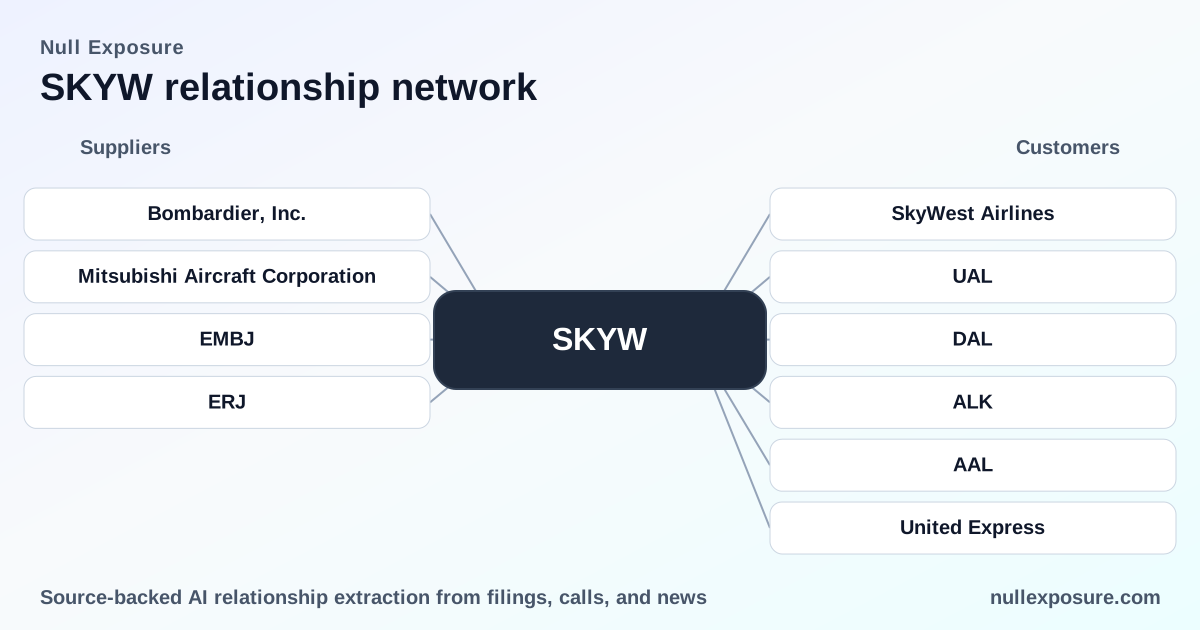
SkyWest Inc (SKYW) — supplier relationships that shape fleet direction and capital exposure
SkyWest operates as a regional airline that monetizes flying capacity through contract flying arrangements with legacy carriers and by owning/ordering regional aircraft to deploy under those contracts. The company’s economics are driven by fleet composition, long-term OEM relationships for aircraft and engines, and outsourcing of component maintenance under fixed-fee arrangements that convert operating variability into predictable per-hour costs. For investors and operators, supplier ties to OEMs and long-term service vendors are primary drivers of capital commitments, delivery timing risk, and operating leverage.
Explore deeper supplier intelligence at https://nullexposure.com/.
Business snapshot: SkyWest’s 2025/2026 profile shows a mid-sized market capitalization base with strong EBITDA generation (EBITDA ~ $982M) and substantial fleet investment activity that is visible in multiple purchase agreements and financing arrangements disclosed in regulatory filings and trade press.
Where SkyWest buys its wings — the supplier roll call Below I review every supplier relationship flagged in SkyWest’s supplier disclosures and related reporting. Each relationship is summarized in plain language with a concise source note.
Bombardier, Inc.
SkyWest has a very long-standing commercial relationship with Bombardier anchored by a Master Purchase Agreement dated November 7, 2000, which governs aircraft procurement and related commercial terms. This long-dated contractual linkage underscores legacy fleet management and the company’s historical sourcing path. (SkyWest 2024 Form 10‑K)
Mitsubishi Aircraft Corporation
SkyWest executed an Aircraft Purchase Agreement dated December 7, 2012 with Mitsubishi Aircraft Corporation, establishing a formal purchase commitment for Mitsubishi regional jets. The 2012 agreement is evidence of SkyWest’s multi-year hedging of future capacity through OEM purchase contracts. (SkyWest 2024 Form 10‑K)
Embraer S.A. (Embraer / ERJ)
Embraer is SkyWest’s most active current OEM partner: SkyWest reported a firm purchase commitment for 16 new E175 aircraft as of December 31, 2024 in its 2024 10‑K, and later public disclosures and media coverage document expanded delivery positions and larger aggregated order books. Recent reports indicate SkyWest secured delivery positions for an additional 44 E175s for 2028–2032 and media cited financing approvals enabling export of 13 E175 aircraft to SkyWest. Management commentary in earnings transcripts notes 69 E175s on firm order when including customer-assigned units. These items jointly establish Embraer as a strategic, high-volume supplier for SkyWest’s medium-term fleet renewal. (SkyWest 2024 Form 10‑K; TradingView coverage, March 2026; Aviator.aero, March 2026; Q4 2025 earnings transcript reported on InsiderMonkey)
How these relationships shape operating constraints and contract posture SkyWest’s supplier footprint and the supporting evidence point to several company-level operating characteristics you must factor into underwriting, investment decisions, and contract negotiations:
-
Long-term contracting posture: SkyWest uses long-dated purchase agreements with OEMs (Bombardier 2000, Mitsubishi 2012, ongoing Embraer commitments) to secure delivery positions and fleet capacity over multi-year horizons. This reduces short-term spot exposure but increases capital and delivery timing risk across business cycles.
-
Buyer role and fixed-cost service outsourcing: SkyWest is explicitly a buyer of long-term engine services and related maintenance arrangements, paying fixed dollars per engine hour while vendors assume repair obligations subject to exclusions. That contracting converts variable maintenance cash flow into predictable per-hour obligations and shifts repair execution risk to service providers. (Evidence from SkyWest 2024 Form 10‑K)
-
Concentration and criticality: Embraer’s expanding role — 16 firm E175s recorded at FY2024 plus later delivery positions and financed shipments — points to supplier concentration risk where a single OEM’s production cadence, financing environment, or regulatory issues could materially affect SkyWest’s fleet delivery schedule and utilization plans.
-
Maturity and legacy commitments: The existence of a 2000 master purchase agreement with Bombardier demonstrates long-tenured partnerships; such legacy contracts can reduce transaction friction but embed commitments that are costly to renegotiate if market conditions change.
Strategic implications for investors and operators SkyWest’s supplier relationships generate clear investment implications:
-
Capital intensity and timing risk are primary drivers of valuation volatility. Large OEM orders and multi-year delivery windows mean SkyWest’s capex profile is lumpy; delays or financing disruptions at OEMs translate into revenue and margin timing variance.
-
Operational predictability through outsourced engine services reduces short-term maintenance volatility but creates concentrated vendor dependency. Fixed per-engine-hour contracts stabilize operating costs, but the vendor’s ability to deliver repairs remains a critical operational dependency.
-
Financing linkages matter. The BNDES-approved financing for Embraer exports to SkyWest—reported in trade press—illustrates that third-party export/agency financing can materially influence the economics and feasibility of aircraft deliveries and therefore fleet strategy. (Aviator.aero, March 2026)
Risk checklist — what to watch in the next 12–36 months
- Monitor Embraer delivery schedule updates and any public OEM production constraints; delays will push capex and revenue timing.
- Track third-party financing arrangements (e.g., export bank approvals) that underpin specific deliveries; financing changes can accelerate or stall fleet uptake.
- Evaluate engine service provider performance and contract renewals; loss of favorable fixed-fee terms or vendor failures would increase maintenance cost volatility.
Mid-article recommended action For due diligence teams validating counterparty exposure or negotiating contract terms with SkyWest, use supplier-disclosure detail to align covenants with delivery and financing milestones. Learn more about supplier risk mapping at https://nullexposure.com/.
Closing perspective and next steps SkyWest’s supplier landscape is a mix of legacy OEM ties and active, expanding commitments—Embraer now sits at the center of near-term fleet growth, while long-standing deals with Bombardier and Mitsubishi illustrate a multi-channel procurement strategy. The company’s use of fixed-fee engine service agreements shows deliberate cost-positioning to stabilize operating margins while accepting concentrated vendor risk.
For investors and operators, the decisive considerations are timing (when aircraft actually arrive), financing (who pays and how), and vendor performance (especially for critical engine services). These dynamics will continue to drive return variability and operational risk for SkyWest.
If you evaluate counterparty exposure, fleet financing, or contract structuring with SkyWest, get the supplier intelligence that matters at https://nullexposure.com/.