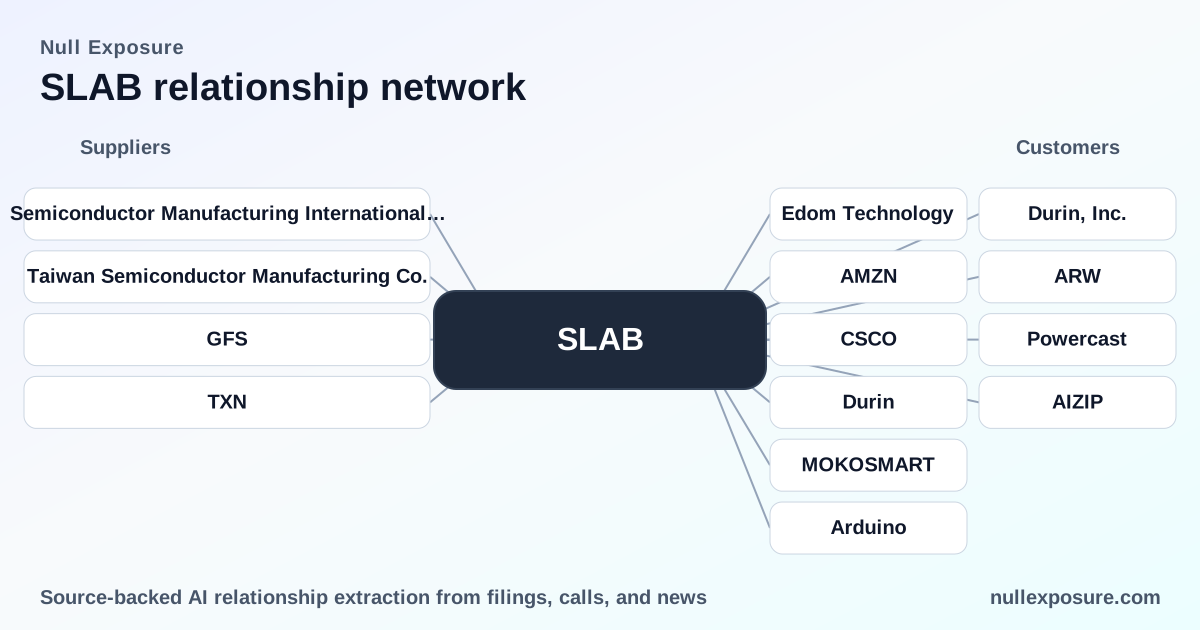
Silicon Labs (SLAB): foundry dependence, reshoring dynamics, and what suppliers tell investors
Silicon Laboratories is a fabless semiconductor company that designs and sells mixed-signal integrated circuits and monetizes through product sales to OEMs and embedded-system customers. Its operating model outsources wafer fabrication and many assembly/test functions to third-party foundries and subcontractors while capturing margin on design, IP and finished-device sales. For investors evaluating supplier risk and counterparty strategy, the critical questions are concentration of manufacturing partners, contract tenor and any shifts toward vertical integration that change cost and supply predictability. Learn more about supplier risk analysis at https://nullexposure.com/.
Supply-chain posture: flexible contracting, concentrated geography, and fabless dependency
Silicon Labs discloses that it does not maintain long-term binding supply contracts with most third-party vendors, which establishes a contracting posture of operational flexibility but elevates exposure to spot shortages and price moves. The company also reports that most foundries and several assembly/test subcontractors are located in Taiwan and the broader Pacific Rim, concentration that directly links SLAB’s execution to APAC geopolitical and logistical dynamics. Finally, the firm is a classic fabless manufacturer, depending on external wafer fabs for semiconductor production rather than owning in-house wafer capacity. These attributes together create a supply profile that is high on vendor flexibility, high on geopolitical concentration, and high on operational criticality because the company cannot internally substitute wafer production without major capital investment.
Who manufactures Silicon Labs wafers today — the full set of supplier relationships
Below are the explicit manufacturing and supplier relationships disclosed in company filings, earnings commentary and news coverage.
-
Taiwan Semiconductor Manufacturing Co. (TSMC): According to the company’s FY2026 10‑K, TSMC manufactures a majority of Silicon Labs’ silicon wafers and is identified as a primary partner for wafer production. This is the company’s largest external foundry relationship as disclosed in the FY2026 filing.
-
Semiconductor Manufacturing International Corporation (SMIC): The FY2026 10‑K states that many of the wafers sold by Silicon Labs were manufactured by SMIC, placing SMIC alongside TSMC as a core wafer supplier under the firm’s fabless model.
-
GlobalFoundries (GFS): Management announced on the 2025 Q3 earnings call that Silicon Labs expanded its partnership with GlobalFoundries to produce Series 2 wireless SoCs at GlobalFoundries’ Malta, New York facility, signaling diversification of manufacturing footprint into the U.S. (2025 Q3 earnings call).
-
Texas Instruments (TXN): Coverage of TI’s proposed acquisition of Silicon Labs frames the transaction as an opportunity for reshoring production into TI’s internal 300 mm wafer fabs and in‑house assembly and test operations, with TI positioning the deal as a way to reduce third-party foundry exposure and lower cost at scale (news coverage, March 2026).
Each relationship above is documented in the referenced company filing, earnings remarks or contemporaneous news reporting cited by source and period.
What these supplier links mean for margins, operations and valuation
Silicon Labs’ trailing twelve-month revenue and gross profit ($784.8M and $457.0M respectively) display a business still scaling product revenue while absorbing negative net margin pressure (reported profit margin around -8.3% and operating margin -1.56%). Heavy reliance on third‑party foundries means wafer pricing and allocation materially affect gross margin and delivery timelines. Analyst consensus positions the stock at a much higher implied upside (analyst target price ~$222.86), which reflects expectations for margin recovery and revenue growth; however, current valuation multiples (price-to-sales ~8.6, EV/Revenue ~7.99) already price in significant improvement.
- Key takeaway: investors are paying for recovery and execution — supplier reliability and reshoring progress are central to validating that thesis.
Constraints and what they signal about operating resilience
Company-level disclosures provide clear operating constraints:
-
Contract tenor: the company states it typically lacks long-term supply contracts obligating vendors to set prices and quantities, a company-level signal that favors procurement agility but reduces supply guarantees and increases exposure to market price volatility.
-
Geographic concentration: the firm reports most foundry, assembly and test partners are in Taiwan and the Pacific Rim, creating concentrated APAC exposure that elevates geopolitical and transportation risk for wafer supply.
-
Manufacturer role (fabless): Silicon Labs explicitly identifies as fabless, meaning wafer manufacturing is critical and outsourced; that constraint ties directly to its disclosed partnerships with TSMC and SMIC and frames the business as dependent on third-party capacity and technology roadmaps.
These constraints are material inputs to any supplier-risk model and should be treated as persistent operating characteristics unless reshoring or contractual changes alter them.
Strategic inflection points: diversification and potential reshoring
Two developments change the supplier-risk calculus. First, the GlobalFoundries expansion announced on the 2025 Q3 call moves some production to a U.S. facility, reducing absolute APAC concentration for at least the Series 2 wireless SoCs. Second, reporting around TI’s acquisition frames the deal as reshoring production into TI’s 300 mm fabs and internal assembly/test, which, if executed, would reduce SLAB’s dependence on external foundries and could improve gross margin predictability and unit costs. Both moves speak to maturation of SLAB’s supply strategy: diversification plus potential vertical integration reduces single-region and single-vendor risk.
For deeper supplier intelligence and scenario planning, review supply-chain mapping and counterparty exposure at https://nullexposure.com/.
Investment implications and risk checklist
Investors and operators should weigh the following, all drawn from disclosed relationships and company signals:
- Concentration risk: Dependence on TSMC and SMIC under a short-term contracting posture creates supply and pricing volatility exposure.
- Geopolitical risk: APAC concentration elevates the impact of regional disruptions on fulfillment and lead times.
- Execution upside: U.S. production through GlobalFoundries and the prospective TI reshoring narrative are real operational levers that would materially change cost structure and risk if realized.
- Valuation tension: Current multiples imply recovery; execution on supplier diversification and reshoring is the primary path to deliver those returns.
If you are modeling SLAB, stress-test scenarios for wafer price shocks, delivery disruptions, and the timing of any reshoring benefits.
Explore supplier and counterparty dashboards for additional context at https://nullexposure.com/.
Bottom line
Silicon Labs is a fabless semiconductor vendor whose profitability and execution depend critically on third-party foundries and the geographic footprint of assembly/test partners. The FY2026 disclosures and recent management commentary reveal a supplier base anchored in TSMC and SMIC, with strategic moves to broaden manufacturing with GlobalFoundries and potential reshoring under the TI acquisition narrative. Investors should treat supplier relationships as primary drivers of near-term margin recovery and the main source of execution risk. For operational due diligence and to map counterparty exposure into valuation scenarios, start with the supplier intelligence work at https://nullexposure.com/.