Solid Biosciences (SLDB): Capital partners, PR channels, and supplier dynamics investors need to know
Solid Biosciences develops precision genetic medicines for neuromuscular and cardiac indications and monetizes primarily through equity financings, out‑licensing and milestone/royalty structures on licensed intellectual property, and value creation from clinical-stage programs that can trigger partner payments or commercial revenues. The company funds R&D via capital markets transactions and leverages a network of licensors, contract manufacturers and service providers to advance clinical candidates. For a concise supplier-relationship view and tracking, visit https://nullexposure.com/.
Quick read: how the relationships drive the business model
Solid’s operating model is typical of small-cap biotech: high R&D intensity, reliance on third-party manufacturing and CRO support, and capital markets activity as the near-term liquidity engine. Licensing inflows are structured as upfronts, milestones and royalties; financing partners provide direct balance-sheet support through placements; and external PR firms and distribution channels manage market communication and disclosure. These relationships are operationally critical — manufacturing and CRO partners are mission-critical to trial timelines, while banks and placement agents are critical to solvency and runway.
Relationship roll-call — who Solid is working with and why it matters
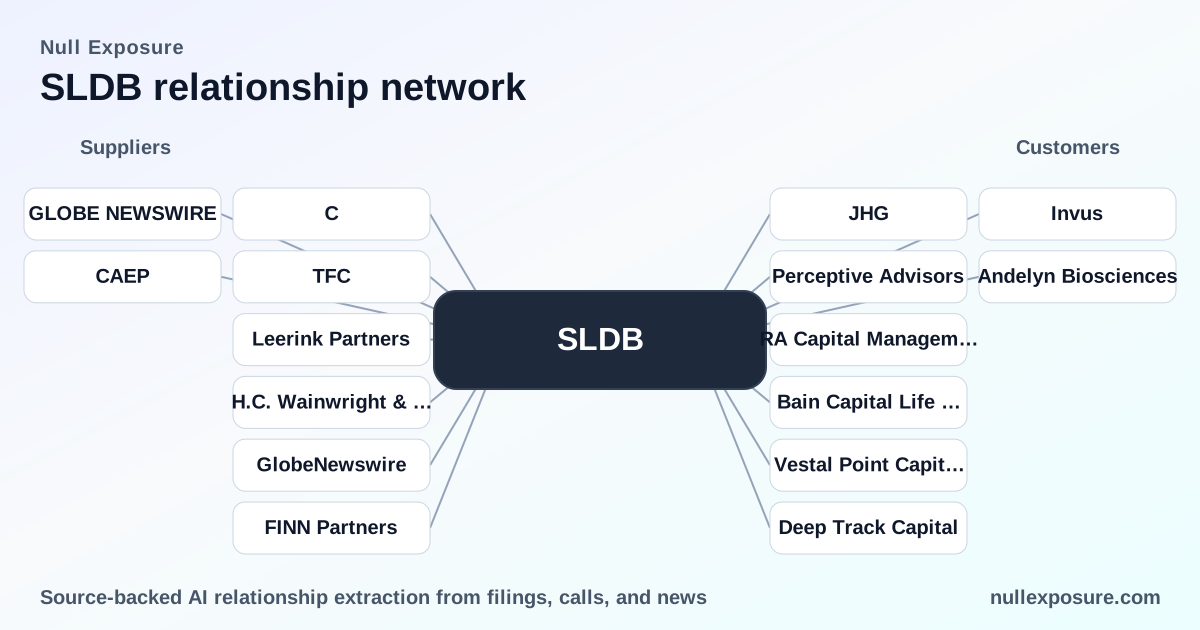
Below are every counterpart in the supplier-scope results for SLDB, with a plain-English summary and source citation.
Citigroup — Acted as a joint lead placement agent alongside Leerink Partners for Solid’s oversubscribed $240 million private placement announced in early March 2026, signaling institutional distribution support for the financing. (Solid Biosciences press release via GlobeNewswire, March 6, 2026: https://www.globenewswire.com/news-release/2026/03/06/3251037/0/en/Solid-Biosciences-Announces-Oversubscribed-240-Million-Private-Placement.html)
Leerink Partners — Named co‑lead placement agent on the same $240 million private placement, providing biotech-focused syndication and investor outreach aligned with life‑science buy‑side demand. (Solid Biosciences press release via GlobeNewswire, March 6, 2026)
Truist — Served as a co‑placement agent for the March 2026 financing, contributing to distribution and placement execution for the equity raise. (Solid Biosciences press release via GlobeNewswire, March 6, 2026)
H.C. Wainwright & Co. — Listed as a co‑placement agent supporting the private placement, reflecting participation from boutique life‑science investment banks. (Solid Biosciences press release via GlobeNewswire, March 6, 2026)
Cantor (Cantor Fitzgerald / CAEP) — Identified as a co‑lead placement agent in the financing announcement, indicating a broader syndicate across both bulge bracket and specialty firms. (Solid Biosciences press release via GlobeNewswire, March 6, 2026)
FINN Partners — Serves as Solid’s external communications/PR agency; multiple press releases and media contacts (Glenn Silver) are routed through FINN Partners across 2026 announcements including clinical updates and corporate disclosures. (Multiple press releases via GlobeNewswire and Yahoo Finance, Jan–Mar 2026; samples: https://www.globenewswire.com/news-release/2026/02/09/3234485/0/en/solid-biosciences-announces-positive-feedback-from-type-c-meeting-with-fda-for-sgt-003-gene-therapy-for-duchenne-muscular-dystrophy.html)
GlobeNewswire / GLOBE NEWSWIRE — Distribution channel used to publish Solid’s corporate press releases (clinical milestones and financing news) to the market throughout 2026; primary public record for the company’s outward disclosures. (See press releases dated Jan–Mar 2026 on GlobeNewswire and Yahoo Finance syndication)
Each of the items above is drawn from Solid’s public disclosures and press distribution in the first quarter of 2026; the financing notice and the clinical program updates are the primary documents cited.
What the relationship map implies for investors and suppliers
Solid’s supplier profile generates a clear set of operational signals investors should price into models:
-
Contracting posture: licensing-heavy. Solid maintains multiple exclusive, royalty-bearing, sublicensable license agreements with academic institutions and third parties. These arrangements create future contingent obligations (milestones and royalties) rather than large fixed manufacturing headcount, preserving capital flexibility while creating long-term royalty liabilities. The licensing posture supports technology access across indications at a relatively low fixed-cost base.
-
Concentration and criticality: third-party manufacturing and CRO dependence is material. The company explicitly relies on CMOs and CROs for production of SGT-003, SGT-212 and SGT-501 and for clinical execution; supply disruptions directly threaten trial timelines and therefore valuation inflection points. This is a structural risk for operators and a counterparty risk for suppliers.
-
Contract maturity and flexibility: a mix of long-term IP licenses and short-term service contracts. While IP licenses are long-dated and global in scope, many operational service contracts are cancellable on short notice (e.g., 30‑day cancellable agreements for some services), enabling tactical adjustments to spend but increasing execution risk if rapid supplier replacement is required.
-
Geographic footprint: primarily North America with global IP reach. Facilities and labs are leased in Massachusetts and North Carolina, concentrating operational dependencies in the U.S., while license rights and commercialization rights are world‑wide under several agreements — a common biotech configuration that centralizes operations while preserving global market options.
-
Spend profile: occasional mid‑range licensing and milestone liabilities. Public excerpts show non-trivial contingent payments — for example, a transaction where Solid paid $1.0 million upfront to FA212 and exposed itself to up to $34.0 million in development milestones and $21.0 million in sales milestones plus low-single-digit royalties — a pattern that places future cash‑flow leverage on successful clinical progress rather than on fixed operational scale.
Collectively, these signals denote a company with high operational leverage to clinical outcomes, reliant on capital markets for liquidity, and anchored by long-term IP agreements that convert scientific progress into potential milestone cash flows.
If you manage counterparty risk or supplier exposure to biotechs, the concise relationship mapping above should inform your credit terms, lead times, and concentration limits. For ongoing tracking and updated supplier insights, visit https://nullexposure.com/.
Tactical investor takeaways and next steps
-
Financing strength: The March 2026 oversubscribed $240 million placement led by a syndicate of Citigroup, Leerink, Truist, H.C. Wainwright and Cantor demonstrates market access and underwriter confidence in near-term capital needs. (GlobeNewswire press release, March 6, 2026)
-
Operational risk: Dependence on CMOs/CROs for product supply and trial conduct is mission-critical; contracts include both long-term licensing and short-notice service arrangements, necessitating active supplier monitoring.
-
Commercial optionality vs. contingent liabilities: Licensing deals deliver global rights but create milestone and royalty obligations that will impact future margins if programs commercialize.
For a consolidated supplier and relationship scorecard you can use in due diligence or portfolio monitoring, explore our platform at https://nullexposure.com/. Solid is a case study in how capital markets and supplier networks jointly determine small-cap biotech viability — monitor both clinical readouts and placement activity closely.