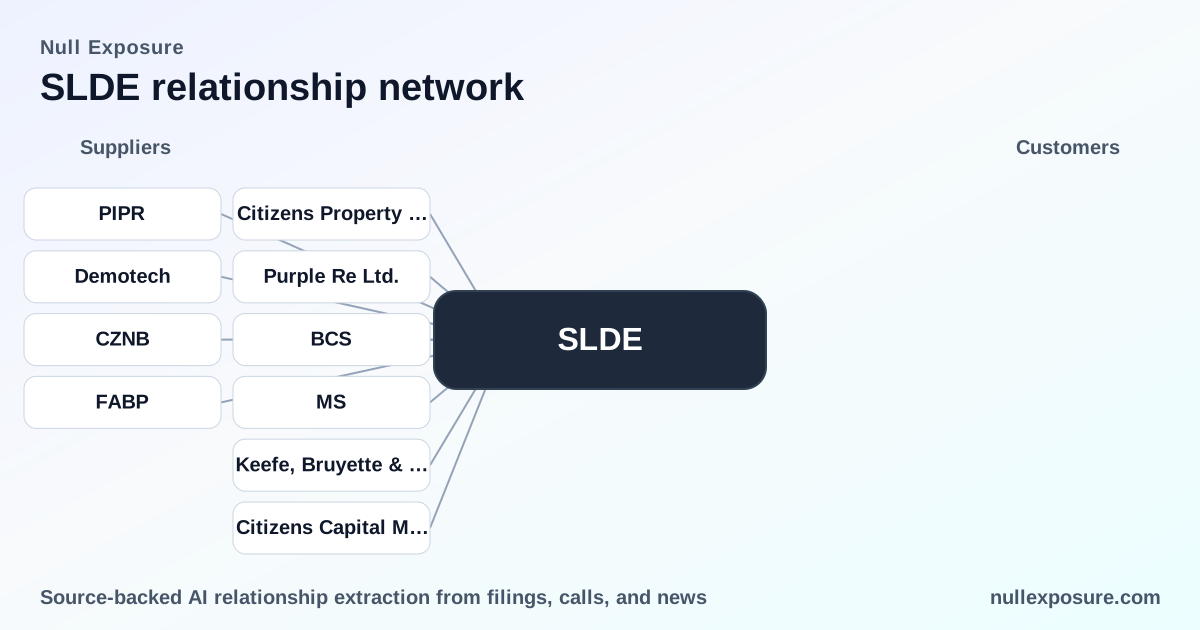
Slide Insurance Holdings (SLDE) — supplier relationships that drive underwriting scale and capital access
Slide Insurance underwrites single‑family and condominium homeowners policies and grows primarily by assuming large portfolios and buying renewal rights, then monetizing through premiums and underwriting profit. The company funds growth and catastrophe exposure through a mix of traditional reinsurance, insurance‑linked securities, and capital‑markets transactions while supplementing distribution with agents and direct channels. For investors and operators, the critical read is this: Slide’s business model is concentration‑driven, capital‑market dependent, and highly levered to policy‑assumption volume. Learn more at https://nullexposure.com/.
How Slide makes money — a concise commercial thesis
Slide writes P&C homeowners business in the U.S., focusing on single‑family and condos; it monetizes through net premiums earned and favorable loss ratios, supplemented by portfolio acquisitions (policy takeouts) that accelerate scale without organic customer acquisition cost. Financials show the model is working at scale: TTM revenue of $1.156 billion, profit margin ~38%, and ROE ~57%, driven by underwriting leverage and policy assumption economics (FY2026 figures). Slide’s strategy requires steady access to reinsurance, catastrophe bonds, and capital markets for both growth and balance‑sheet protection.
The relationships that underpin underwriting and capital — what matters and why
Below I cover every named counterparty found in public reporting. Each entry is a plain‑English summary plus the published source for verification.
Citizens Property Insurance Corp.
Slide has repeatedly assumed large blocks of policies from Citizens, a principal channel for rapid portfolio scale in Florida; these assumptions materially lifted gross premiums written and net premiums earned in FY2025–FY2026. According to an Insurance Business report (Mar 2026), policy acquisitions from Citizens were a direct driver of a 25% increase in gross premiums written year‑over‑year. (Source: Insurance Business, Mar 10, 2026 — https://www.insurancebusinessmag.com/us/news/breaking-news/slide-insurance-q2-profit-jumps-as-premiums-and-policies-surge-545966.aspx)
Citizens (as cited separately in market notices)
Market filings and press coverage also record specific bulk assumptions, including a 60,147‑policy takeout in October 2025 that was the largest in Florida’s market and continued contribution to FY2026 revenue growth. ReinsuranceNews and TradingView coverage attribute significant revenue lifts to these Citizens assumptions in FY2025–FY2026. (Sources: Reinsurance News, TradingView, Mar 2026 — https://www.reinsurancene.ws/; https://www.tradingview.com/news/tradingview:9c2b43b676458:0-slide-insurance-holdings-10-k-1-155-9m-revenue-3-36-diluted-eps/)
Purple Re Ltd.
Slide has sourced named‑storm and hurricane protection through Purple Re Ltd. catastrophe bonds, executing back‑to‑back transactions in 2024 and 2025 — including a $210M Series 2024‑1 and a $250M Series 2025‑1 — to expand reinsurance capacity for Florida and South Carolina exposure. Artemis and Reinsurance News reported these cat‑bond placements as integral to Slide’s reinsurance program expansion. (Sources: Artemis (2026) and Reinsurance News (2026) — https://www.artemis.bm/news/slide-secures-its-largest-catastrophe-bond-yet-250m-purple-re-2025-1/; https://www.reinsurancene.ws/slide-finalises-1-86bn-2024-reinsurance-program/)
Barclays
Barclays acted as a joint book‑running manager for Slide’s IPO, indicating investment‑bank distribution support for Slide’s market access. Insurance Business identified Barclays among the lead underwriters for the offering announced in early 2026. (Source: Insurance Business, Mar 2026 — https://www.insurancebusinessmag.com/us/news/breaking-news/slide-insurance-unveils-ipo-of-20-million-shares-for-nasdaq-debut-538420.aspx)
Morgan Stanley
Morgan Stanley served as the co‑book runner alongside Barclays for the IPO, demonstrating Slide’s ability to engage top‑tier capital markets counterparties. Insurance Business cited Morgan Stanley in the IPO syndicate. (Source: Insurance Business, Mar 2026 — https://www.insurancebusinessmag.com/us/news/breaking-news/slide-insurance-unveils-ipo-of-20-million-shares-for-nasdaq-debut-538420.aspx)
Keefe, Bruyette & Woods (KBW)
KBW (a Stifel company) participated as a co‑manager in the offering, an element of Slide’s distribution and capital‑markets plumbing that broadens sell‑side coverage and syndicate reach. Insurance Business listed KBW as a co‑manager in the IPO announcement. (Source: Insurance Business, Mar 2026 — https://www.insurancebusinessmag.com/us/news/breaking-news/slide-insurance-unveils-ipo-of-20-million-shares-for-nasdaq-debut-538420.aspx)
Citizens Capital Markets
Citizens Capital Markets appears on the IPO syndicate as a co‑manager, reflecting local market and distribution support tied to the company’s Florida‑centric strategy. The IPO press release noted Citizens Capital Markets in the co‑manager list. (Source: Insurance Business, Mar 2026 — https://www.insurancebusinessmag.com/us/news/breaking-news/slide-insurance-unveils-ipo-of-20-million-shares-for-nasdaq-debut-538420.aspx)
Piper Sandler
Piper Sandler also served as a co‑manager, adding institutional distribution capacity for Slide’s equity issuance and signaling active sell‑side engagement. Insurance Business names Piper Sandler among the co‑managers. (Source: Insurance Business, Mar 2026 — https://www.insurancebusinessmag.com/us/news/breaking-news/slide-insurance-unveils-ipo-of-20-million-shares-for-nasdaq-debut-538420.aspx)
Demotech
Slide holds a Demotech Financial Stability rating of “A” (Exceptional), which supports its market credibility with agents and cedants and aids in regulatory and depositor confidence in the company’s financial stability. Reinsurance News documented the Demotech rating in the context of Slide’s reinsurance program disclosures. (Source: Reinsurance News, Mar 2026 — https://www.reinsurancene.ws/slide-finalises-1-86bn-2024-reinsurance-program/)
Farmers
Slide expanded through renewal‑rights acquired from Farmers, and the completion of offers under that agreement in February 2025 affected sequential new‑policy flows and renewals. TradingView and Insurance Business coverage note that Farmers renewal‑rights were a component of Slide’s distribution and acquisition strategy. (Sources: TradingView and Insurance Business, 2026 — https://www.tradingview.com/news/tradingview:9c2b43b676458:0-slide-insurance-holdings-10-k-1-155-9m-revenue-3-36-diluted-eps/; https://www.insurancebusinessmag.com/us/news/breaking-news/slide-insurance-q2-profit-jumps-as-premiums-and-policies-surge-545966.aspx)
(For additional context on transactions and capital structure, visit https://nullexposure.com/.)
Company‑level constraints and operating signals (what public data shows)
There are no explicit constraint excerpts in the supplier relationship feed, so readers should rely on company‑level signals to infer operational posture:
- Concentration of growth strategy: Slide’s rapid growth is heavily driven by policy assumptions (notably Citizens and Farmers takeouts), which creates earnings scalability but also exposes the P&L to concentrated geographic and peril risk.
- Capital‑market dependency: Frequent use of catastrophe bonds (Purple Re) and an IPO syndicate reflects a contracting posture that relies on external capital markets to fund reinsurance and balance‑sheet expansion.
- Rating and maturity: A Demotech “A” rating is a positive signal for market acceptance, but Slide’s reinsurance program has evolved only over the past two years, implying a maturing but still developing catastrophe protection profile.
- Ownership and governance signals: Insider ownership at ~44% and institutional ownership ~34% indicates founder/insider concentration alongside meaningful institutional stakes — a governance dynamic that supports decisive strategic moves but concentrates control.
Investment implications and operator takeaways
- Growth engine: Policy assumptions from Citizens and renewal‑rights from Farmers are Slide’s primary organic and inorganic growth levers; they accelerate premium scale without proportional customer acquisition spend.
- Capital and risk transfer: The Purple Re cat‑bond program and traditional reinsurance are critical to converting growth into repeatable underwriting earnings; failure to secure market capacity would compress margins.
- Profitability profile: Current margins and ROE are strong, but they are sensitive to named‑storm outcomes and reinsurance pricing cycles.
- Syndicate access: The IPO syndicate (Barclays, Morgan Stanley, KBW, Piper Sandler, Citizens Capital Markets) demonstrates market access that management can call upon for future capital needs.
If you’re evaluating supplier and counterparty exposure for underwriting or investment decisions, prioritize diligence on reinsurance attachments, cat‑bond terms, and the pipeline of Citizens/Farmers policy assumptions. For deeper intelligence on counterparties and contract terms, start with Slide’s public filings and the transaction notices listed above; you can also request enhanced supplier profiles at https://nullexposure.com/.
Practical next steps for operators and investors
- Validate the structure and layers of Purple Re transactions and corresponding attachment points.
- Confirm ceded loss recovery timelines and counterparty limits for all major reinsurance and ILS placements.
- Monitor the pipeline of policy assumptions and the company’s ability to integrate large transferred portfolios without reserve mismatch.
For structured supplier intelligence and relationship mapping tied to insured portfolios and capital transactions, visit https://nullexposure.com/ — the fastest route to consolidated counterparty visibility.
Bottom line: Slide has built a replicable growth engine through policy takeouts and capital‑markets solutions, but its risk profile is tightly coupled to catastrophe financing and a small set of large counterparties, making active counterparty due diligence essential for both operators and investors.