Sallie Mae (SLM) — What the Goldman Sachs ASR and supplier signals mean for investors
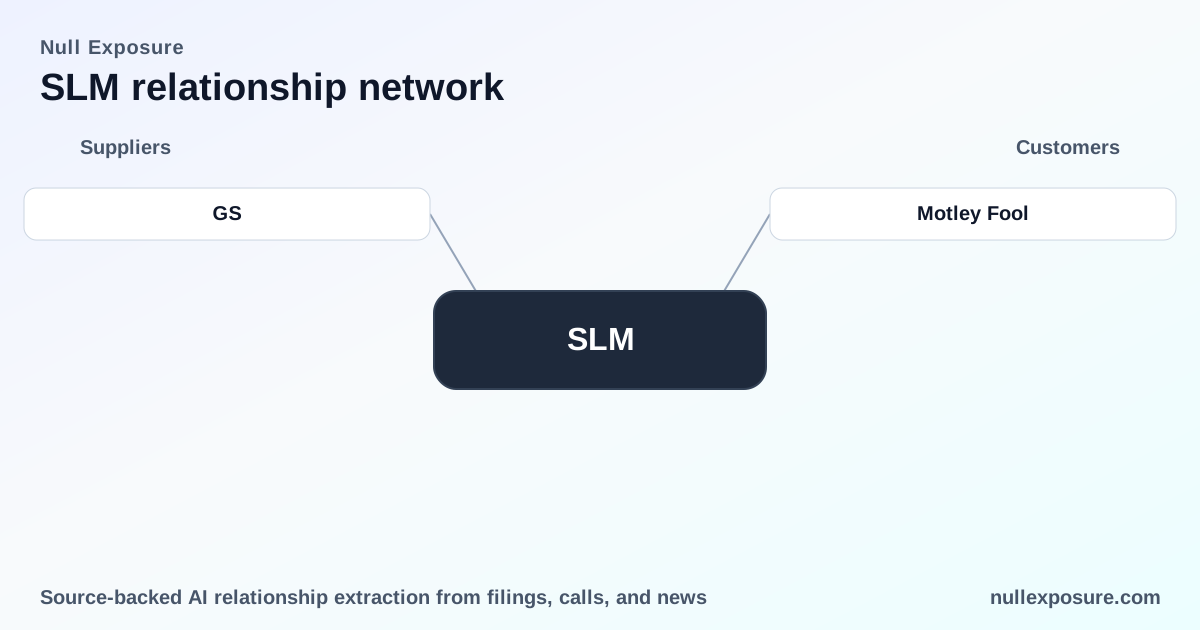
Sallie Mae (SLM) is a consumer-credit originator that monetizes its balance sheet through private education loans, fee income on loan servicing and deposit-like products, and active capital allocation (dividends and buybacks) that compresses share count and supports earnings per share. The company’s recent $200 million accelerated share repurchase (ASR) with Goldman Sachs is a capital-return action that repositions leverage and signal-strength to the market while leaving operational dependencies with third-party providers intact. For a focused review of counterparties and supplier posture, see more at https://nullexposure.com/.
The headline: a $200 million ASR arranged by Goldman Sachs
Sallie Mae announced a $200 million ASR under a previously disclosed $500 million buyback program. This transaction will deliver most shares up front with a final share count determined by the VWAP discount mechanics of the ASR. ASRs accelerate buybacks and immediately reduce the public float, transferring execution and timing risk to the counterparty bank. TradingView reported the agreement on March 10, 2026 (source: https://www.tradingview.com/news/tradingview:c050f0ded2a4d:0-slm-launches-200-million-accelerated-share-repurchase-with-goldman-sachs/).
For more detail on how these counterparty arrangements influence supplier and capital allocation risk, visit https://nullexposure.com/.
What the primary relationship entries say (each source referenced)
-
TradingView coverage on March 10, 2026 reports that Goldman Sachs will deliver most of the shares up front, with the final number tied to VWAP over the program term, reflecting standard ASR mechanics that shift market-execution risk to the bank; source: TradingView, March 10, 2026 — https://www.tradingview.com/news/tradingview:c050f0ded2a4d:0-slm-launches-200-million-accelerated-share-repurchase-with-goldman-sachs/.
-
MiniChart’s March 9–10, 2026 write-up notes that Sallie Mae entered into a $200 million ASR with Goldman Sachs Co. LLC as part of a $500 million buyback authorization, formalizing the company’s near-term capital return plan; source: MiniChart, March 9–10, 2026 — https://www.minichart.com.sg/2026/03/09/sallie-mae-announces-200-million-accelerated-share-repurchase-under-500-million-buyback-program-in-2026-1/.
-
A market news aggregation (Intellectia) echoed the same point and placed completion timing before end of Q2 2026, observing that management structured the ASR to signal confidence in stock value while compressing outstanding shares ahead of forthcoming quarters; source: Intellectia/market news, March 10, 2026 — https://intellectia.ai/news/stock/notice-of-class-action-lawsuit-against-slm-corporation.
Why the ASR matters to investors: capital allocation, signaling and execution risk
The $200 million ASR is a tactical capital allocation move with three investor-relevant implications:
-
Immediate EPS and float effect. ASRs reduce public float immediately and vest the buyback economics up front, producing a near-term lift to EPS if net income holds steady. Sallie Mae’s fiscal profile—market cap ~$3.97 billion and trailing P/E ~5.8—makes buybacks a high-leverage tool for shareholder returns.
-
Execution shifted to the bank. An ASR places price and timing execution on Goldman Sachs for the term of the program; Sallie Mae realizes the economic reduction in shares while ceding short-term market execution risk to its counterparty. This is normal for ASRs but creates an operational and counterparty exposure that investors should track.
-
Signal of balance-sheet confidence. Management’s willingness to deploy $200 million into an ASR under a $500 million program signals confidence in internal capital forecasts and in the stock’s valuation versus alternative uses (deleveraging, buybacks, or dividends).
Supplier posture and company-level constraints investors must weigh
Beyond the ASR, Sallie Mae’s public disclosures and evidence excerpts highlight structural supplier and contract features that shape operational risk:
-
Contracting posture (framework agreements): The company maintains a policy of using standard master agreements—including ISDA Master Agreements—for derivative contracts, which reflects a formalized and institutionally mature contracting posture that reduces bespoke contractual risk across treasury and hedging relationships.
-
Service-provider dependence: Sallie Mae’s filings state a significant dependence on third parties for operations, customer servicing, deposit product servicing, and cybersecurity services. This establishes an operational concentration risk: while third-party relationships are common in financial services, they are mission-critical for servicing and IT. Evidence includes explicit references to third-party servicing of deposit products and the use of external cybersecurity providers.
-
Concentration and criticality signals: These constraints are company-level signals that point to operational criticality of suppliers (high-impact if disrupted) but not to a single named vendor. Investors should treat supplier disruptions as potential amplifiers of reputational and financial risk rather than isolated line items.
Together, these characteristics mean Sallie Mae combines mature financial contracting with meaningful operational reliance on external vendors—a dual profile of financial sophistication and operational concentration.
For deeper supplier intelligence and to map counterparties more comprehensively, visit https://nullexposure.com/.
Risk checklist for relationship-driven investors
- Counterparty execution risk from the ASR with Goldman Sachs: monitor completion timing and any post-transaction adjustments to outstanding shares.
- Operational concentration: track contractual renewals and performance for third-party servicers and cybersecurity vendors.
- Capital allocation trade-offs: with a trailing P/E below 6 and significant buyback authorization, weigh the buyback’s return profile versus potential uses such as loan portfolio growth or enhanced liquidity buffers.
Final takeaways and what investors should do next
Key takeaway: The $200 million ASR with Goldman Sachs is a material capital-return action that reduces float immediately and signals management’s confidence, while Sallie Mae’s broader supplier posture emphasizes heavy reliance on external service providers and standardized financial contracting. Investors should treat the ASR as a positive near-term EPS lever, but monitor counterparty execution and third-party operational resilience as persistent, company-level risks.
If you are evaluating SLM supplier relationships or constructing a counterparty risk view, start here: https://nullexposure.com/. For more granular supplier and contract intelligence about Sallie Mae, explore our research platform at https://nullexposure.com/.