SLMBP — What the Sallie Mae (SLM Corp Pb Pref) supplier footprint tells investors
Thesis: SLM Corporation (preferred ticker SLMBP) is a financially profitable originator and servicer of private education loans that monetizes through interest income, deposit gathering, loan servicing, and capital markets activity (securitization and share repurchases). Recent counterpart engagements and company disclosures show a capital-allocation posture that leverages market counterparties to return capital and a service-provider model for non-core operational functions, which has direct implications for liquidity, earnings stability, and counterparty exposure. For a deeper supplier-risk view visit https://nullexposure.com/.
Why the Goldman Sachs ASR matters to an investor
Sallie Mae has executed a $200 million accelerated share repurchase (ASR) agreement with Goldman Sachs, scheduled to complete before the end of Q2 2026. According to an Intellectia news report dated March 10, 2026, this trade is a deliberate capital-return action that reduces outstanding common shares and signals management’s decision to deploy excess capital into equity buybacks rather than alternative investments. The ASR is a financing and capital-allocation interaction with Goldman Sachs that also exposes SLM to counterparty execution and settlement mechanics while supporting per-share metrics for equity holders.
Every supplier / counterparty relationship on record
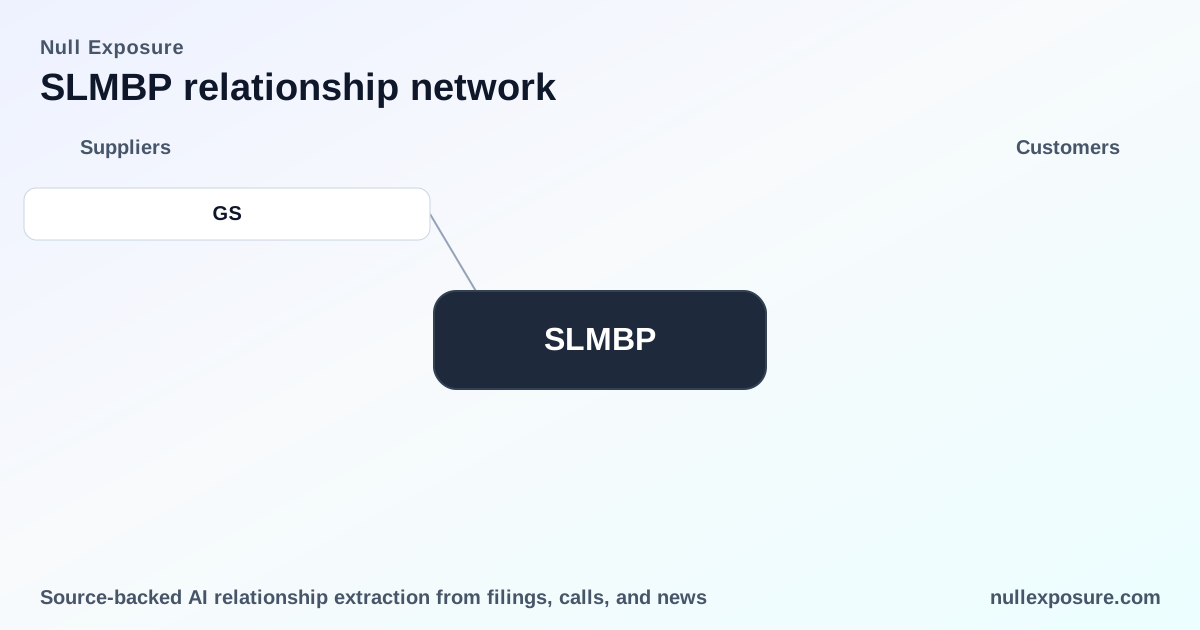
- Goldman Sachs — Sallie Mae entered an accelerated share repurchase agreement with Goldman Sachs for $200 million, expected to close before Q2 2026; this contract is a capital markets counterparty relationship used to execute share repurchases (Intellectia news report, March 10, 2026: https://intellectia.ai/news/stock/class-action-filed-against-slm-corporation-by-shareholders).
What constraints and company disclosures reveal about SLM’s operating model
Company disclosures and constraint excerpts provide operative detail beyond any single counterparty. These excerpts are company-level signals that shape supplier risk analysis:
- Contracting posture — standardized and risk-managed. SLM’s documented policy requires derivative contracts to be governed by ISDA Master Agreements and the Credit Department regularly reviews counterparties, which indicates a preference for standardized, legally robust contracts and repeat counterparty due diligence (company disclosure excerpt).
- Outsourced servicing for some deposit products — operational reliance. The company acknowledges that certain deposit products are serviced by third-party providers, showing deliberate reliance on external servicers for non-core operational functions and the attendant concentration and operational continuity risks (company disclosure excerpt).
- Core deposit diversification. Interest-bearing deposits include funds from Educational 529 and Health Savings plans and are treated as core funding sources, indicating that deposits are strategically used to diversify liquidity and funding rather than being purely transactional (company disclosure excerpt).
These disclosures collectively indicate a mature supplier posture: SLM uses legal standardization and counterparty selection to manage market-risk exposures, while delegating some operational functions to third-party service providers — a structure that reduces fixed overhead but increases vendor concentration and operational dependency.
How the Goldman Sachs relationship interacts with SLM’s capital profile
SLM’s financial profile provides the backdrop for the ASR: market capitalization roughly $4.92 billion, ROE 32.3%, profit margin 45.1%, and a dividend yield of approximately 0.69% (company financials through latest quarter 2025-12-31). These metrics justify active capital deployment.
- Capital-efficiency signal: A $200 million ASR is consistent with a company with strong ROE and positive profit margins choosing to allocate excess capital to support per-share metrics.
- Counterparty execution risk: The ASR is executed through Goldman Sachs, which introduces settlement and execution exposure for the duration of the agreement and until the transaction completes in Q2 2026 (Intellectia, March 10, 2026).
- Implication for preferred holders: While the ASR directly affects common-equity outstanding, improved per-share metrics and capital-management discipline have second-order effects on preferred shares through balance-sheet strength and capital cushion perceptions.
Risk and upside from a supplier-risk perspective
Investors evaluating supplier relationships should weigh these factors:
- Upside: The ASR demonstrates accessible capital and disciplined allocation; SLM’s profitability and robust ROE underpin its ability to engage with major capital markets counterparties and return capital without immediate liquidity strain.
- Operational risk: Third-party servicing of deposit products is a structural dependency; vendor failure, contract disputes, or service degradation could impair deposit processing and customer experience, with downstream effects on funding stability.
- Counterparty concentration: Major transactions routed through global banks (e.g., Goldman Sachs) centralize execution risk; SLM’s use of ISDA agreements mitigates legal risk, but execution and settlement exposure remain present until transactions settle.
For investors who want a consolidated view of supplier exposures and counterparties, check practical supplier intelligence at https://nullexposure.com/.
Investment implications and practical next steps
- Monitor capital allocation disclosures and ASR settlement updates. The completion of the Goldman Sachs ASR will materially change share count dynamics; follow 8-Ks and quarterly filings to confirm execution and any settlement adjustments.
- Assess vendor concentration for deposit servicing. Request or review vendor lists and transition plans to understand operational continuity and contract renewal terms.
- Track derivative counterparty exposures. ISDA-governed derivatives reduce legal uncertainty but preserve counterparty credit exposure; require counterparty credit metrics in diligence.
Key takeaways: SLM operates with a mature contracting posture and uses third-party service providers for certain operational functions; the $200 million ASR with Goldman Sachs is a clear capital-allocation move that reduces common equity and increases short-term counterparty exposure while supporting per-share performance.
For a structured supplier-risk assessment tailored to SLMBP and peer comparisons, start here: https://nullexposure.com/.
Endnote: All relationship references draw on the March 10, 2026 Intellectia news report for the Goldman Sachs ASR and on the company’s disclosures for contractual and product-role statements; investors should corroborate with the company’s upcoming filings and 8-Ks for final terms and settlement confirmations.