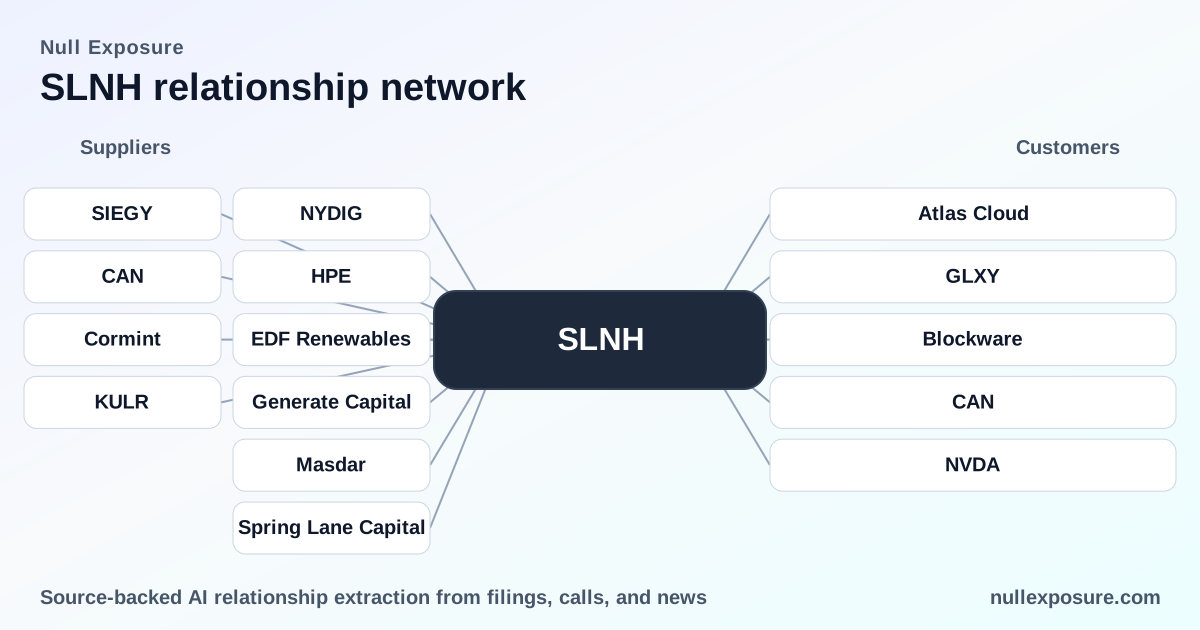
Soluna Holdings (SLNH): Supplier relationships that shape a green compute growth story
Soluna monetizes by pairing renewable power generation with energy‑intensive computing — hosting Bitcoin miners and selling AI/compute capacity from data centers built alongside wind and solar projects. Revenue is driven by long‑term power contracts and hosting agreements, while capital partners and equipment suppliers underwrite project buildouts and scale. Investors should view SLNH as a project‑oriented developer whose margin and execution hinge on supplier finance, equipment supply, and a small number of strategic partners. For a rapid vendor map and risk checklist, visit https://nullexposure.com/.
How Soluna’s supplier map converts wind into compute revenue
Soluna’s business model compresses three levers: renewable generation, capital providers that finance construction, and equipment/IT partners that supply compute and hosting services. Project economics depend on long‑dated PPAs and capital lines rather than spot asset trading, and operational scale requires suppliers that can deliver both hardware and predictable financing. That contracting posture elevates counterparty risk — a supplier shortfall or a terminated vendor agreement can delay revenue from an entire project.
Supplier relationships you need on your radar
Below I cover each partner excerpted in public disclosures and recent press — concise, plain‑English summaries with source notes so you can follow up.
NYDIG
Soluna disclosed a default on equipment loans under a Master Equipment Finance Agreement with NYDIG tied to a Soluna subsidiary in the 2024 Form 10‑K, and subsequent quarterly reporting recognized a net $10.1 million gain on debt extinguishment and revaluation related to NYDIG in FY2025. According to Soluna’s 2024 Form 10‑K, the borrower default occurred December 20, 2022; later earnings commentary in FY2025 summarized the accounting and financing impact. (Soluna 10‑K FY2024; Q3 FY2025 earnings commentary.)
Hewlett Packard Enterprise (HPE)
Soluna has deployed HPE GreenLake infrastructure with NVIDIA H100 GPUs in its data centers to support an AI cloud offering, making HPE a strategic hardware and managed‑services supplier; however, Soluna’s filings also record an HPE contract termination for cause related to payment defaults. A DataCenterDynamics report described the HPE‑based deployment for Atlas Cloud (FY2025 reporting), while Soluna’s corporate disclosures document the HPE termination and associated payment obligations. (DataCenterDynamics FY2025; Soluna filings FY2025.)
Generate Capital
Generate Capital provided a scalable credit facility of up to $100 million to fund green data centers and expand AI and Bitcoin hosting capacity, positioning Generate as a major project finance partner for Soluna’s growth. Soluna announced the close of the facility in public remarks and quarterly results during FY2025. (InvestingNews and StocksToTrade reporting, FY2025.)
EDF Renewables
EDF Renewables is a co‑developer on Project Kati, which targets 166 MW of clean power in Texas for Bitcoin hosting and AI compute, making EDF a long‑term generation partner for that site. The Project Kati announcement (Sep 2025) lists EDF as a founding developer alongside other strategic partners. (StocksToTrade coverage, Sep 11, 2025 announcement.)
Masdar
Masdar participates with EDF and Spring Lane Capital on Project Kati, contributing to the large‑scale wind generation that underpins Soluna’s Texas deployments. Public project disclosures from Sep 2025 name Masdar as a developer on the Kati initiative. (StocksToTrade coverage, Sep 2025.)
Spring Lane Capital
Spring Lane Capital expanded its investment to support the first 35 MW of Project Kati and separately provided $20 million secured to launch Kati 1, signaling a direct equity/credit commitment to early phases of buildout. Soluna’s FY2025 quarterly reporting cites Spring Lane’s capital as instrumental for initial construction. (InvestingNews FY2025; StocksToTrade Sep 2025.)
Siemens
Soluna signed a memorandum of understanding with Siemens to test infrastructure for AI power management, positioning Siemens as a potential systems‑level supplier for grid and power controls across AI deployments. TradingView coverage in early 2026 summarized the MOU and testing intent. (TradingView, FY2026 reporting.)
Canaan
Canaan is identified as the supplier for a 20 MW deployment at Project Dorothy 1A, making Canaan an equipment vendor for Bitcoin mining hardware in Soluna’s Dorothy cluster. Company business updates referenced expectations for the Canaan deployment in FY2026 communications. (BastillePost monthly business update, FY2026.)
Cormint
Soluna executed an equipment supply agreement with Cormint for a 12 MW deployment at Kati 1, indicating Cormint’s role as a short‑term supplier for miner equipment at a key Texas site. Finviz reported the equipment supply agreement as part of Kati 1 execution plans (FY2026 coverage). (Finviz FY2026.)
KULR Technology Group
KULR is a hosting partner for a 3.3 MW Bitcoin mining operation at Project Sophie, reflecting Soluna’s hosting strategy that mixes owned operations and third‑party hosted miners. StocksToTrade reported the hosting partnership as part of Soluna’s FY2025 expansion into Project Sophie. (StocksToTrade Oct 2025.)
(If you want a consolidated relationship table and timeline for diligence, review the partner index at https://nullexposure.com/.)
Contracting posture, concentration and operational constraints
Several company‑level signals shape Soluna’s supplier risk profile:
- Long‑term contracting is a structural feature: Soluna has entered long‑term PPAs and multi‑year ground leases, which support predictable power costs and stabilize hosting economics. Those long‑dated contracts reduce merchant exposure but raise execution risk if construction lags or counterparty credit deteriorates.
- Service dependence is material: Soluna relies on third‑party technology and service providers to monetize compute capacity; this is a company‑level signal of operational criticality where supplier performance drives revenue realization.
- Supplier spend spans multiple bands: public excerpts show obligations ranging from relatively small asset purchases to tens of millions in remaining payment streams under terminated vendor agreements, indicating mixed maturity of supplier engagements and meaningful funding risk at scale.
- Contract termination has precedent: Soluna’s filings explicitly record an HPE agreement termination for cause (March 26, 2025), which creates a specific counterparty execution event that investors must incorporate into scenario modeling.
What this means for investors: upside and the watchlist
- Upside: Strategic capital partners (Generate, Spring Lane) paired with large‑scale generation developers (EDF, Masdar) create a credible pathway to scale compute capacity backed by contracted renewables — that combination is the company’s primary value driver.
- Execution risk: Equipment supplier performance, credit exposures to financers, and the potential for contract terminations (HPE precedent) create concentrated operational dependencies that can delay revenue ramps.
- Operational leverage: Once projects are commissioned, margins should improve as fixed renewable costs and financed capex normalize — but that outcome depends on timely equipment delivery and stable supplier financing.
For a vendor risk checklist and partner timelines tailored to institutional diligence, visit https://nullexposure.com/ and request the Soluna supplier brief.
Bottom line and next steps
Soluna is a capital‑intensive play that stitches renewable power to compute demand via a small number of deep supplier and finance relationships. Investors should underwrite both the upside of large, contracted projects and the counterparty execution risk embedded in supplier finance and equipment agreements. For ongoing coverage and partner monitoring tools, see https://nullexposure.com/.