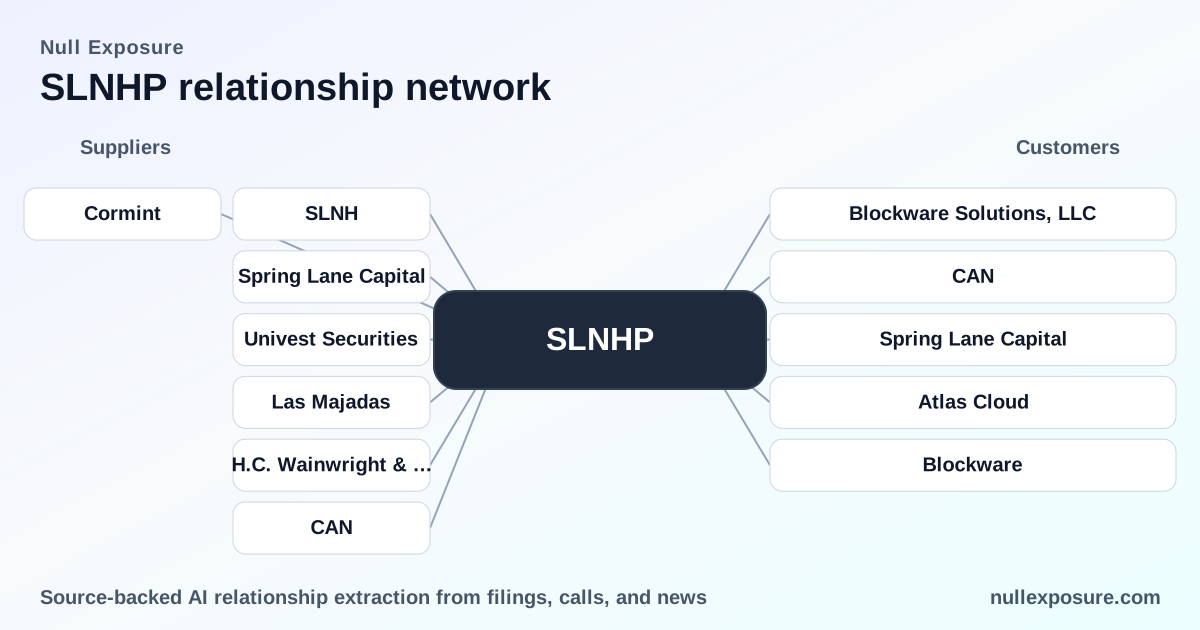
SLNHP: Infrastructure-first crypto compute with supply relationships that determine execution
Soluna Holdings Inc. Preferred Series A (SLNHP) backs a company that builds renewable-energy powered data centers and deploys high-performance computing and crypto-mining capacity. The firm monetizes through capacity sales, hosted compute/mining revenue, and project financing arrangements that pre-fund buildouts; preferred holders effectively sit behind an operating business whose cash flows are driven by large, capital-intensive supplier agreements and power contracts. Investors should evaluate SLNHP through the twin lenses of supplier execution and energy availability — both are the primary drivers of near-term revenue and value realization.
Explore SLNHP coverage on NullExposure
How Soluna’s commercial model maps to supplier risk
Soluna runs a capital-intensive model: it signs long-term supply and infrastructure deals, secures project financing, and deploys specialist mining and GPU hardware at renewable-generation sites. Revenue is generated by operating compute facilities and mining rigs colocated with generators and backed by PPAs or behind-the-meter integrations; capital partners and equipment vendors therefore sit at the center of monetization.
The public record and company filings reveal several consistent operating model characteristics:
- Contracting posture: Soluna executes multi-year, prepaid or committed agreements rather than spot purchases; filings disclose a 36-month vendor commitment and project finance structures that require sizable upfront payments. This establishes a high fixed-cost base and a dependence on predictable supplier performance.
- Concentration and criticality: A small set of suppliers — equipment vendors, EPC/infrastructure partners and utilities — are critical to operations. Company disclosures explicitly call out third-party utility providers as a single point of operational risk, signaling high concentration.
- Maturity and stage: The business mixes pilot and scaled deployments; several relationships are in pilot / initial energization phases, indicating that revenue growth depends on successful commissioning and scale replication.
- Spend scale: Material counterparty commitments sit in the mid-double-digit millions, with disclosed remaining payment streams in the $10m–$100m band, implying meaningful counterparty credit and delivery risk.
These company-level signals should guide diligence for preferred-holders: performance of a handful of counterparties will determine cash flow conversion.
Material contract and termination: the HPE episode
Soluna’s filings document a significant long-term provision with Hewlett Packard Enterprise (HPE): a 36-month datacenter and cloud services commitment with an initial prepayment of $10.3 million and a total contractual commitment of roughly $34 million. CloudCo provided notice to terminate the agreement for convenience on March 24, 2025; HPE then terminated for cause on March 26, 2025 citing material breach and unpaid obligations. Filings record that CloudCo was obligated for approximately $19.3 million in remaining payments as of March 31, 2025. This episode reveals both the company’s willingness to enter material multi-year vendor commitments and the financial strain such commitments can create when execution stalls. (Source: company filing disclosures through FY2025.)
Supplier relationship roll call — what matters to investors and operators
Below are the counterparties surfaced in public reporting and what they mean for operations.
Siemens — behind-the-meter AI pilot at Project Grace
Siemens is supplying electrical infrastructure, controls and monitoring for a 2 MW pilot at Soluna’s Project Grace in Texas, designed to evaluate performance under fast load steps and variable compute demand and to create a repeatable blueprint for future behind-the-meter AI deployments. This relationship positions Soluna to commercialize behind-the-meter AI services paired with renewable generation. Source: Siemens press release, March 2026.
Spring Lane Capital — project-level financing partner
Spring Lane Capital provided $35 million in project financing in May (reported 2022) to fund additional Soluna facilities, reflecting the private-equity project-finance route Soluna uses to scale capacity. External project finance reduces immediate equity dilution but pushes operational execution risk to asset-level cash flows. Source: CoinDesk, October 24, 2022.
Univest Securities — underwriter role on equity offering
Univest Securities acted as underwriter on a Soluna equity sale and was granted a greenshoe option in that offering, indicating a capital-markets partnership used to raise public financing. Investment-bank placement relationships facilitate capital raises that feed project pipeline execution. Source: CoinDesk, October 24, 2022.
Las Majadas — renewable energy supplier to Project Kati
Public reporting identifies Las Majadas wind energy as the power source for Project Kati’s energization, tying Soluna’s Kati 1 deployment directly to a named renewable generator. Direct generator partnerships are core to Soluna’s value proposition and critical to project-level economics. Source: TradingView report, March 2026.
H.C. Wainwright & Co. — placement agent for direct offering
H.C. Wainwright & Co. served as exclusive placement agent on a $32 million direct offering, underscoring continued reliance on investment-bank-led capital raises to fund buildouts. Placement agents are a recurring capital-enablement channel for growth-stage project deployments. Source: TradingView news, FY2025.
Canaan / Canaan Inc. — supplier of mining hardware for Project Dorothy
Soluna announced a deployment of 20 MW of Canaan Avalon A15 XP Bitcoin miners at Project Dorothy in Texas, establishing hardware supply and fleet scale for mining operations. Hardware OEM relationships determine hashing capacity, cost curves and deployment timelines. Sources: BastillePost (monthly business update, FY2026) and TimothySykes.com reporting (FY2025).
Cormint — equipment supply agreement for Kati 1
Soluna executed an equipment supply agreement with Cormint for a 12 MW deployment at Kati 1, a direct procurement of deployment-critical infrastructure. Supply agreements of this size are execution-critical and carry delivery and integration risk that flow straight to commissioning schedules and revenue ramp. Source: MarketScreener, FY2026.
What these relationships imply for risk-adjusted value
The counterparty mix shows a dual strategy: secure capital via placement agents and financiers, and build operational capability via infrastructure and OEM partners. Key risk vectors are supplier delivery, utility availability, and the company’s ability to convert pilot integrations into repeatable, revenue-generating rollouts. The HPE termination demonstrates the cash-flow consequences of missed vendor payments and the legal/contractual tail that can follow. Conversely, successful Siemens and Canaan integrations would de-risk replication and improve margin profile.
Monitor these specific metrics in diligence:
- Commissioning outcomes and operational metrics from the Siemens 2 MW pilot and the Kati energization.
- Hardware delivery and warranty terms from Canaan and Cormint, and their effect on hashing/utilization.
- The status of project financing and capital raises led by Spring Lane, H.C. Wainwright, and underwriters such as Univest.
- Remaining contractual obligations and potential liabilities from terminated vendor contracts (disclosed ~$19.3m remaining as of March 31, 2025).
Explore SLNHP coverage on NullExposure
Conclusions and actionable investor checklist
Soluna’s economics are driven by a small set of high-dollar supplier relationships and the availability of renewable power at project sites. For SLNHP holders, supplier execution and energy availability are the dominant determinants of cash conversion and preferred recovery prospects. Recommended priority actions for investors and operators:
- Get vendor delivery schedules and acceptance/commissioning milestones for Siemens, Cormint and Canaan hardware.
- Verify power delivery terms and PPA or behind-the-meter arrangements with named generators such as Las Majadas.
- Reconcile disclosed vendor payment obligations and any contingent liabilities arising from contract terminations (HPE-related exposure documented in FY2025 filings).
- Track forthcoming operational updates that convert pilot results into scalable pipelines.
Explore SLNHP coverage on NullExposure
These are the levers that will translate Soluna’s infrastructure strategy into sustainable cash flow — supplier performance and energy delivery.