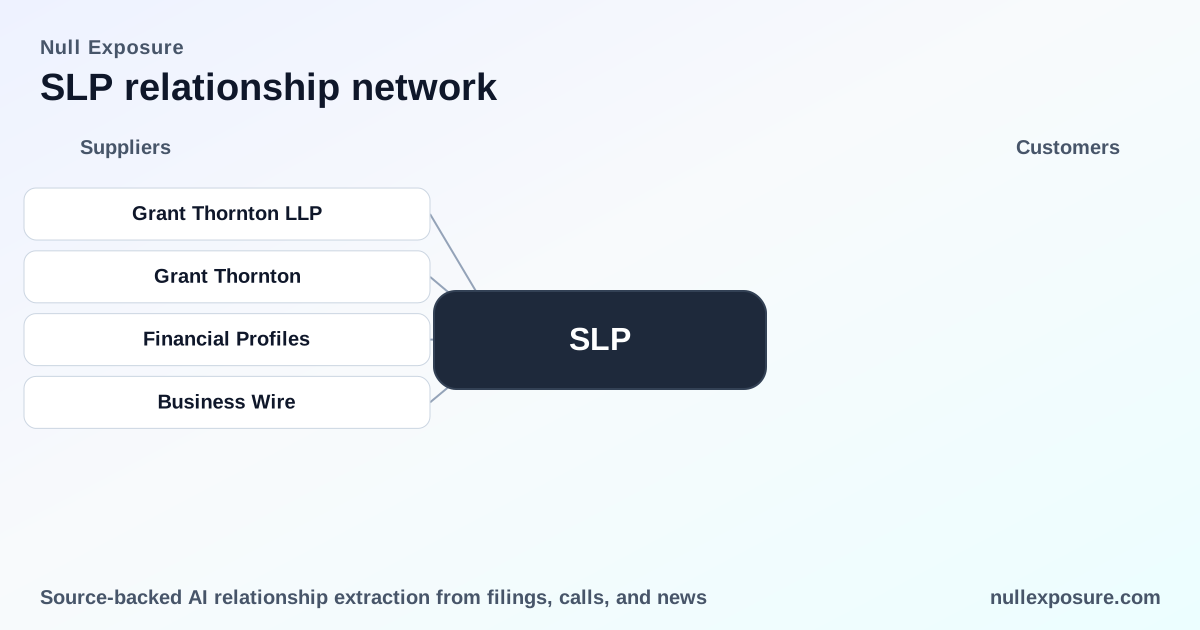
Simulations Plus (SLP): supplier relationships, governance signals, and what operators should price in
Simulations Plus develops mechanistic modeling and AI tools that sell as licensed software and cloud-enabled services to biopharma customers; the company monetizes through software licenses, cloud-based subscriptions, and professional services tied to model-informed drug development. Investors should treat SLP as a hybrid licensor/service-provider with revenue sensitivity to adoption of model-informed regulatory practices and vendor execution around cloud delivery. For a concise vendor-risk view and supplier signal map, visit https://nullexposure.com/.
Why supplier relationships matter for a software-led life-sciences vendor
Simulations Plus sits at the intersection of regulated drug development and cloud software delivery. That duality creates two classes of suppliers that matter to valuation and operational risk: software licensors and cloud infrastructure providers. Licensing relationships influence gross margins and product roadmaps; cloud providers shape uptime, scalability, and customer trust when models are relied on in regulatory submissions.
What the press and filings show about recent supplier and third‑party ties
Below I run through every relationship signal in the public results so investors and operators can see each external tie and its market implication.
Grant Thornton — audit dismissal reported (GlobeNewswire, FY2026)
The company disclosed that it dismissed its auditor, Grant Thornton LLP, citing unresolved reporting issues that could not be corrected in time, a governance event that increases near-term disclosure and audit-cycle risk. According to a GlobeNewswire release dated January 20, 2026, this dismissal prompted outside counsel and plaintiff-firm attention.
Grant Thornton — prior coverage of auditor change and internal-control issues (PR Newswire, FY2025)
A separate announcement recorded that Simulations Plus dismissed Grant Thornton shortly after identifying reporting and internal-control issues that could not be remediated in time, creating investor scrutiny over financial reporting processes. This was captured in an investigation alert published via PR Newswire and highlighted in FY2025 filings and notices.
Financial Profiles — investor relations contact cited in market commentary (FY2025)
A Yahoo Finance repost cites Financial Profiles as the investor relations contact for Simulations Plus (Lisa Fortuna), indicating that the company uses a third-party communications firm for investor outreach, a typical outsourced IR arrangement for small-cap technology vendors. The investor-contact detail appeared in coverage positioning SLP for regulatory-driven demand.
Business Wire — company response to FDA draft guidance (Dec 9, 2025; Business Wire)
Simulations Plus issued a Business Wire press release on December 9, 2025, positioning itself to benefit from the FDA’s draft guidance on streamlined nonclinical safety studies for monospecific monoclonal antibodies, underscoring the firm’s go-to-market messaging around regulatory tailwinds and product-market fit in model-informed submissions.
How supplier constraints shape the operating model and valuation posture
Public evidence points to two explicit supplier roles: licensor and service provider. These are company-level signals about how Simulations Plus contracts and scales.
- The licensor signal: capitalized software development costs and purchases of existing software indicate that SLP licenses IP and incorporates third-party software into its products, which creates ongoing licensing cost exposure and potential vendor-concentration on certain middleware or commercial components.
- The service-provider signal: explicit use of Amazon Web Services to run cloud-based solutions shows SLP relies on at least one major cloud provider for production delivery, training, and customer-facing services.
From those signals we infer several operational constraints investors must price into models:
- Contracting posture: SLP operates as a licensor for core products and as a service provider for cloud deployments; contracts will therefore mix perpetual or subscription license terms with cloud-service SLAs.
- Concentration: reliance on a single dominant cloud provider introduces concentration risk to availability and cost structure; that risk is material for customers using SLP models in regulatory filings.
- Criticality: both licensed algorithms and the cloud layer are critical to revenue delivery—loss of licensing rights or cloud outages would directly interrupt sales and renewals.
- Maturity: capitalization of development costs shows a mature R&D investment profile, but the recent auditor dismissal signals governance and reporting growing pains as the company scales.
These supplier-role signals are company-level and should be integrated into diligence rather than tied to any single press item.
Visit https://nullexposure.com/ to see a structured supplier risk checklist tailored to life-sciences software vendors.
Investment implications: what to watch and how to size risk
Simulations Plus presents a classic small-cap opportunity with growth tied to regulatory adoption of model-informed drug development and near-term governance sensitivity.
- Growth driver: regulatory guidance favorable to model-informed approaches is a tangible demand catalyst, supported by the Business Wire announcement on December 9, 2025.
- Governance and reporting risk: the dismissal of Grant Thornton and subsequent investigation notices are immediate red flags that increase the probability of noisy quarters and potential restatements; investors should model higher disclosure volatility and monitor any special-audit or remediation costs.
- Operational dependency: the AWS service-provider relationship is critical—plan for potential cost inflation or service outages as tail risks that would compress margins and affect retention.
- Outsourced investor communications: usage of an external IR firm (Financial Profiles) is standard but signals active management of market narratives following governance events.
For operators, prioritize contractual protections with cloud providers, maintain clear IP licensing terms for third-party components, and accelerate internal controls remediation to restore auditor continuity.
Quick checklist for managers and investors
- Confirm the timeline and remediation plan for the auditor dismissal and any pending investigations; audit continuity is a valuation lever.
- Map dependencies on third-party software components and AWS regions/SLA terms; concentrate mitigation on critical-path suppliers.
- Reconcile capitalized software spend and license agreements to evaluate margin sustainability and renewal economics.
Bottom line and next steps
Simulations Plus combines licensed scientific software with cloud delivery, creating attractive upside from regulatory adoption but exposing investors to governance and supplier concentration risks. The recent auditor dismissal elevates short-term uncertainty; operational focus should be on controls remediation and cloud-resilience contracts.
For a structured view of supplier exposure and governance signals across technology vendors, start here: https://nullexposure.com/. If you want a custom supplier-risk memo for SLP or comparable suppliers, visit https://nullexposure.com/ for engagement options.