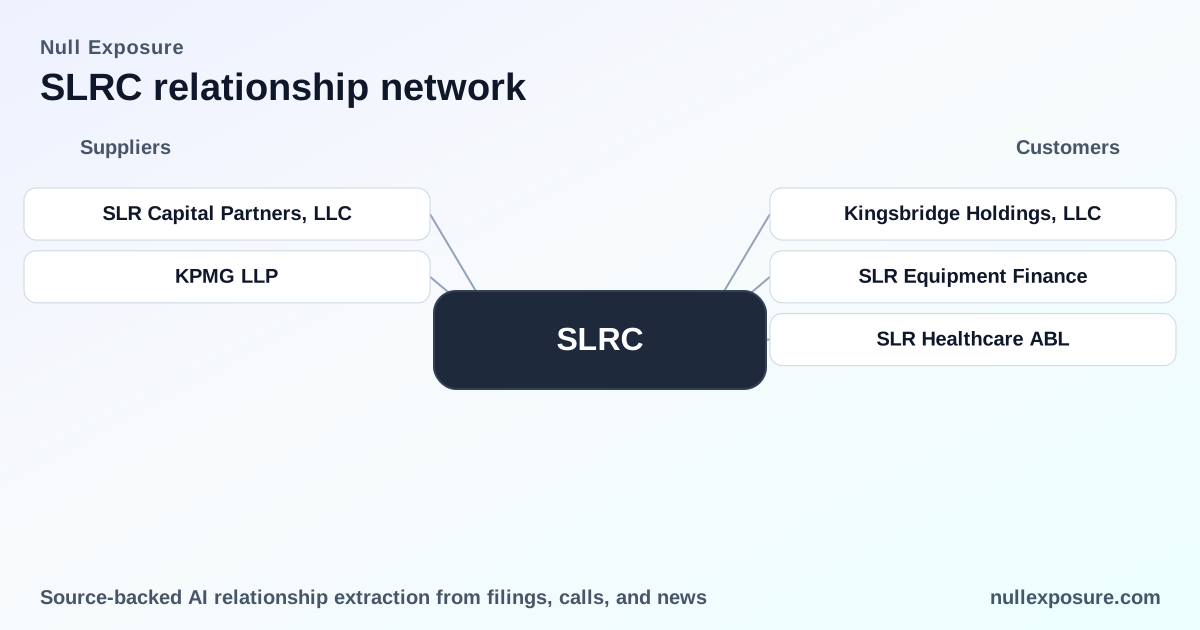
SLRC: Supplier Relationships That Drive a BDC’s Operating Economics
SLR Investment Corp (Nasdaq: SLRC) is a publicly traded business development company that earns returns primarily from yield on secured and subordinated loans, minority equity stakes and fee income tied to its investment adviser. The company monetizes through interest and fee income from its portfolio of mid-market lending positions and by paying management and incentive fees to an external adviser while retaining net investment income for shareholders. For due-diligence on counterparty exposure and supplier concentration, investors should review how the adviser, administrator and auditor relationships shape governance, cost structure and operational resilience. Learn more about the methodology we use at Null Exposure: https://nullexposure.com/.
Operational model in one line
- Active lending portfolio managed externally: SLR outsources portfolio management and much of its back-office administration to SLR Capital Partners/SLR Capital Management while retaining a board oversight structure and paying performance-linked fees.
How SLRC monetizes
- Interest and fee income from secured first‑ and second‑lien loans, subordinated debt and selective equity investments.
- Net returns are a function of portfolio yield less advisor management/incentive fees and operating expenses; the adviser relationship therefore materially influences net economics.
Key supplier relationships and what they mean for investors
SLR Capital Partners, LLC — investment adviser and operating hub
- SLR Capital Partners is the firm that manages SLR Investment Corp’s public and private BDC strategies, private credit funds and separately managed accounts and serves as the investment adviser to SLRC. This relationship is the central operating dependency for sourcing deals, setting credit policy and directing portfolio construction (sources: PR Newswire FY2024; CityBiz FY2023).
- MarketScreener also notes the firm’s role and recent leadership hires within SLR Capital Partners that reinforce its operational control of the asset manager function (source: MarketScreener, reported March 2026).
KPMG LLP — independent registered public accounting firm
- Stockholders ratified KPMG LLP as the independent registered public accounting firm for the 2025 fiscal year, establishing the external audit oversight used in financial reporting and committee pre‑approval processes (source: Globe and Mail press release, FY2025).
What the supplier map implies about SLRC’s operating profile
Long-term contracting posture and financing horizon
- SLRC operates with long-dated credit facilities and financing commitments, with multiple facilities showing maturities in 2028–2029 and ratable amortization in final years; this indicates strategic capital structures that extend debt tenor and support sustained lending activity. The company discloses amendments and maturity schedules for its SPV Credit Facility and other facilities with effective dates through 2028–2029 (company filings; constraint excerpts).
Concentration and criticality of the adviser relationship
- The investment adviser is a material and central counterparty: SLRC pays management and incentive fees to SLR Capital Partners, reimburses it for administrative costs, and depends on its senior investment professionals for deal origination and portfolio oversight. Company disclosures state the loss of senior investment professionals could have a material adverse effect on achieving the investment objective, flagging meaningful key‑person risk (company disclosures cited in constraint excerpts).
Brand and contractual linkage to the adviser
- SLRC holds a royalty‑free, non‑exclusive license to use the marks “SOLAR” and “SLR” that is contingent on SLR Capital Partners or an affiliate remaining the investment adviser — this is an explicit legal tie that reinforces both naming rights and reputational linkage to the adviser (license agreement excerpt).
Service provision and administrative dependency
- Administration and office facilities are provided by SLR Capital Management, with the company reimbursing allocable overhead such as rent, technology and shared officer time; this integrates operational processes and reduces third‑party diversification in back‑office functions (administration agreement excerpt).
Portfolio segmentation as a supplier signal
- Public disclosures list investments across distribution, infrastructure, services and software verticals — for example, equipment financing for transportation infrastructure and senior secured loans to software companies — signaling a sector‑diversified lending strategy that nonetheless relies on specialized origination channels (segment excerpts).
Active relationship stage and breadth
- The firm reports an active investment program with typical positions ranging between $5 million and $100 million; this active posture implies ongoing, high-touch interactions with the adviser and counterparties, not a passive, static portfolio (company statement in constraint excerpts).
Risk and governance contours investors must weigh
- Key-person and adviser concentration are principal governance risks. Management and advisory fees, the license for the corporate name, and administrative services are all concentrated with SLR-affiliated entities; the filings explicitly warn loss of senior investment professionals would materially affect performance.
- Long-dated financing reduces refinancing frequency but increases dependency on credit markets over the medium term. Facilities maturing in 2028–2029 create predictable capital windows; investors should monitor covenant terms, margin spreads to SOFR and the company’s liquidity buffers.
- Audit independence controls are formalized. The audit committee pre‑approves audit and non‑audit work and ratified KPMG for FY2025, which preserves a standard external control but does not eliminate operational concentration risk in management.
Actionable takeaways for investors and operators
- For investors: stress-test net yield assumptions against advisor fee scenarios and potential key-person turnover, since adviser economics feed directly into distributable income and dividend coverage.
- For ops teams and counterparties: document continuity plans and contingency sourcing for administrative and IT services currently provided by SLR Capital Management to reduce single‑point‑of‑failure exposure.
- For credit analysts: track the maturity ladder of SLRC’s credit facilities and the SOFR spreads; the company’s facilities use SOFR plus defined margins and are important to funding cost and liquidity planning.
Mid‑article resource
- If you want a structured review of SLRC’s supplier relationships and how they affect credit and dividend durability, see our analytics hub: https://nullexposure.com/.
Bottom line
SLR Investment Corp runs an externally managed BDC model where the investment adviser and affiliated administrators are intrinsic to both portfolio performance and operational continuity. Long-term facilities and diversified sector exposures mitigate some refinancing and concentration risks, but key-person dependency and single-adviser economics are material and actionable considerations for investors evaluating SLRC’s supplier map.
Further reading and next steps
- Scrutinize recent filings for any staffing changes at SLR Capital Partners and updates on facility covenants ahead of the 2028–2029 maturities.
- Review the company’s audit committee disclosures and fee schedules to model net yield under alternative fee structures.
Final call to action
- To explore an in-depth supplier map and scenario stress tests for SLRC, visit our platform at https://nullexposure.com/ and request the SLRC supplier dossier.