Salarius Pharmaceuticals (SLRX) — supplier footprint, deal posture, and what it means for investors
Salarius Pharmaceuticals operates as a clinical‑stage biopharmaceutical company focused on oncology and peptide‑conjugate therapeutics. The company monetizes primarily through advancing early‑stage assets to value‑creating inflection points — licensing, strategic acquisitions, and collaborative research — while relying on capital markets and corporate actions for financing. Recent supplier and partner disclosures show an operating model built on asset acquisitions, outsourced preclinical research, and routine corporate services that support capital restructuring. For deeper supplier analytics, visit https://nullexposure.com/.
How these supplier relationships map to Salarius’s operating model
Salarius runs a classic early‑stage biotech supplier architecture: project‑based scientific partnerships for R&D, targeted asset acquisitions to build the pipeline, and external corporate services for governance and capital transactions. The mix signals a company that prioritizes rapid asset accumulation and externalized development rather than owning large internal manufacturing or clinical infrastructure.
- Contracting posture: short‑term, project and milestone‑driven agreements dominate — acquisitions and research collaborations rather than long, fixed‑price supplier contracts.
- Concentration and criticality: the science partners are highly critical to preclinical progress but are non‑exclusive and transactional in nature; corporate service suppliers (transfer/exchange agents) are critical for shareholder actions but not for product development.
- Maturity: relationships reflect an organization in precommercial phase where external relationships are tactical enablers of pipeline advancement, not long‑term operational dependencies.
There are no explicit contractual constraints disclosed in the supplier data feed, which itself is a company‑level signal: Salarius has not reported supplier constraints that would materially alter its contracting flexibility. That absence suggests the company retains bargaining flexibility with scientific vendors and service providers while relying on capital markets for funding.
Supplier roll call — the relationships you need to know
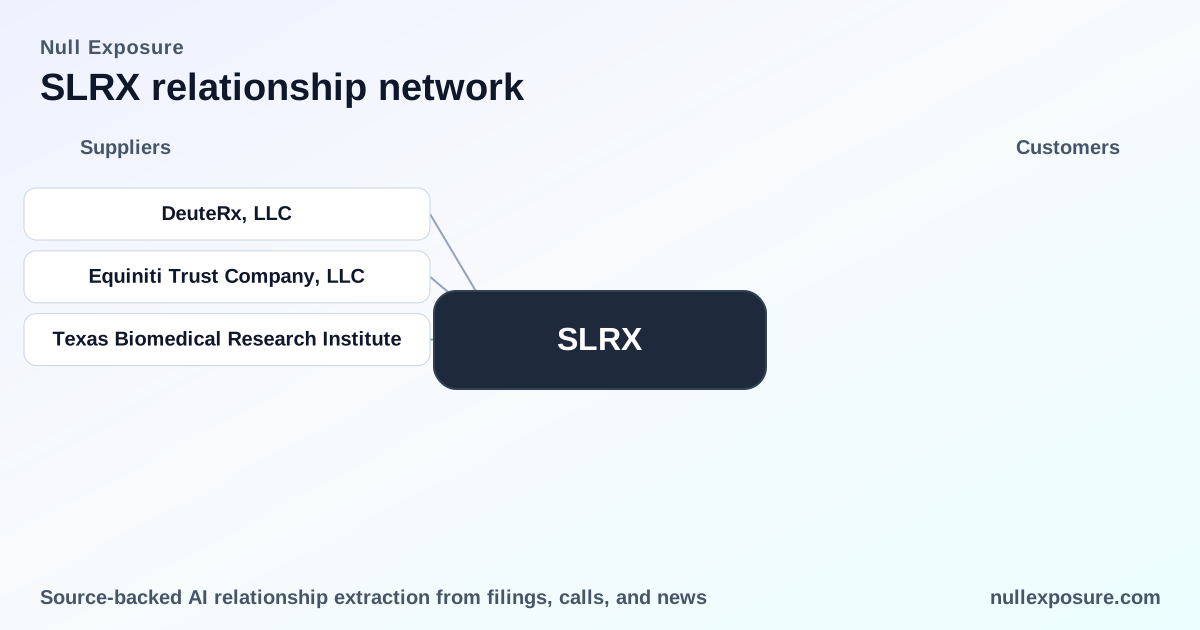
Below I cover every supplier/partner mention in the record, with concise takeaways and source notes.
DeuteRx, LLC
Salarius announced a definitive agreement to acquire an oral, small‑molecule targeted protein degradation portfolio from DeuteRx, enhancing its small‑molecule oncology capabilities and expanding potential clinical candidates. This transaction was disclosed in a company release filed on the SEC site for FY2022. (SEC press release, FY2022 — salariusdeuterxdealpressre.htm)
Equiniti Trust Company, LLC
Equiniti acted as the exchange agent and transfer agent for Salarius’s 1‑for‑15 reverse stock split, a corporate action tied to capital structure and market compliance. The role of Equiniti is procedural but signals active balance‑sheet and shareholder remediation efforts around FY2025. (GlobeNewswire press release, Aug 14, 2025)
Texas Biomedical Research Institute
Decoy Therapeutics, a preclinical Salarius subsidiary, entered a collaboration with Texas Biomedical Research Institute to conduct in‑vitro testing of Decoy’s peptide conjugate fusion inhibitors against multiple influenza strains including H5N1, supporting antiviral R&D breadth outside core oncology work. This collaboration was announced in press releases on Dec 1, 2025 by both GlobeNewswire and Sahm Capital. (GlobeNewswire and Sahm Capital releases, Dec 1, 2025)
Why these partnerships matter for valuation and execution
Each relationship reinforces a distinct strategic vector for Salarius:
- Acquisition‑driven pipeline growth (DeuteRx) accelerates asset diversification and can create near‑term upside if the acquired candidates show preclinical promise; however, acquisitions increase integration risk and require capital to advance candidates.
- Outsourced preclinical testing (Texas Biomed) provides scientific validation and accelerates lead optimization without large fixed overhead, reducing cash burn volatility but increasing dependence on third‑party lab schedules and results.
- Corporate services for capital actions (Equiniti) are low‑tech but high‑signal: engagement of an exchange/transfer agent for a reverse split indicates active balance‑sheet management and shareholder base restructuring.
Major takeaway: Salarius is executing a lean R&D model that leverages targeted M&A and external scientific partnerships to extend its pipeline while managing limited internal infrastructure. That model compresses fixed cost but places execution risk squarely in external collaborators and in the success of integration efforts.
Risk profile driven by supplier posture
The supplier footprint implies several investor‑relevant risks:
- Execution concentration risk: progress depends on discrete partners for testing and on integration of acquired assets; negative data or missed milestones at a partner lab would have outsized effects.
- Capital and liquidity signals: corporate actions such as a reverse split, supported by Equiniti, point to capital constraints and shareholder base management — typical for precommercial biopharma but relevant for dilution and financing timelines.
- Operational flexibility vs. transparency: the lack of long‑term supplier constraints provides contracting agility but limits visibility into negotiated exclusivities or priority access to critical testing resources.
These are not theoretical; they align directly with the relationships disclosed above. Investors should treat scientific collaborations as binary catalysts that drive valuation inflections, while corporate‑services relationships are indicators of balance‑sheet posture.
For actionable supplier analytics and comparative supplier risk scoring, visit https://nullexposure.com/.
What to monitor next
For investors evaluating SLRX supplier risk and upside, watch these items closely:
- Integration milestones and candidate status from the DeuteRx portfolio — any publicized nonclinical readouts or IND‑enabling progress will be value drivers.
- Results timelines and progress reports from the Texas Biomed collaboration, particularly any in‑vitro efficacy or breadth findings against influenza strains that could expand Decoy’s strategic optionality.
- Corporate actions and financing updates around capital structure adjustments; further engagements with transfer agents or exchange agents will signal ongoing shareholder restructuring.
Catalysts to watch: DeuteRx integration milestones, Decoy/Texas Biomed experimental outcomes, and any financing or licensing announcements tied to these relationships.
Final read — how relationships affect the investment case
Salarius’s supplier record paints a coherent strategic picture: an asset‑acquisition and partnership‑centric biotech that minimizes fixed costs and accelerates pipeline breadth, but with concentrated execution risk tied to a small number of discrete external partners and the company’s access to capital. Investors should value SLRX on scenario outcomes for the DeuteRx portfolio and Decoy Therapeutics collaborations, while treating corporate‑services disclosures like the Equiniti engagement as supporting evidence of financial housekeeping and market positioning.
If you want a structured supplier risk brief or to benchmark SLRX relationships against peer biotech suppliers, review our platform at https://nullexposure.com/ — it’s designed for investors and operators who need supplier intelligence integrated into valuation and diligence workflows.
For diligence updates or a supplier‑focused investor memo on SLRX, start with the homepage and contact our team through https://nullexposure.com/.