SELLAS (SLS) — Supplier map, concentration risks, and what investors should know
SELLAS Life Sciences is a clinical-stage oncology company that monetizes by in‑licensing academic immunotherapy programs and advancing them through clinical development toward commercialization, relying on third‑party manufacturers and clinical networks to execute trials. The company’s economics depend on successful pivotal readouts for GPS (a WT1‑targeting peptide vaccine) and SLS009 (a selective CDK9 inhibitor), combined with the ability to scale manufacturing under exclusive license terms. For a quick supplier-risk snapshot, visit https://nullexposure.com/.
H2: How SELLAS runs the engine — a concise operating thesis SELLAS operates as a license-driven biopharma: it acquires rights to academic and third‑party intellectual property, funds clinical development, and outsources manufacturing and trial execution. The business model concentrates value in a small number of programs and a small number of external suppliers, which compresses overhead but increases execution and counterparty risk. Contract posture is predominantly exclusive licensing and third‑party manufacturing under cGMP; supplier relationships are operationally critical and, in several instances, single-sourced. This structure accelerates time-to-trial at the expense of vendor concentration.
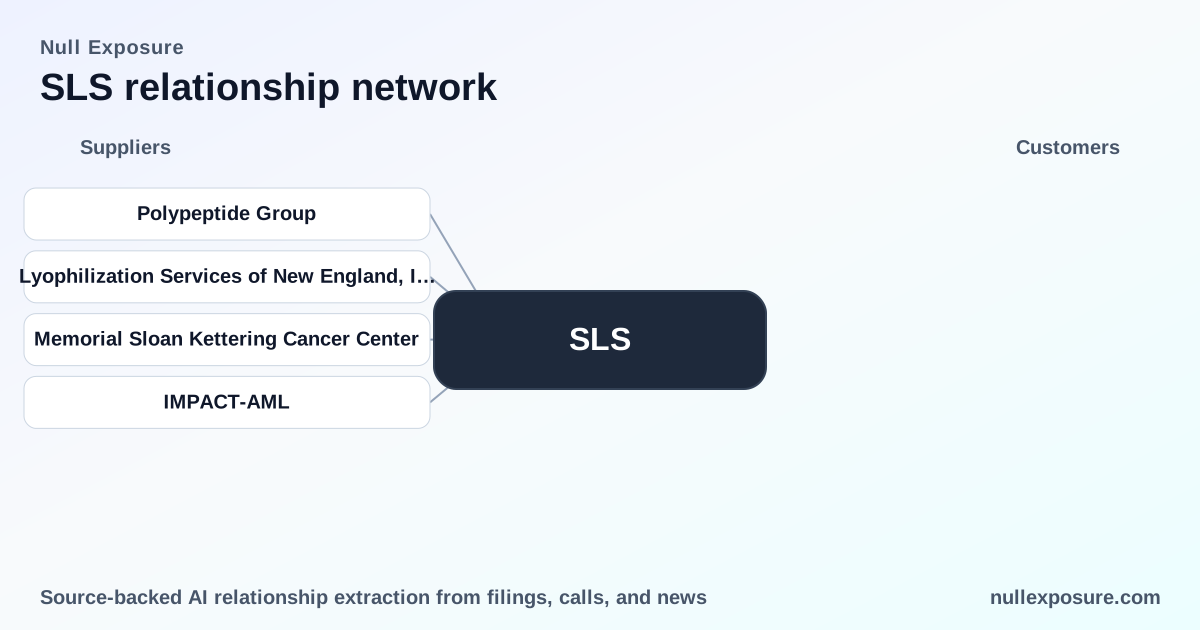
H2: Key supplier relationships that shape near-term value Below I cover every supplier and partner flagged in public filings and press releases. Each entry is a plain-English summary with a source.
H3: Polypeptide Group — sole CMO for GPS drug substance peptides SELLAS identifies Polypeptide Group as its sole contract manufacturing organization for GPS drug substance peptides, which makes Polypeptide a single-source supplier for the active peptide material in GPS. This concentration creates operational dependency for clinical supply and future commercial scale-up. According to SELLAS’ Form 10‑K for the year ended December 31, 2024, “Our sole CMO for GPS drug substance peptides is Polypeptide Group.” (SELLAS 2024 Form 10‑K)
H3: Lyophilization Services of New England, Inc. (PCI Pharma Services) — sole CMO for GPS drug product SELLAS names Lyophilization Services of New England (operating under PCI Pharma Services) as its sole CMO for GPS drug product, meaning final drug product manufacturing and lyophilization are single‑sourced. This creates a supply chain chokepoint that is critical for dosing schedules and regulatory filings. The 2024 Form 10‑K states, “Our sole CMO for GPS drug product is Lyophilization Services of New England, Inc. (PCI Pharma Services).” (SELLAS 2024 Form 10‑K)
H3: Memorial Sloan Kettering Cancer Center (MSK) — licensor of GPS WT1 technology GPS is licensed from Memorial Sloan Kettering Cancer Center; MSK is the originating academic licensor of the WT1 peptide vaccine technology, which underpins SELLAS’ lead asset. Multiple company releases reiterate this IP relationship in updates around the REGAL Phase 3 program and SLS009 development. A GlobeNewswire release in December 2025 and follow‑on announcements in January 2026 note that “SELLAS’ lead product candidate, GPS, is licensed from Memorial Sloan Kettering Cancer Center.” (GlobeNewswire, Dec 29, 2025; Jan 14, 2026)
H3: IMPACT‑AML — European clinical network partner for SLS009 SELLAS entered an agreement with the IMPACT‑AML network to expand SLS009 clinical studies into Europe, enabling access to multiple clinical sites and patients across the region, which supports enrollment and regulatory footprint for the SLS009 program. The agreement was announced in January 2026. (GlobeNewswire, Jan 14, 2026)
H2: What these relationships mean for investors — concentration, criticality, and readiness The supplier map highlights four structural realities that drive investment outcomes.
- Single‑source manufacturing for GPS: Both the peptide substance and the lyophilized drug product are contracted to sole CMOs (Polypeptide Group and Lyophilization Services of New England/PCI). That creates high operational leverage — any manufacturing disruption directly threatens trial timelines and regulatory submissions.
- IP dependency on academic licensor(s): GPS is licensed from MSK, and SELLAS has other in‑licensing history (including GenFleet per corporate disclosures). Intellectual property control is a critical asset and a gating factor for commercialization and any downstream partnering or royalties.
- Clinical expansion through external networks: The IMPACT‑AML agreement demonstrates SELLAS’ reliance on specialized clinical networks to access EMEA patients and sites, which is necessary for geographic expansion but introduces multi‑jurisdictional operational complexity.
- Outsourced, cGMP‑dependent manufacturing posture: SELLAS explicitly relies on third parties to produce clinical/commercial quantities under cGMP; this is a typical biotech model but elevates outsourced quality control and regulatory inspection risk.
For a more detailed supplier due diligence framework and counterparty scoring, see https://nullexposure.com/.
H2: Constraints and company-level signals that affect counterparty risk Public filings provide direct excerpts that flesh out contract types and geographic scope:
- Licensing is central: SELLAS’ corporate history includes an exclusive MSK license signed in 2014 and an exclusive GenFleet license executed March 31, 2022, positioning the company as a licensee of third‑party IP. These are explicit contractual foundations of the business (SELLAS 2024 Form 10‑K).
- Geographic supplier reliance in EMEA: The company notes reliance on suppliers in the EU, which aligns with its use of European clinical networks like IMPACT‑AML for trial expansion and creates cross‑border supply and regulatory dependencies.
- Manufacturing is outsourced and regulated: SELLAS states it will continue to rely on third parties for clinical and commercial production in compliance with cGMP, a company-level signal that manufacturing quality and qualification are persistent risk areas.
H2: Investment implications and risk-reward calculus SELLAS’ model yields asymmetric outcomes: positive pivotal data or successful commercialization would unlock licensing revenues and potentially premium partner interest, while manufacturing or IP disruptions would sharply compress value because a small number of suppliers and licensors hold operational control. Key investor checkpoints are trial milestones for GPS/SLS009, evidence of manufacturing scale-up or diversification, and any amendments to MSK or GenFleet license terms.
- Focus on near-term catalysts: REGAL Phase 3 readouts and SLS009 enrollment via IMPACT‑AML.
- Monitor supplier diversification: any moves to qualify secondary CMOs would meaningfully de‑risk timelines.
- Watch licensing and royalty clauses: changes to exclusivity or sublicensing rights materially affect valuation.
If you’re mapping counterparty exposure for portfolio stress tests or operational due diligence, use the supplier list above as the baseline and track public filings for any additions or alternative CMOs.
For an investor-grade supplier intelligence toolkit, visit https://nullexposure.com/ to get started.
H2: Bottom line SELLAS is a license-heavy, outsourcing‑dependent biotech where a handful of external relationships materially determine execution risk and upside. Investors should treat manufacturing single-sourcing and licensor dependence as primary gating factors for near-term valuation changes, while clinical partnerships like IMPACT‑AML are the vector for geographic expansion. Monitor manufacturing qualifications, MSK licensing terms, and trial timelines as the three highest‑impact data points for the stock.