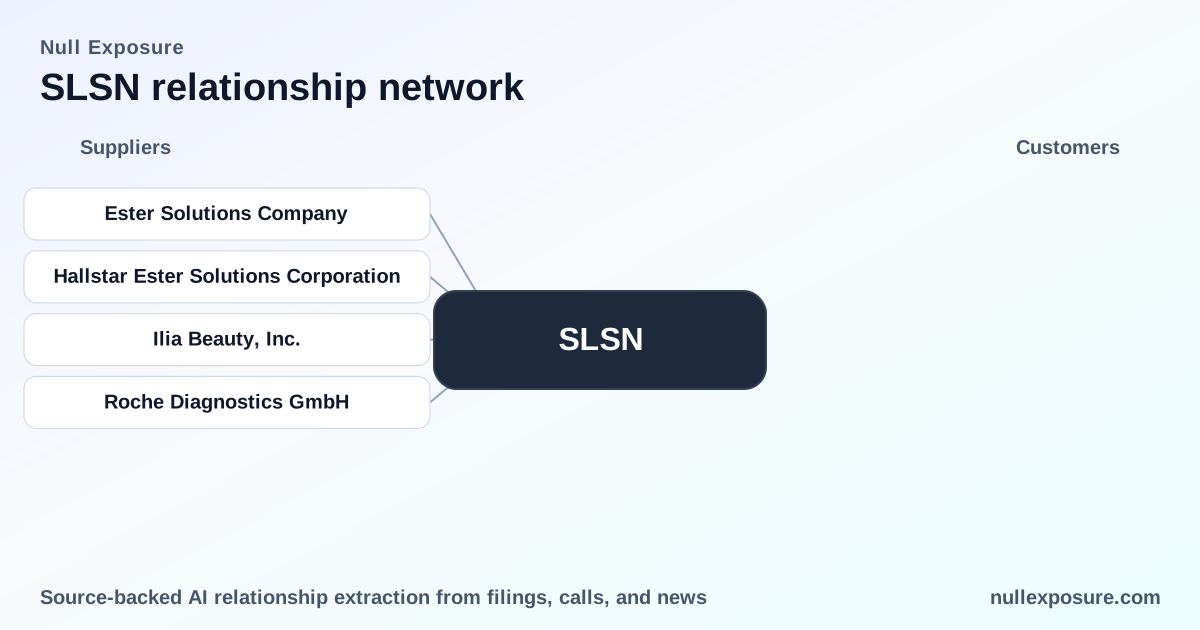
SLSN supplier map: how Solesence monetizes through long-term supply contracts and where the operational risks sit
Solesence (SLSN) manufactures and sells specialty materials and finished household/personal products, monetizing through product sales enabled by long-standing supply agreements and select exclusive customer deals. The company captures margin by integrating proprietary chemistries into partner products and by locking in upstream supply through contractual relationships; those same contracts create both revenue visibility and supplier-concentration risk for investors evaluating the supply chain. For active diligence on supplier concentration and counterparty risk, review exposure details at https://nullexposure.com/.
Company snapshot that matters to supplier analysis Solesence is a science-driven consumer-products manufacturer headquartered in Illinois with ~$62.1M revenue (TTM) and a market capitalization near $67.0M. The business operates with thin but positive profit margins and a high insider ownership stake (over 73% insiders), indicating concentrated control that influences contracting posture and negotiation leverage with suppliers and customers. Financial metrics such as a trailing PE around 95 and a forward PE near 11.4 suggest market expectations for future earnings improvement, but supply constraints can materially affect execution.
A clear, actionable overview of supply counterparts Below I cover every supplier/customer relationship disclosed in the company’s FY2024 10‑K, with concise plain‑English takeaways and source citations.
Long-term manufacturing partner: Ester Solutions Company
Ester Solutions Company is listed in Solesence’s FY2024 10‑K under a Supply Agreement dated March 31, 2016, indicating a multi-year upstream relationship for materials or intermediates. According to the FY2024 10‑K filing, this agreement reflects a legacy supply arrangement that underpins production continuity. (Source: Solesence FY2024 10‑K)
Same supplier, corporate evolution: Hallstar Ester Solutions Corporation
An amendment recorded in the FY2024 10‑K shows a First Amendment dated May 21, 2018 referencing Hallstar Ester Solutions Corporation (formerly Ester Solutions Company), implying corporate rebranding or acquisition while preserving contractual terms. The presence of an amendment signals contract continuity and possible renegotiation of terms over time. (Source: Solesence FY2024 10‑K)
Commercial partner with exclusivity: Ilia Beauty, Inc.
Solesence has an Exclusive Supply Agreement effective April 1, 2021 with Ilia Beauty, Inc., establishing a dedicated revenue stream through an exclusive customer-supplier relationship. The FY2024 filing identifies this exclusivity as a deliberate commercial strategy to embed Solesence technology in a branded partner’s product line. (Source: Solesence FY2024 10‑K)
Industrial/diagnostics counterparty: Roche Diagnostics GmbH
The FY2024 10‑K records a First Amendment to a Supply Agreement originally entered November 19, 2014 with Roche Diagnostics GmbH, indicating a long-duration supplier or customer relationship in the diagnostics/industrial channel. Such a relationship suggests Solesence’s materials have applications beyond consumer products and that the company supports regulated customers with contractual obligations. (Source: Solesence FY2024 10‑K)
Mid-article strategic prompt: for a consolidated view of supplier contracts and risk scoring across counterparties, visit https://nullexposure.com/ for detailed exposure dashboards.
Interpreting these relationships: what investors and operators should extract The documented contracts reveal a contracting posture that mixes long-tenor supply agreements, an exclusive commercial deal, and ongoing amendments—a pattern consistent with a manufacturer that both buys critical inputs and supplies formulated materials to strategic customers. Key operational characteristics:
- Concentration and criticality: The company states that some raw materials and parts are sourced from single suppliers in China and Korea, a company-level signal that creates concentration risk and potential supply-chain vulnerability for production and revenue continuity. The FY2024 disclosures treat these inputs as critical to operations.
- Buyer posture and inventory policy: Solesence reports it typically maintains at least one month’s supply for single-sourced inputs and is actively pursuing additional suppliers. This signals a buyer posture with limited buffer—inventory provides some runway but not a full hedge against multi-month outages.
- Maturity of relationships: Contracts with counterparties date back to 2014–2016 with subsequent amendments and a 2021 exclusivity agreement, evidencing mature, stable relationships rather than ad hoc sourcing. That maturity supports revenue stability but locks in exposure to legacy suppliers.
- Active mitigation: The company explicitly states efforts to reduce the number of singularly sourced raw materials, which is an operational improvement trajectory rather than a completed fix. That positions the business to reduce concentration over time but does not eliminate near-term risk.
Risk and upside framed for investors
- Upside: The exclusivity with Ilia Beauty and long-term contracts with industrial customers like Roche provide visible topline channels and margin capture opportunities if production scales without interruption.
- Risk: Single-source dependence in APAC for critical inputs is the primary operational risk, compounded by a tight inventory buffer (one month). A sustained supply disruption from a China/Korea supplier would materially impact production and could compress margins or delay customer deliveries.
- Counterparty negotiation leverage: High insider ownership and modest institutional ownership suggest management-driven negotiations; counterparty power likely depends on how specialized the supplied materials are and whether alternative vendors exist.
Operational recommendations for diligence teams
- Prioritize supplier-site audits and alternate-sourcing feasibility studies for the APAC-sourced materials identified in the filing.
- Request contract-level details (pricing escalators, termination rights, minimum purchase commitments) for the Ester/Hallstar and Ilia agreements to quantify switching costs and revenue visibility.
- Model cash-flow sensitivity to a 30–90 day supply interruption given the stated one-month inventory buffer.
Closing view and next steps Solesence’s supplier relationships combine stability through long-tenor contracts and commercial exclusivity with operational vulnerability due to single-sourced materials from APAC suppliers. For investors and operators, the balance between predictable revenue from partner agreements and supply concentration risk defines the risk/return trade-off.
For deeper supplier-level scoring, remediation roadmaps, and to benchmark SLSN against peer supply chains, explore the full exposure suite at https://nullexposure.com/. If you want tailored supplier diligence or a briefing tailored to fund-level underwriting, start at https://nullexposure.com/ for concierge analysis and exposure reports.