Sylvamo (SLVM) supplier relationships: what operators and investors need to know
Sylvamo is a global paper producer that monetizes by manufacturing and selling high-margin printing and writing papers to commercial printers, distributors and corporate customers, while extracting operating leverage from integrated mills and selective proprietary product certifications. Revenue is driven by mill throughput, offtake agreements and differentiated product positioning (e.g., ColorLok certification); profitability depends on stable raw-material supply, contractual offtake terms and disciplined working-capital management.
If you evaluate supplier risk or counterparty exposure in industrial supply chains, this profile focuses on the supplier relationships and contractual constraints that matter for SLVM. For an integrated view of third-party risk mapping and supplier disclosures, visit https://nullexposure.com/.
Why suppliers matter for Sylvamo’s economics
Sylvamo’s business model is physical, concentrated and contract-driven. The company runs large, capital-intensive mills that require steady inbound raw materials and reliable third-party services (including cybersecurity and technical vendors) to keep paper lines running. Key operating characteristics: long-term contracting posture, material fixed-cost exposure, and active supplier monitoring — all of which directly affect margins, cash flow variability and balance-sheet leverage.
- Framework contracts and long-term offtakes lock in costs and volumes and therefore increase operational inflexibility when demand declines.
- Active supplier monitoring and cybersecurity clauses increase compliance costs but reduce tail operational risk.
- Certification exclusivity (product differentiation) provides pricing power but concentrates demand on a narrow product line.
Learn more about firm-level supplier signals and how they affect premium finance underwriting at https://nullexposure.com/.
What the disclosures and press coverage actually show
Sylvamo’s recent disclosures and media coverage reveal two specific supplier-related relationships and several company-level contractual constraints that shape operational exposure.
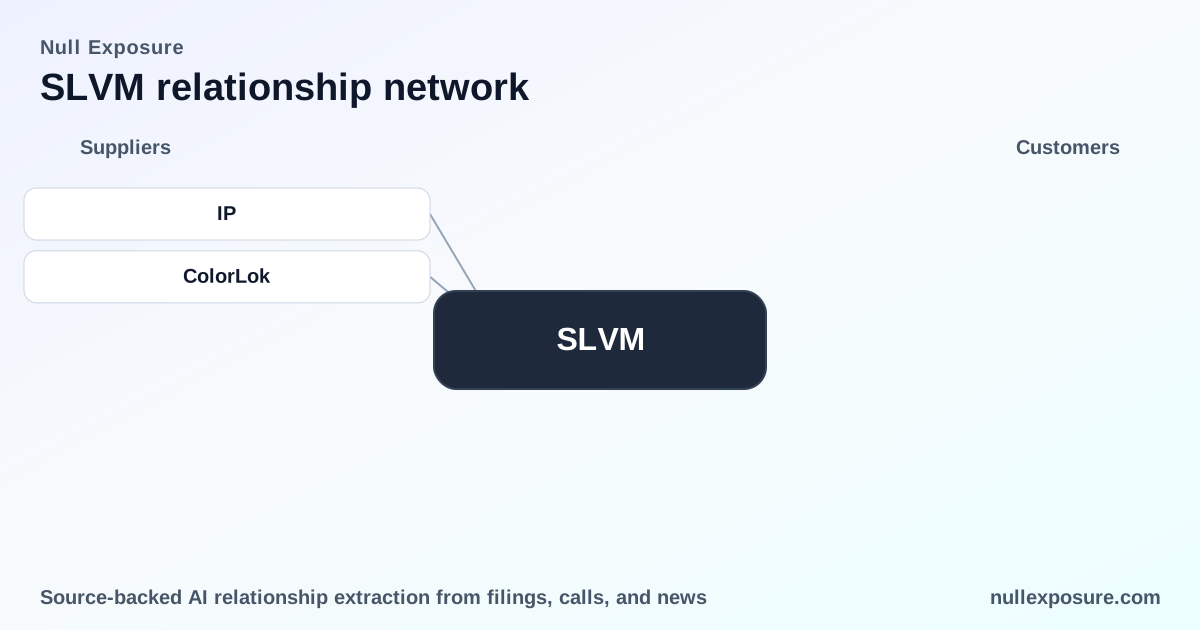
International Paper: transactional payable tied to Riverdale tons
Sylvamo directly referenced a payable to International Paper related to tons purchased from the Riverdale facility, linking inventory flows and payable settlements as drivers of quarterly working-capital swings. This was discussed on the Q4 2025 earnings call transcript published by InsiderMonkey on March 10, 2026. (InsiderMonkey earnings call transcript, March 2026 — https://www.insidermonkey.com/blog/sylvamo-corporation-nyseslvm-q4-2025-earnings-call-transcript-1695420/)
ColorLok: exclusive authorized producer for ColorLok-certified paper
Sylvamo announced it will serve as the sole authorized producer of paper certified under the ColorLok technology standard, a product-level exclusivity that supports premium positioning in the printing & office segment. The arrangement was reported by PrintWeek in an article covering the company’s FY2025 developments. (PrintWeek product news, reported March 2026 — https://www.printweek.com/content/product-news/sylvamo-to-become-exclusive-colorlok-certified-producer)
Company-level contractual constraints that shape supplier risk
Sylvamo’s public disclosures include clear clauses and operational constraints that investors and operators must factor into supplier relationship assessments. These are company-level signals; they are not attributed to any single counterparty unless explicitly named in the disclosure.
- Framework contracting posture: Sylvamo requires suppliers and service providers to adopt security-control principles based on NIST or equivalent standards and embeds these requirements into form contracts, signaling standardized vendor governance and elevated compliance expectations. The company discloses these provisions in its external filings and supplier governance language.
- Long-term fixed-cost offtakes: The firm has disclosed a Riverdale offtake agreement that carries fixed-cost obligations that continue regardless of order levels, with a stated non-termination window through January 1, 2026. This creates downside exposure to demand shocks and raises the importance of accurate demand forecasting and inventory management.
- Active third-party monitoring: Sylvamo states it maintains systems that continuously monitor third parties with access to its systems and encourages remediation while continuing oversight, which increases operational resilience but requires ongoing vendor-management spend.
- Services segmentation: The company uses third-party service providers for cybersecurity assessment, implementation and testing, signaling reliance on specialized external providers for critical non-core functions.
These constraints together describe a supplier governance model that is mature (formalized controls and monitoring), contractually rigid (long-term fixed-cost commitments), and centrally managed (standardized cybersecurity clauses).
Implications for investors and operators
- Counterparty exposure and working capital volatility: The International Paper payable tied to Riverdale tons illustrates how supplier transactions translate directly into cash-flow swings. Investors should stress-test working capital and cash-conversion cycles for scenarios where inventory accumulation or payable timing shifts.
- Concentration vs. differentiation trade-off: ColorLok exclusivity gives Sylvamo pricing leverage and product differentiation, but exclusivity also concentrates sales around a smaller set of product standards and partners. Evaluate customer diversification for ColorLok products and margin sustainability over price-sensitive demand cycles.
- Contractual inflexibility increases operational risk: The Riverdale offtake fixed-cost clause increases downside risk in weak demand environments; operational teams must prioritize demand-signal accuracy and flexible product routing where possible.
- Cybersecurity and vendor management as non-trivial costs: The disclosure of NIST-based supplier controls and continuous monitoring elevates compliance as an ongoing expense line that reduces idle capacity flexibility but lowers catastrophic operational-risk probability.
Practical checklist for relationship diligence
- Confirm whether Riverdale-related obligations are tied to a specific supplier in recent SEC filings and reconcile payable timing with inventory policies.
- Quantify the revenue and margin contribution from ColorLok-certified products and review renewal/termination provisions for the exclusivity.
- Review vendor contracts for cybersecurity deliverables, SLAs and cost-sharing for compliance remediation.
- Stress-test short-term liquidity under scenarios where fixed-cost offtakes remain and demand falls by 10–30%.
Final read: what to do next
For underwriters, operators and investors, the defensive posture is to treat Sylvamo as a capital-intensive manufacturer with contractual rigidity on its cost base and targeted product differentiation that both supports margins and concentrates risk. Prioritize working-capital dynamics, counterparty-payable timing, and the earnings sensitivity to mill utilization and product certification volumes.
Explore specialist analyses and supplier-mapping tools that place these disclosures into an actionable scorecard at https://nullexposure.com/.
If you need a deeper counterparty mapping or a bespoke supplier-risk memo for SLVM, start with the company filings and the earnings-call evidence cited above, and review our contractor-risk playbook at https://nullexposure.com/ for practical next steps.