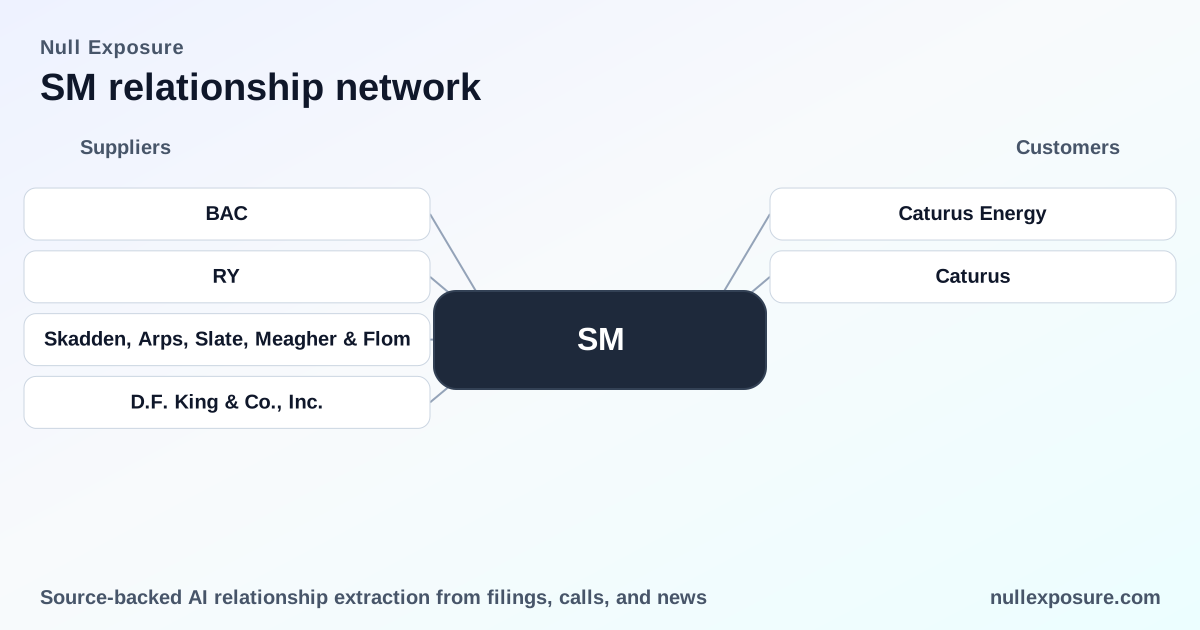
SM Energy: supplier map and what it means for investors and operators
SM Energy is an upstream E&P that monetizes production through commodity sales, strategic asset divestitures, and targeted liability management programs; it also hires external financial, legal, and information services to execute capital structure transactions. Revenue is generated from oil and gas production and optimized by selling non-core assets and managing debt via tender offers and auctions, while outsourced advisors and agents execute the market-facing steps. For investors assessing supplier relationships, the company’s counterparty footprint signals a conventional E&P contracting posture—heavy reliance on service providers for operations and specialist advisors for capital markets work.
Explore detailed supplier intelligence at https://nullexposure.com/.
How SM’s supplier posture shapes operational and financial risk
SM runs a dual contracting model: material long-term delivery commitments coexist with high-frequency short-term operational contracts. That hybrid creates predictable mid-term cashflow obligations while keeping operational flex exposed to spot service markets and execution cycles.
- Long-duration commitments: SM has contractual obligations to deliver substantial oil volumes and produced water into 2027–2028, indicating guaranteed off-take and disposal throughput that supports baseline revenue but also locks capacity commitments. (Company disclosures, year-end 2024)
- Short-term operations exposure: Drilling and completion work is largely contracted on terms under 12 months, concentrating execution risk in the short-term services market and making costs sensitive to cycle changes.
- Service-provider model: Drilling, completion and cybersecurity activities are outsourced to third-party contractors and specialist vendors, reflecting a low-asset, operator-with-contractors model that is typical of modern E&P players.
- Active derivatives and lender alignment: The company’s derivative counterparties sit inside its lender group, and commodity hedges are in place through Q1 2027, showing deliberate credit-side concentration for derivatives.
- Scale of spend: Costs rose to roughly $3.5 billion in 2024, which positions supplier spend well into the $100m+ band and makes supplier procurement and negotiation a material lever on margins.
These constraints are company-level signals of maturity and concentration: high absolute spend, service-provider reliance, and multi-year delivery commitments combine to make SM a counterparty that is both critical to major suppliers and vulnerable to operational-service disruptions.
What each named supplier relationship means in plain English
BofA Securities, Inc.
SM retained BofA Securities as dealer manager and solicitation agent for a cash tender offer related to Civitas Resources’ 8.375% notes due 2028, reflecting a tactical debt-management engagement to reduce interest burden and reshape maturities. According to a PR Newswire release dated March 10, 2026, BofA executed the dealer-manager role in the tender offer (PR Newswire, March 10, 2026 — https://www.prnewswire.com/news-releases/sm-energy-company-announces-cash-tender-offer-for-up-to-750-0-million-aggregate-principal-amount-of-8-375-senior-notes-due-2028-originally-issued-by-civitas-resources-302703888.html).
Takeaway: BofA is a transaction partner for capital structure optimization.
RBC Capital Markets
RBC Capital Markets is acting as SM’s exclusive financial adviser on asset divestitures and auctions intended to sharpen portfolio focus and reduce leverage, a role cited in multiple March 2026 coverage notes. Offshore-Technology and SimplyWall St reported that RBC is running an auction process tied to asset sales aimed at debt reduction and Permian concentration (Offshore-Technology, March 10, 2026 — https://www.offshore-technology.com/news/sm-energy-divest-galvan-ranch-assets-caturus/; SimplyWall St, March 10, 2026 — https://simplywall.st/stocks/us/energy/nyse-sm/sm-energy/news/a-look-at-sm-energy-sm-valuation-as-it-sells-eagle-ford-asse).
Takeaway: RBC is the strategic financial adviser steering the company’s divestiture program.
Skadden, Arps, Slate, Meagher & Flom
Skadden serves as legal counsel on the divestiture process and related transactions, supporting deal documentation, regulatory clearance and execution mechanics in the asset sale and auction processes. Offshore-Technology’s March 10, 2026 report confirms Skadden’s counsel role alongside RBC’s advisory mandate (Offshore-Technology, March 10, 2026 — https://www.offshore-technology.com/news/sm-energy-divest-galvan-ranch-assets-caturus/).
Takeaway: Skadden provides legal capacity for transaction execution and risk mitigation.
D.F. King & Co., Inc.
D.F. King is retained as information agent for SM’s tender offer process, handling investor communications and delivery mechanics for noteholders participating in the offer; the PR Newswire release describes D.F. King’s contact points for tender logistics (PR Newswire, March 10, 2026 — https://www.prnewswire.com/news-releases/sm-energy-company-announces-cash-tender-offer-for-up-to-750-0-million-aggregate-principal-amount-of-8-375-senior-notes-due-2028-originally-issued-by-civitas-resources-302703888.html).
Takeaway: D.F. King is the operational interface to bondholders for the tender offer.
Strategic implications for investors and operators
SM’s supplier mix reflects a transactional capital-markets layer plus an operational service layer. Financial advisers, legal counsel and information agents are engaged for discrete capital transactions, while contractors run the physical well-cycle and cybersecurity partners cover IT controls. Investors should track three priorities:
- Execution of the divestiture process: Successful auctions run by RBC will materially reduce leverage and re-shape asset concentration; legal and information-agent workflow speed (Skadden, D.F. King) will determine timing and market impact.
- Counterparty concentration in derivatives and lenders: Hedging counterparties inside the lender group reduce third-party credit dispersion but increase systemic credit linkage to the bank group through early 2027.
- Operational cost volatility: With a significant portion of costs contracted short-term and a $3.5 billion cost base in 2024, margin sensitivity to service pricing and drilling cadence is high.
For procurement and operations teams, the service-provider dependency is a risk and an opportunity: negotiating multi-year servicing frameworks for critical disposal and transport obligations (which the company is contractually committed to through 2028 for oil and 2027 for produced water) would reduce execution volatility.
If you want ongoing supplier intelligence and monitoring for SM or comparable E&P names, start here: https://nullexposure.com/.
Monitoring checklist and recommended next steps
- Monitor auction sale timelines and pricing updates from RBC; track any material prepayment or covenant relief tied to tender outcomes.
- Watch cost-of-services trends in quarterly reports—short-term contracting means near-term cost moves will show up quickly.
- Validate counterparty credit exposure on derivative counterparties and lender-group alignment ahead of Q1 2027 hedge expirations.
- Ensure vendor cybersecurity assessments for critical third-party IT and data services are documented given the company’s reliance on external security consultants.
Bottom line: where risk and opportunity line up
SM’s supplier relationships are conventional for an E&P executing portfolio simplification and liability management: specialist financial and legal partners run capital markets activity while independent contractors and agents execute operations and investor communications. The company’s long-term delivery commitments provide cashflow anchors, but short-term service contracts and a large cost base leave margins sensitive to cycle changes. Investors should prioritize outcomes from the RBC-run divestiture and the BofA-led tender mechanics as the next major value catalysts. For deeper counterparty maps and ongoing updates, visit https://nullexposure.com/.