SmartStop Self Storage (SMA) — supplier relationships that move capital and operations
SmartStop Self Storage REIT (SMA) operates as an owner-operator and developer of self‑storage assets, monetizing through rental income, occupancy-driven fees and strategic capital markets activity (preferred equity and debt). Its supplier and capital relationships reveal a hybrid operating model: capital partners and creditors provide liquidity and structural leverage, while a named administrative services provider handles recurring operations for modest but recurrent fees. For investors, that combination implies concentrated financing risk balanced against a steady operating expense profile. Learn more about relational risk analytics at https://nullexposure.com/.
Why the counterparties matter to returns
SMA’s listed relationships split into two functional buckets: capital providers (preferred stock commitments and credit facilities) and operational vendors / local partners (marketing and land development counterparts). The capital links determine funding flexibility and refinancing risk; the operational links drive execution and cost variability. The filings and press coverage summarized below give a concise map of who SMA leans on and how that reliance shows up in the numbers.
Long-term financing anchors the balance sheet
The company discloses long-dated liabilities and renewable credit arrangements that create predictable but material contractual cash requirements. The 10‑K highlights senior notes and an amended revolving credit facility that set the contours for near- and medium-term liquidity management. These arrangements are central to assessing leverage, covenant exposure and refinancing calendars.
What each counterparty actually is (and why it matters)
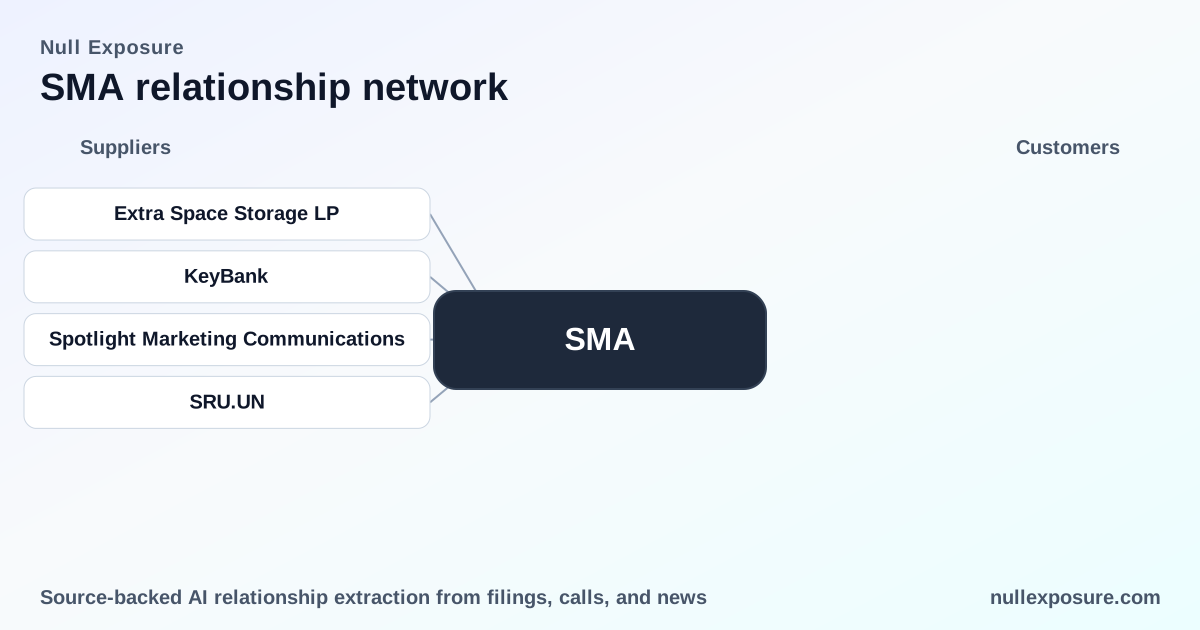
- Extra Space Storage LP — On October 29, 2019 SMA entered a preferred stock purchase agreement where Extra Space Storage LP committed to purchase up to $200 million of newly created Series A Convertible Preferred Stock, signaling a significant strategic capital commitment. According to SMA’s FY2024 10‑K filing, the commitment remains recorded as a formal agreement (sma-2024-12-31).
- KeyBank — SMA executed an amended and restated revolving credit facility with KeyBank on February 22, 2024, which serves as its primary short‑term liquidity and working capital backstop. This is disclosed in the company’s FY2024 10‑K (sma-2024-12-31).
- Spotlight Marketing Communications — Spotlight is listed as the media relations contact in SMA press materials, indicating an external PR supplier used for investor and public communications; the contact info appears in a January 6, 2026 press release/coverage (BizWire / Markets FinancialContent, first seen March 10, 2026).
- SmartCentres REIT — Market coverage shows SmartStop buying land for a Class A self‑storage development with SmartCentres REIT, reflecting local real‑estate partnership or land-seller activity that supports SMA’s development pipeline (MarketScreener reporting, noted March 10, 2026).
Contracting posture, concentration and criticality — what the constraints tell us
The company-level signals in SMA’s disclosures produce several clear operating-model characteristics:
- Long-term contractual posture. SMA demonstrates long-dated obligations—evidence includes issued senior notes due in 2032 and agreements with initial multi‑year terms and automatic renewals—indicating a preference for extended tenor in financing and supplier commitments. This structure reduces short‑term rollover risk but amplifies exposure to longer-term market rate shifts.
- Materiality skewed to financing obligations. The 10‑K explicitly identifies debt obligations as the primary material cash requirement, which places capital-market and interest-rate risk at the center of SMA’s liquidity profile.
- Managed operational outsourcing at modest scale. SMA reports recurring administrative service fees and reimbursements (approximately $0.8 million for the year ended December 31, 2024), which positions external administrative support as necessary but non‑disruptive to total spend (spend band in disclosures implies $100k–$1M annually).
- Service-provider relationship in practice. The company’s administrative arrangement—referenced as SAM in filings—receives monthly administrative fees and reimbursements; these are line-itemized under Managed REIT Platform expenses and represent a predictable operating outflow rather than a variable pass-through. (Evidence drawn from SMA FY2024 10‑K excerpts.)
Financial and operational risks to monitor
- Refinancing and covenant risk. With long-term notes and a revolving facility in place, liquidity shocks or widening spreads could compress free cash flow or trigger covenant remediation — this is the dominant financial risk highlighted by SMA’s own disclosures.
- Counterparty concentration on capital. A single large preferred purchase commitment from Extra Space Storage LP (up to $200 million originally) and bank-led credit facilities concentrate funding relationships; investors should quantify counterparty credit strength and contractual triggers.
- Low-cost operational dependency. Third-party administrative fees are small in absolute terms (~$0.8M annually), but the arrangement is functionally critical—operational continuity relies on that provider’s performance. Operational disruptions would be manageable but visible to results.
If you want a deeper counterparty risk scorecard or covenant timeline for SMA, visit https://nullexposure.com/ for model-driven analysis and reporting.
Practical investor takeaways
- Capital structure drives risk and return. SMA’s supplier relationships are dominated by financing counterparties; performance analysis should prioritize debt maturities, interest‑rate exposure and any convertibility terms from preferred commitments.
- Operational supplier spend is modest but essential. Administrative services are a stable, predictable cost center; monitor vendor remedies and SLAs in future filings to assess operational resilience.
- Local partnerships support growth. Transactions with local real-estate partners such as SmartCentres REIT point to an active development pipeline that can boost returns if executed in disciplined markets.
For portfolio teams evaluating SMA as a holding or counterparty, focus first on the debt maturity ladder and any embedded conversion features in preferred instruments, then layer in operational continuity checks. Our platform can integrate these elements into a concise counterparty profile — learn more at https://nullexposure.com/.
Closing assessment
SMA presents a classic REIT profile where capital relationships determine solvency leverage and operational suppliers deliver predictable, low‑volatility spend. The company’s disclosures reveal long-term financing commitments and a modest, repeatable administrative cost base; together these dynamics define where value is created and risk concentrated. For investors, the essential questions are creditor strength, the calendar of maturities and the execution risk of development partnerships — those factors will determine whether SMA’s supplier mix is a stabilizing force or a levered vulnerability.