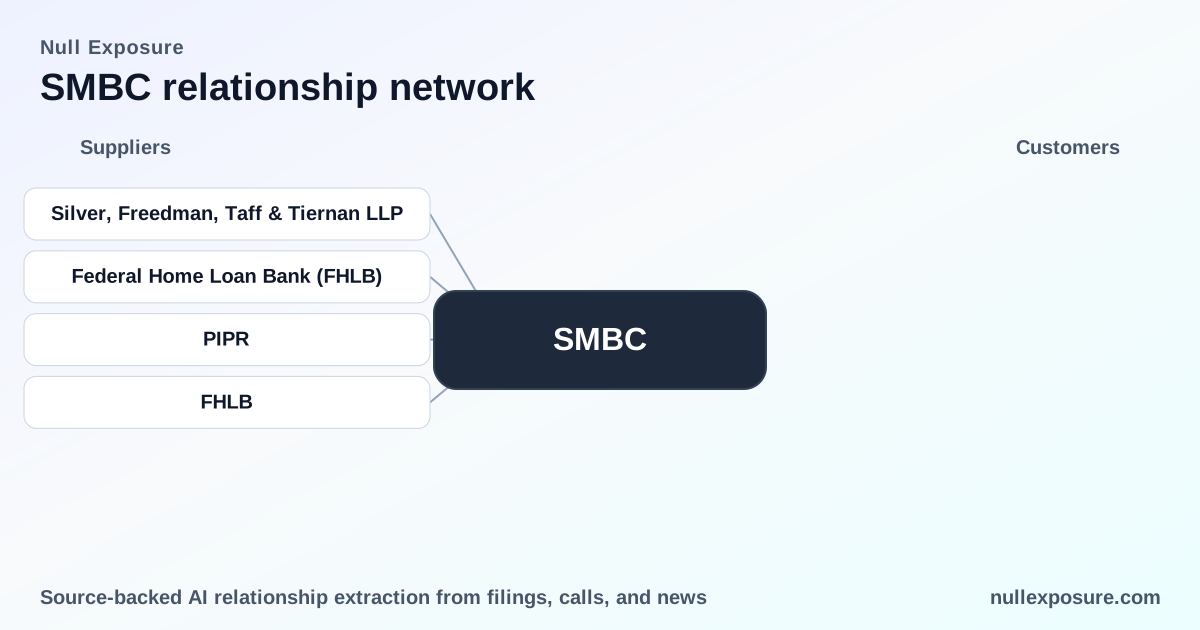
Southern Missouri Bancorp (SMBC): supplier map and capital relationships investors should track
Southern Missouri Bancorp is a regional bank holding company that monetizes through traditional banking economics: deposit gathering, loan origination and net interest margin, complemented by fee income and measured M&A-driven growth. Its recent activity shows a deliberate funding posture — steady use of Federal Home Loan Bank advances, occasional securities repurchase activity and outside advisors on completed mergers — which collectively shape funding cost, liquidity flexibility and deal execution capacity. For a concise supplier risk map and ongoing monitoring tools, visit https://nullexposure.com/.
Why supplier relationships matter for a community bank like SMBC
SMBC’s supplier stack is not populated with technology giants; it is composed of capital counterparties, legal and financial advisors, and standard lease obligations. For investors, the relevance is straightforward: capital counterparties determine liquidity and margin pressure; advisors and legal counsel influence M&A execution and regulatory readiness; lease and repo commitments set a floor on fixed obligations. These relationships are signals for funding concentration, contractual duration and operational maturity — all input variables for a valuation or risk review.
For additional context on counterparties and supplier-level exposure, see https://nullexposure.com/.
Relationship-by-relationship readout: who does SMBC work with and why it matters
Silver, Freedman, Taff & Tiernan LLP — legal adviser on recent mergers
Silver, Freedman, Taff & Tiernan acted as legal counsel to Southern Missouri for M&A closings reported in FY2022 and FY2023, supporting the company’s integration of target banks. According to GlobeNewswire press releases announcing the Fortune Financial (Feb 25, 2022) and Citizens Bancshares (Jan 20, 2023) mergers, the firm served as Southern Missouri’s legal advisor during those transactions. (GlobeNewswire, Feb 25, 2022; GlobeNewswire, Jan 20, 2023)
Piper Sandler — financial adviser for a merger
Piper Sandler served as financial advisor to Southern Missouri in the Citizens Bancshares transaction completed in FY2023, providing deal advisory and valuation support. This relationship is documented in Southern Missouri’s Jan 20, 2023 press release announcing the completion of that merger. (GlobeNewswire, Jan 20, 2023)
Federal Home Loan Bank (FHLB) — ongoing funding counterparty
FHLB advances are a meaningful and active funding line for SMBC: advances totaled $102.0 million at December 31, 2025, down slightly from mid‑2025 as maturing advances were not renewed, indicating active management of wholesale funding. Southern Missouri’s preliminary fiscal 2026 disclosures cite the $102.0 million FHLB balance and note the company’s use of fixed‑rate long‑term advances as part of its asset/liability strategy. (GlobeNewswire, Jan 21, 2026; Yahoo/Finance coverage, Jan 2026)
What the contractual signals tell investors about SMBC’s operating model
SMBC’s provider and funding footprint deliver several actionable company-level signals:
-
Contracting posture: a mix of long-term and short-term funding options. The company reports fixed-rate, long‑term FHLB advances outstanding as of June 30, 2025 and retains access to short-term facilities such as the Federal Reserve discount window (approved capacity noted, no outstanding balance as of June 30, 2025). These arrangements show deliberate layering of term in the funding book to manage interest-rate and liquidity risk. (FY2025 reporting excerpts)
-
Concentration and criticality: funding relationships are concentrated but standard. FHLB advances represent the primary identifiable wholesale counterparty in public disclosures; that concentration is typical for community banks but is material to liquidity planning given the size of advances relative to the balance sheet. (FY2025–FY2026 reporting)
-
Maturity and spend scale: evidence of multi-year commitments and mid-range repo usage. The company discloses long-term leased properties and office equipment leases (terms exceeding 12 months) and repurchase agreements totaling roughly $15.0 million as of June 30, 2025 — fixed-cost obligations that reduce flexibility and set minimum funding needs. (FY2025 reporting)
-
Relationship stage: active and operational. FHLB advances were explicitly reported as outstanding into FY2026, indicating an active, ongoing counterparty relationship rather than a one-off facility. (FY2026 preliminary results)
These signals frame the bank’s capital behavior: reliance on deposits first, supplemented by structured long-term advances when growth or asset/liability needs require it, and maintenance of short-term liquidity backstops.
Investment implications and risk checklist
-
Funding concentration risk: The presence of >$100 million in FHLB advances is material for a bank of SMBC’s scale; investors should model scenarios where roll‑forwards of these advances are constrained or repriced. (FHLB disclosures, FY2025–FY2026)
-
Execution and M&A support: Use of external legal and financial advisors (Silver, Freedman, Taff & Tiernan; Piper Sandler) signals an active M&A strategy that has cost and integration risk but also pipeline value if management continues to execute. (GlobeNewswire, 2022–2023)
-
Fixed obligations: Lease portfolios and repurchase agreements create a predictable cash drain that should be considered when stress-testing margins or dividend sustainability. (FY2025 lease and repo disclosures)
-
Operational maturity: The mix of long-term fixed-rate advances and retained short-term access to discount window facilities demonstrates maturity in funding strategy, reducing the likelihood of reactive, high-cost emergency borrowing.
For a deeper supplier-specific risk matrix and monitoring workflow, visit https://nullexposure.com/.
Bottom line — how these relationships affect the valuation frame
Southern Missouri Bancorp runs a classic regional banking model with disciplined deposit preference, strategic use of FHLB term advances, and transactional use of outside advisors to execute inorganic growth. That combination reduces tactical funding volatility relative to banks that lean on overnight wholesale funding, while concentrating risk in a small number of counterparties and fixed contractual obligations. For investors focusing on funding repricing, liquidity resilience and M&A execution upside, tracking disclosed FHLB advance balances and announced advisor engagements is high‑value surveillance.
If you want an actionable supplier risk dashboard or ongoing alerts for SMBC counterparties, explore offerings and research at https://nullexposure.com/.