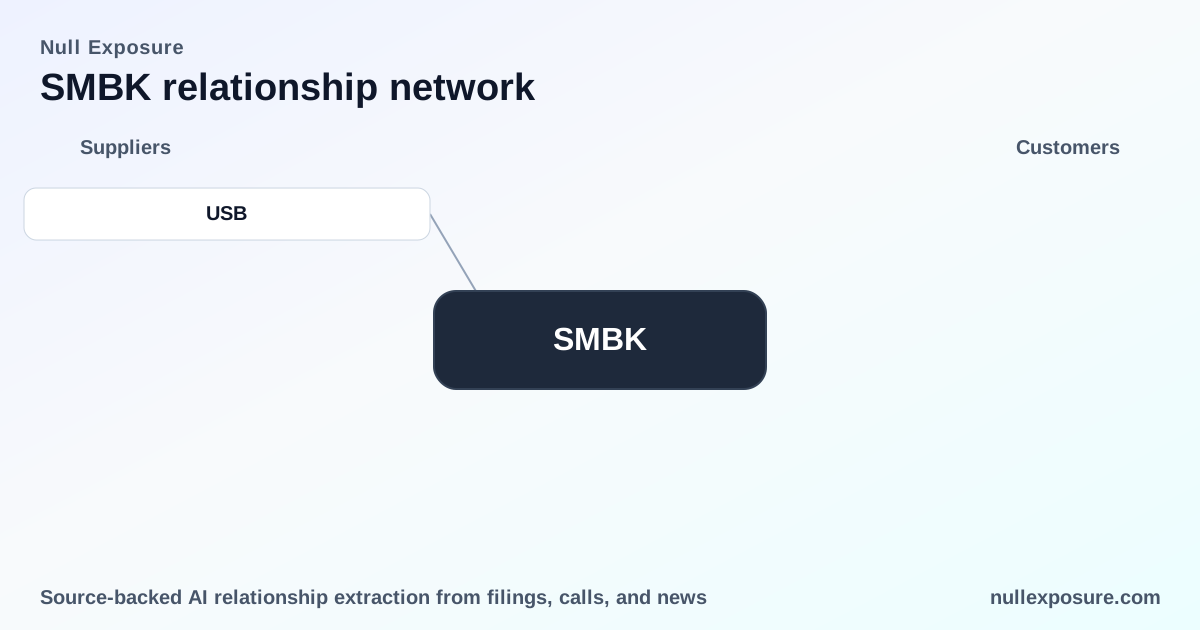
SmartFinancial (SMBK): supplier landscape and implications for investors
SmartFinancial (SmartBank) operates as a regional bank holding company that earns returns primarily through net interest margin on loans and investment securities, supplemented by fee income and transactional services. The company funds lending with retail deposits and standby access to wholesale liquidity, and it monetizes securities activity through portfolio management and trading. For investors evaluating supplier relationships, the critical questions are source-of-liquidity, custodial and agent arrangements, and the scale of third‑party services that underpin operations. Learn more at https://nullexposure.com/.
The commercial model in plain English: where revenue and supplier risk intersect
SmartFinancial generates core revenue from interest on loans and securities — reflected in a 26.1% profit margin and a trailing revenue of roughly $193 million — while managing liquidity through a mix of deposits and counterparty facilities. The company's purchasing and sales of investment securities (over $131 million bought and sizable dispositions in 2024) indicate active portfolio management that requires large, trusted counterparties and custodial services. That activity creates reliance on external institutions for settlement, custody, exchange-agent duties, and liquidity facilities.
These supplier links are not peripheral: custodians and exchange agents handle investor communications and settlements during corporate actions; wholesale banks and government facilities provide temporary funding under stress. For a deeper look at supplier-side exposures and counterparty mappings, visit https://nullexposure.com/.
Third‑party posture and operational constraints: scale, criticality, and control
SmartFinancial discloses a formal third‑party risk program, implying a contractual and governance posture that centralizes vendor oversight rather than informal ad hoc relationships. The company’s approach shows the following operational characteristics:
- Contracting posture: Centralized vendor management with documented risk assessments and cybersecurity oversight, signaling enforceable service agreements and vendor performance monitoring.
- Concentration and scale: Material securities trading (purchase activity above $100 million in 2024) points to high-dollar counterparties for trading, custody, and settlement — a concentration that elevates the operational importance of a few large providers.
- Criticality: Relationships performing custody, exchange-agent, and liquidity roles are mission-critical; failures would directly affect capital management and shareholder actions.
- Maturity: The bank’s use of established facilities (Federal Home Loan Bank advances and the Federal Reserve discount window) and common backstop counterparties suggest mature, time-tested counterparty relationships rather than experimental fintech vendors.
These are company-level signals drawn from official disclosures about liquidity tools, securities activity, and vendor controls disclosed by the firm.
The named supplier relationship you need to know
U.S. Bank Trust Company, National Association — SmartFinancial engaged U.S. Bank Trust as the exchange agent for a securities exchange offer, meaning U.S. Bank Trust handled investor communications, document distribution, and the mechanics of the exchange process. According to a company press release posted on Yahoo Finance on March 10, 2026, requests for documents related to the exchange offer were directed to U.S. Bank Trust Company at the exchange‑agent phone number provided. (Source: Yahoo Finance press release, March 10, 2026.)
Other counterparty signals visible in filings
The company’s public disclosures contain several additional supplier and counterparty signals that are material to operations and risk:
- The bank maintains agreements with the Federal Home Loan Bank of Cincinnati (FHLB) that provide advance/borrowing capacity, which establishes a government‑linked liquidity backstop available under secured terms. This is described directly in company disclosures around funding arrangements (company filings, year ended Dec. 31, 2024).
- SmartFinancial also notes access to the Federal Reserve’s discount window as an additional funding source, reinforcing a conservative liquidity posture with central‑bank facilities available if needed (company filings, year ended Dec. 31, 2024).
- When the company enters into market instruments to meet customer needs, it enters offsetting positions with large U.S. financial institutions to minimize risk, indicating routine hedging and reliance on big-bank counterparties for risk transfer (company disclosures).
- The firm operates a third‑party risk management program focused on identifying and managing cybersecurity and operational risks tied to external service providers and supply‑chain relationships, which signals contractual discipline and ongoing oversight (company disclosures).
- Purchases of securities totaled $131.4 million during the year ended Dec. 31, 2024, offset by over $210 million of sales and maturities — evidence of sizable trading and portfolio turnover that requires high‑capacity custodians and trading counterparties (company disclosures, year ended Dec. 31, 2024).
Each of these points should be considered company-level supplier signals that shape counterparty risk profiles and operational resilience.
What this means for investors and operations
- Liquidity and funding resilience are strong relative strengths. Access to FHLB advances and the Fed discount window, combined with institutional offsetting counterparties, creates durable options for short-term funding and risk mitigation.
- Concentration risk is a real exposure. Large volume securities activity and reliance on a small set of large financial institutions and custodial agents means an operational failure at any of those partners could have outsized consequences.
- Service provider governance is mature. The documented third‑party risk program reduces execution risk and raises the bar for remediation and contract enforcement, but governance cannot fully eliminate counterparty default or market disruptions.
- Operational criticality centers on custody and agent services. The explicit use of U.S. Bank Trust as exchange agent illustrates how custodial/agent suppliers are integral to corporate actions and investor-facing events.
Tactical actions for investors and operators
- For buy-side investors: monitor counterparties and custodial arrangements in periodic filings, and factor concentrated supplier exposure into scenario stress tests for liquidity events.
- For operators/management: continue to diversify custodial and hedging counterparties where possible and maintain transparent contractual SLAs with exchange agents and custodian banks.
- For analysts and due-diligence teams: map the counterparties supporting securities trading and corporate actions and validate the operational contingency plans tied to each.
If you want a concise counterparty map and supplier risk score tailored to SmartFinancial, get detailed analysis at https://nullexposure.com/. For ongoing supplier monitoring and targeted alerts about changes to exchange-agent, custody, or funding arrangements, sign up at https://nullexposure.com/.
Bottom line
SmartFinancial runs a classic regional bank model with material reliance on institutional custodians, exchange agents, and government liquidity facilities. That structure supports active securities management and predictable funding options, but it creates concentrated operational dependencies that investors should track. For a deeper supplier risk profile and proactive coverage of counterparties, visit https://nullexposure.com/ and integrate supplier signals into your investment process.