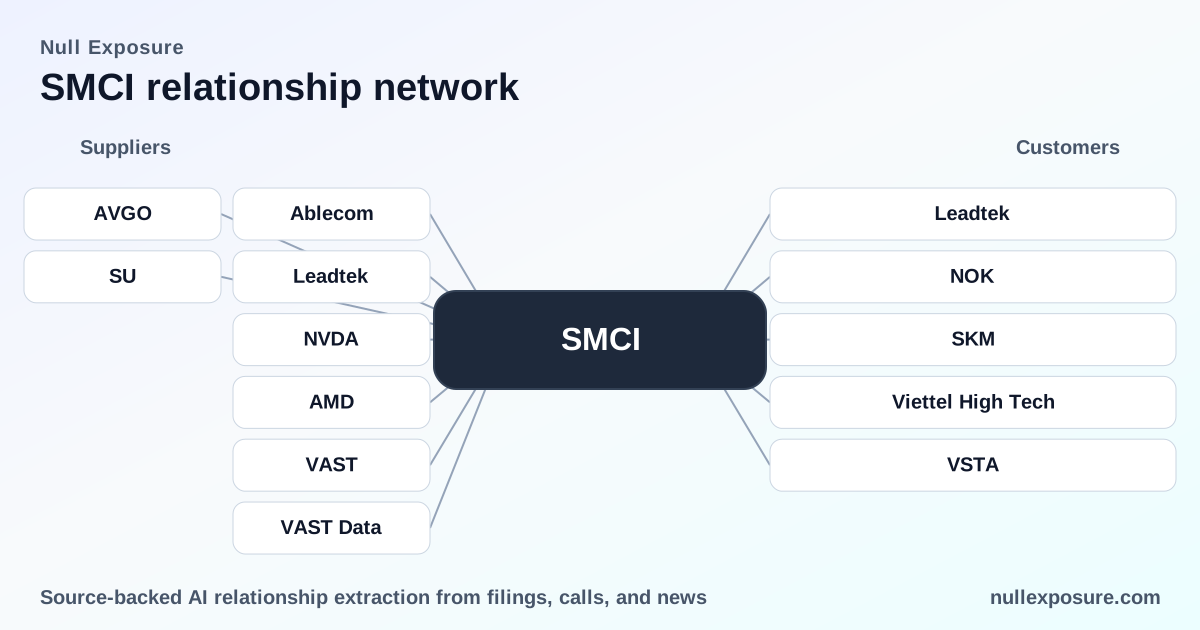
Supermicro (SMCI) — Supplier Map and What It Means for Investors and Operators
Super Micro Computer, Inc. builds and sells high‑performance compute and storage systems using an open, modular architecture and monetizes primarily through hardware sales, integrated AI and storage platforms, and long‑term supplier commitments that underpin its manufacturing and data center operations. Revenue derives from system sales and large, recurring purchase commitments with contract manufacturers and chip partners, while strategic OEM and software alliances broaden addressable markets for turnkey AI solutions. For an interactive view of supplier signals and counterparty exposure, visit https://nullexposure.com/.
How Supermicro runs its supply chain — a concise investor view
Supermicro outsources critical manufacturing and design work to contract manufacturers and relies on a narrow set of silicon and networking suppliers for high‑margin AI and data‑center products. The company reports material purchase commitments (roughly $1.6 billion remaining at June 30, 2025) and multi‑hundred‑million dollar purchases from individual contract manufacturers, which creates both operating leverage and concentrated vendor exposure. According to the FY2025 10‑K, Supermicro also executes long‑term data center leases and has used sublicensing to manage those obligations, creating a non‑inventory fixed‑cost footprint that affects future cash flow. For ongoing supplier analysis, see https://nullexposure.com/.
Key supplier relationships (plain English, source-backed)
Ablecom — SMCI outsources a portion of design and a significant share of server chassis manufacturing to Ablecom under contractual agreements, and Ablecom is a material supplier in FY2025. According to SMCI’s FY2025 10‑K, purchases from Ablecom totaled $321.9 million in fiscal 2025. (FY2025 10‑K)
Leadtek — Leadtek is a modest component supplier of graphics cards to Supermicro, with purchases of $0.5 million in 2025 (down from $2.1 million in 2024), indicating a limited but traceable GPU sourcing relationship. (FY2025 10‑K)
NVIDIA (NVDA) — NVIDIA supplies accelerated computing hardware and software that Supermicro integrates into validated AI systems; recent public announcements describe the CNode‑X solution combining Supermicro servers with NVIDIA Blackwell GPUs and NVIDIA libraries. Supermicro’s March 2026 press release and subsequent coverage note the integrated stack for enterprise AI. (Supermicro IR release, March 2026; HPCwire/StockTwits coverage, March 2026)
Advanced Micro Devices (AMD) — Supermicro is shipping blade and EBox platforms powered by AMD EPYC processors, including the new EPYC 4005 and EPYC 9005 series, positioning AMD as a key CPU supplier for cloud, edge and SaaS workloads. This relationship is documented in Supermicro’s March 2026 product announcements and PR Newswire. (Supermicro IR release / PR Newswire, March 2026)
VAST Data — VAST provides the software layer (InsightEngine and DataBase) that Supermicro pairs with its GPU and storage servers for an integrated enterprise AI platform; Supermicro and VAST jointly announced the CNode‑X solution in March 2026. (Supermicro IR release / HPCwire, March 2026)
Broadcom (AVGO) — Broadcom components (for example, BCM57414 25GbE controllers) are integrated into Supermicro networking subsystems, providing high‑speed connectivity and security features in new blade offerings. This is reflected in product release collateral published in March 2026. (PR Newswire / Supermicro product releases, March 2026)
Schneider Electric SE (SU) — Schneider Electric is identified as the MEP infrastructure design and construction partner to support AI deployments, signaling a supplier role for facility‑level power, cooling, and electrical systems required by Supermicro’s large AI installations. (StockTwits news coverage referencing March 2026 announcements)
What the constraints tell investors about SMCI’s operating model
-
Contracting posture: Supermicro operates with a mix of long‑term and transactional supplier commitments. The company disclosed a long‑term data center lease with a substantial financial obligation (over $292 million for the lease term) that it has sublicensed, indicating strategic use of contractual instruments to manage capital deployment and revenue recognition. (Company filing excerpts)
-
Concentration and spend: High concentration of spend is a material feature: Supermicro reported multi‑hundred‑million dollar purchases from individual contract manufacturers (Ablecom and Compuware) and an overall $1.6 billion of non‑cancelable commitments as of June 30, 2025. That level of committed spend creates both supply continuity and single‑vendor risk. (FY2025 10‑K)
-
Role and criticality: The company classifies counterparties primarily as contract manufacturers for chassis, power supplies and sub‑assemblies; these relationships are operationally critical because they handle both design outsourcing and large portions of manufacturing. Separately, third‑party cybersecurity and services providers support operational resilience. (FY2025 10‑K)
-
Geography and supply chain exposure: There is an APAC manufacturing footprint, including relationships with Taiwanese firms such as Ablecom and Compuware, which concentrates operational risk geographically and ties supply continuity to Asia‑Pacific manufacturing dynamics. (FY2025 10‑K)
-
Relationship maturity: Many supplier arrangements are active and recurring, with mechanisms to offset receivables and payables with contract manufacturers—an indication of integrated commercial terms beyond simple purchase orders. (FY2025 10‑K)
Investment and operational implications — risks and opportunities
Supermicro’s supplier configuration creates a clear investment tradeoff. On the upside, deep integration with NVIDIA, AMD and VAST Data positions SMCI as a turnkey provider for enterprise AI, which drives margin expansion and higher ASPs when successful. The Broadcom networking integrations and Schneider Electric partnership further enable enterprise deployments where facility readiness is necessary.
On the downside, concentrated manufacturing spend and long‑term lease obligations increase fixed cost and counterparty risk: disruptions at a major contract manufacturer or APAC supply interruptions would have an outsized impact on delivery and margins. The company’s ability to offset payables/receivables with manufacturers reduces short‑term cash friction but raises counterparty credit concentration concerns.
For operators, the takeaway is to prioritize continuity planning with primary contract manufacturers, validate dual sources for critical chassis and power components, and monitor NVIDIA/AMD supply cadence given GPU and CPU dependencies.
For investors, key monitors are:
- Quarterly disclosure of purchase commitments and counterparty breakdowns.
- Product roadmaps showing dependency on single‑vendor silicon releases.
- Progress on integrating VAST and NVIDIA solutions into recurring revenue streams.
If you want deeper counterparty exposure visualizations and supplier risk scoring, explore practical research tools at https://nullexposure.com/.
Recommended next steps for due diligence
- Request recent supplier schedules and receivable/payable offset agreements for the largest contract manufacturers to quantify counterparty credit exposure.
- Validate inventory and lead‑time resilience for GPU and CPU suppliers (NVIDIA and AMD) given AI demand cycles.
- Stress‑test the financial impact of non‑performance by a major contract manufacturer over a 60–90 day period.
For continuing tracking of SMCI supplier relationships and to pull a consolidated supplier risk report, visit https://nullexposure.com/.
Supermicro’s supplier map is an asset: it enables differentiated AI products through tight integration with silicon and software partners, but it also concentrates execution risk in a few high‑impact counterparties. Investors and operators who actively monitor those counterparties will be best positioned to capture upside and mitigate downside. For more supplier intelligence and ongoing alerts, go to https://nullexposure.com/.