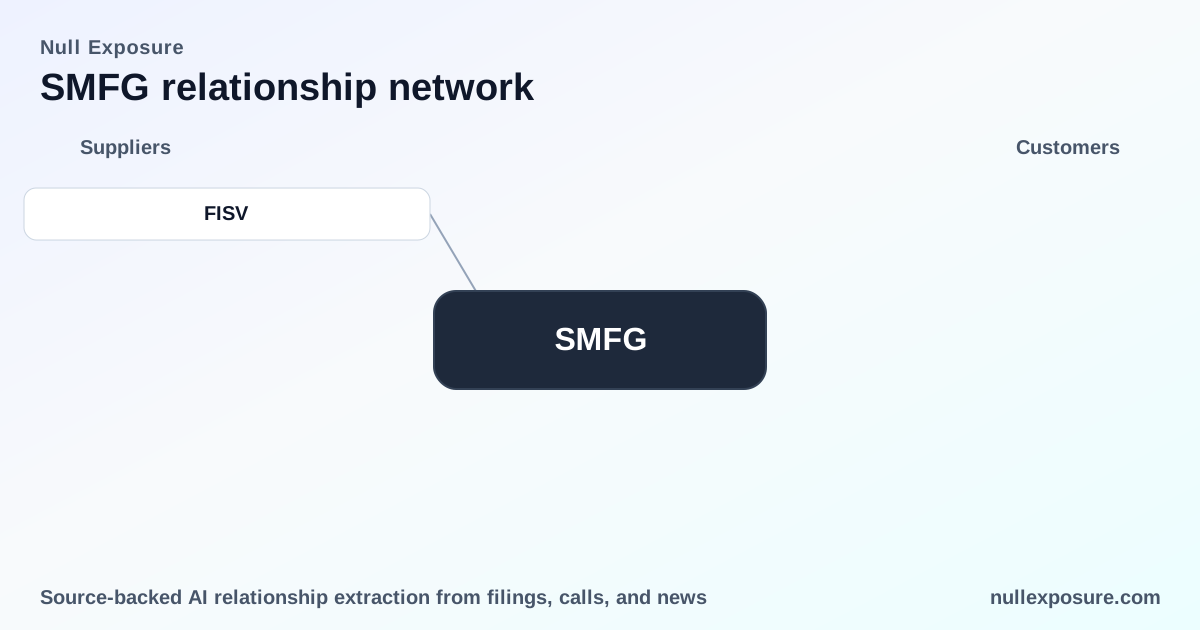
Sumitomo Mitsui Financial Group (SMFG): Supplier Relationships and Strategic Implications for Investors
Sumitomo Mitsui Financial Group (SMFG) operates as one of Japan’s largest diversified banking groups, monetizing through a mix of commercial banking interest spreads, fee income from transaction and advisory services, securities and asset management revenue, and consumer finance and leasing operations. The company’s scale and breadth make its supplier relationships—especially in payments and technology—pivotal to distribution and product innovation, directly affecting customer acquisition, fee growth, and operational efficiency. For investors and operators evaluating SMFG as a counterparty or investment, supplier ties are a lens into both capability uplift and concentration risk. Learn more at https://nullexposure.com/.
Quick take: what this supplier footprint signals to the market
SMFG’s public footprint shows targeted partnerships to import mature payments platforms into Japan, which aligns with a push to modernize merchant services and capture incremental merchant fee pools. This is not a general technology refresh; it is a revenue-facing partnership focused on payments acceptance and embedded services.
- Scale and resilience: SMFG’s market capitalization and earnings profile fund long-term vendor commitments and co-investments.
- Revenue leverage: Payment-platform rollouts convert into fee income and cross-sell opportunities across corporate and retail banking franchises.
- Execution focus: Partnerships with large, experienced vendors shorten time-to-market and reduce build risk.
If you want a concise supplier risk summary or deeper diligence, start with our homepage: https://nullexposure.com/.
What the Fiserv relationship is and why it matters
Fiserv — bringing the Clover point-of-sale suite to Japan
SMFG has partnered with Fiserv to introduce the Clover merchant platform into the Japanese market, a direct effort to expand merchant-facing services and capture payment processing and ancillary fee revenue. According to a Globe and Mail press release on March 10, 2026, Fiserv and Sumitomo Mitsui announced plans to bring the Clover suite to Japan, positioning SMFG to accelerate merchant onboarding and modernize point-of-sale capabilities (The Globe and Mail, March 10, 2026: https://www.theglobeandmail.com/investing/markets/stocks/SMFG-N/pressreleases/37384222/dbs-remains-a-buy-on-sumitomo-mitsui-financial-group-smfnf/).
This relationship is strategically meaningful because merchant services are a high-margin, recurring revenue stream that also creates data and cross-sell vectors for loans, deposits, and corporate banking products. The choice of an established global vendor like Fiserv signals SMFG’s preference for mature, proven platforms rather than internal build for merchant acceptance.
Operating-model signals and contract posture investors should know
SMFG’s supplier behavior conveys several company-level operating characteristics:
- Contracting posture — strategic, long-term vendor alignments. SMFG’s public partnership with Fiserv demonstrates a preference for established third-party platforms to accelerate capability delivery and limit in-house development risk.
- Concentration — limited public supplier disclosures but high potential impact. The current visible supplier roster is narrow in public records, but the strategic nature of each partner (e.g., payments platforms) means low visible count but high criticality for those relationships.
- Criticality — payments and merchant services are operationally critical and revenue-sensitive. Partners that handle transaction throughput and POS ecosystems directly affect fee income and customer experience.
- Maturity — vendors selected are mature, enterprise-grade providers. The Clover platform is a well-known solution in other geographies, indicating SMFG’s tilt toward proven, scalable technology partnerships.
No supplier-level constraints were disclosed in the supplier-scope records available for this analysis; that absence is itself a signal at the company level — disclosure on commercial constraints is limited, which increases the value of active diligence when underwriting counterparty risk for operations-heavy investments.
Investment implications: upside, risks, and what to watch next
SMFG’s core financials show a substantial franchise with Revenue TTM above JPY 3.7 trillion and a market capitalization of roughly USD 124 billion, supporting strategic vendor investments. Valuation metrics such as a trailing P/E of about 13.9 and a forward P/E near 11.2 indicate a market pricing that expects steady earnings and some operational leverage from initiatives like payments expansion.
Key takeaways for investors:
- Upside: Bringing Clover to Japan creates immediately addressable merchant fee pools and cross-sell opportunities to SMFG’s corporate and retail customers; successful execution would lift non-interest income and deepen client relationships.
- Execution risk: Rollout and merchant adoption timelines determine revenue capture speed; integration and local regulatory adaptation are operational tasks that affect outcomes.
- Concentration risk: While publicly disclosed supplier relationships are sparse, the strategic importance of any payments partner implies single-vendor outages or disputes carry outsized operational risk for merchant services.
- Governance signal: Choosing a large global vendor signals seasoned procurement and governance—SMFG is executing with partners that can scale.
For portfolio managers and operators wanting to map supplier risk to financial outcomes, our platform provides structured views and triggers — learn more at https://nullexposure.com/.
Practical next steps for analysts and operations teams
- Request contract term summaries and SLAs for merchant-processing arrangements to quantify uptime, settlement cadence, and fee sharing.
- Benchmark merchant onboarding assumptions and retention rates versus other regional rollouts of the Clover platform.
- Monitor regulatory filings and local payment association notices for rule changes that could affect interchange or settlement economics.
For investors seeking actionable supplier intelligence or to commission a targeted supplier-due-diligence brief, visit our homepage at https://nullexposure.com/ to get started.
Bottom line
SMFG’s visible supplier activity is concentrated and strategic: the Fiserv/Clover partnership is a clear example of using a mature external platform to accelerate payments capabilities and unlock fee income. Investors should treat supplier relationships not as ancillary details but as direct levers on revenue growth and operational continuity. With limited publicly disclosed supplier constraints, active diligence on contract terms and operational SLAs is essential for accurate risk-adjusted valuation.