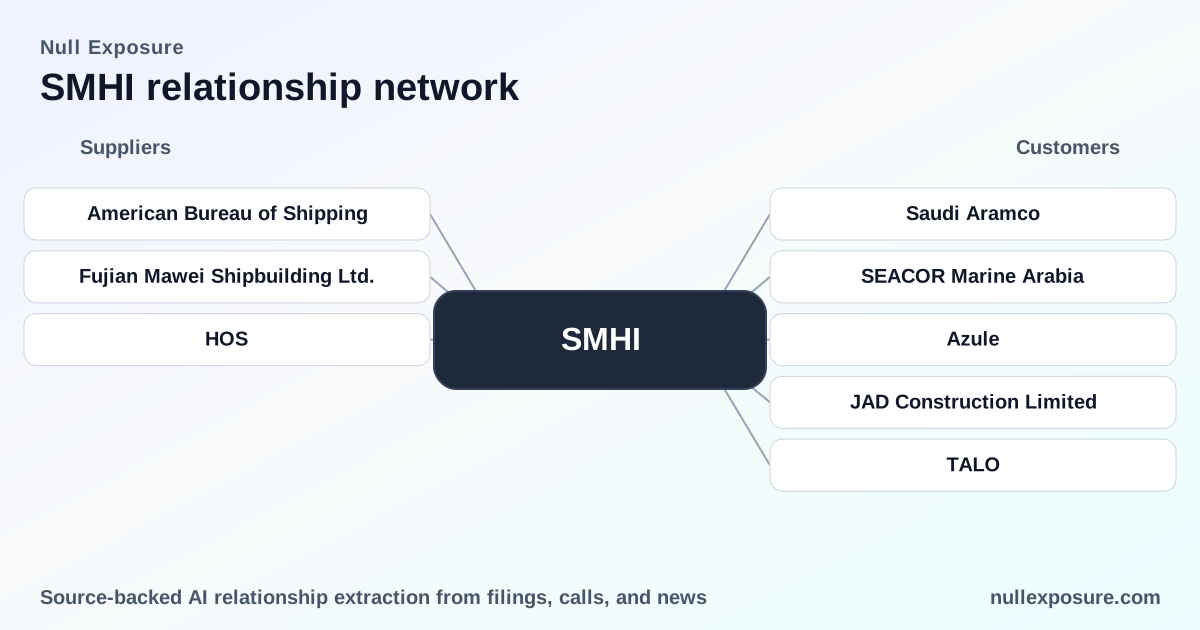
SEACOR Marine (SMHI): Supplier Map and Strategic Implications for Investors
SEACOR Marine operates a global fleet providing marine transportation and offshore support services to oil, gas and wind customers, monetizing through a mix of day‑rates, term charters and owned-asset utilization while funding growth with periodic new‑build capital commitments. Investors should view supplier relationships as core to both fleet capability and capital intensity: shipyards, classification societies and consolidation partners directly affect uptime, delivery schedules and cost structure. For a deeper look at supplier risk and exposure, visit NullExposure.
How SEACOR Marine makes money and why suppliers matter
SEACOR Marine generates revenue by operating platform service vessels (PSVs), crew boats and other offshore support assets under short-term and longer-term contracts. Profitability and free cash flow convert principally from the combination of utilized vessel days and charter rate environment, but the path from order to revenue is governed by supplier execution — classification approvals, shipyard delivery timing and strategic combinations with peers. Capital commitments to new builds and major equipment upgrades are therefore a direct lever on growth and a concentrated channel of supplier spend.
Supplier relationships you need to evaluate
American Bureau of Shipping — class society
The company’s vessels are classed by the American Bureau of Shipping, underscoring a reliance on an established classification society for safety and regulatory certification. A gCaptain report referencing the Seacor Power incident noted that the vessel in question was classed by ABS (gCaptain, March 2026). Class society relationships are critical for operational legality and charter eligibility.
Fujian Mawei Shipbuilding Ltd. — shipbuilder for new PSVs
SEACOR has a new‑build program with Fujian Mawei Shipbuilding in the People’s Republic of China for two foreign‑flag DP‑2 PSVs, with expected deliveries in Q4 2026 and Q1 2027, indicating multi‑year delivery risk and cross‑border construction exposure. This construction program is disclosed in the company's filings and was summarized in a TradingView news item citing the firm’s SEC 10‑K (TradingView, March 2026). New‑build lead times and yard performance will directly affect fleet availability and future revenue.
Hornbeck Offshore Services — transaction / asset combination
SEACOR Marine consolidated offshore capabilities through a combination that included assets acquired from Hornbeck Offshore Services, enlarging technical depth and vessel mix following the transaction. MarketBeat reported on SEACOR’s share movement related to that combination and noted the integration of Hornbeck assets into the SEACOR Marine fleet (MarketBeat, February 2026). Consolidation partners change fleet composition and operating cost structure and can improve scale quickly, but integration execution is a near‑term operational risk.
What the constraints tell us about SEACOR Marine’s operating model
The supplier constraints observed in company disclosures and newsflow form a coherent picture:
-
Contracting posture — multi‑year capital commitments. SEACOR reported $90.0 million of unfunded capital commitments as of December 31, 2024, with scheduled payments across 2025–2027, indicating a multi‑year capex profile that locks in supplier spend and delivery schedules. This is a company‑level signal of long‑term capital contracting and cashflow timing pressure.
-
Geographic supplier footprint includes APAC shipyards. The construction work at Fujian Mawei demonstrates explicit exposure to Chinese shipbuilding capacity and the operational, logistic and geopolitical considerations that come with foreign yards. This constraint is directly tied to the Fujian Mawei relationship.
-
Manufacturer role and maturity. The new‑build activity classifies shipyards like Fujian Mawei as manufacturer/producer partners in SEACOR’s supply chain; that role implies typical yard-related risks — schedule slippage, quality rework and cross‑jurisdictional regulatory steps — and is explicitly supported by the Fujian Mawei disclosure.
-
Spend concentration in the $10m–$100m band. The unfunded commitment size ($90.0m total) places individual project exposure in the mid‑cap range of supplier spend, signaling material but non-systemic dependence on a limited set of suppliers rather than a highly fragmented procurement base.
Taken together, these constraints describe a capital‑intensive, moderately concentrated supplier model with multi‑year delivery risk and direct exposure to classification and foreign yard execution.
For additional supplier analytics and monitoring, explore NullExposure for curated supplier signals.
Risk and opportunity implications for investors
-
Operational criticality is high. Classification societies (ABS) are not optional — they govern seaworthiness and charter eligibility — so any friction with ABS affects operating days and revenue recognition. The gCaptain reference underlines this point in a public safety context.
-
Delivery timing is a core execution risk. The Fujian Mawei new‑builds have specific delivery windows in late 2026 and early 2027; late deliveries would compress the growth runway and delay revenue tied to those assets (TradingView, March 2026).
-
Integration upside from Hornbeck assets is tangible. The Hornbeck combination expanded technical capabilities and vessel availability quickly, which can raise utilization and broaden bid eligibility in tendered contracts (MarketBeat, February 2026). However, integration execution governs the real value capture.
-
Balance‑sheet and cashflow sensitivity. With $90.0m in unfunded commitments and current negative EBITDA reported in recent periods, capital allocation and financing of shipyard obligations are strategic levers investors should monitor in filings and quarterly updates.
How to monitor these suppliers going forward
- Track ABS notices and class renewals for any notations or restrictions; classification actions are early warning signals for operational downtimes.
- Monitor Fujian Mawei delivery progress through company filings and yard announcements around milestones and sea trials.
- Watch integration KPIs announced post‑transaction for Hornbeck‑sourced assets: utilization, charter rates and opex per day.
Bottom line and investor actions
SEACOR Marine’s supplier set — comprising classification societies, a Chinese shipbuilder and consolidation partners — is a determinative factor for near‑term growth and medium‑term profitability. The firm’s capital commitments create predictable supplier spend but also concentrate execution risk in a few counterparties. Investors should weigh fleet utilization upside against delivery and integration risk while tracking cashflow funding of committed builds.
For a focused supplier risk briefing and continuous monitoring of these counterparties, visit NullExposure to see how these relationships map to financial outcomes.