Smith‑Midland (SMID): Supplier relationships, financing posture, and operational constraints investors should price in
Smith‑Midland manufactures and sells precast concrete products to construction, highway, utility, and agricultural markets, monetizing through product sales, installation services, and licensed facade systems; recurring revenue is limited, and working capital and equipment financing are central to the operating model. Investors should view SMID as a capital‑intensive, margin‑oriented small‑cap in building materials where supplier and financing relationships materially affect cash flow and capacity to meet project schedules. Learn more about supply analytics and relationship risk at https://nullexposure.com/.
How Smith‑Midland makes money and why supplier relationships matter
Smith‑Midland generates revenue by selling and installing precast concrete components and licensing architectural cladding systems. The company’s latest reported TTM revenue is roughly $88.9 million with a healthy operating margin (~18%) and a return on equity above 25%, indicating an efficient asset base for its size. Profitability is sensitive to materials input costs, plant utilization, and the availability of capital to purchase or renovate production equipment.
Contracting posture: Smith‑Midland operates with a mix of project‑level sales and multi‑year equipment commitments that are capitalized and financed. The company exhibits longer-term contractual commitments for capital expenditures, which pushes financing counterparties to the foreground of supplier analysis.
Concentration and criticality: The business is not heavily diversified across product lines; licensed cladding relationships and a small set of financial counterparties and licensors are disproportionately critical for maintaining capacity and product breadth.
Maturity and predictability: As a small‑cap manufacturer, Smith‑Midland’s operations are mature in processes but sensitive to cyclical construction demand and input price volatility, producing higher earnings leverage relative to larger peers.
The active supplier and partner relationships you need to know
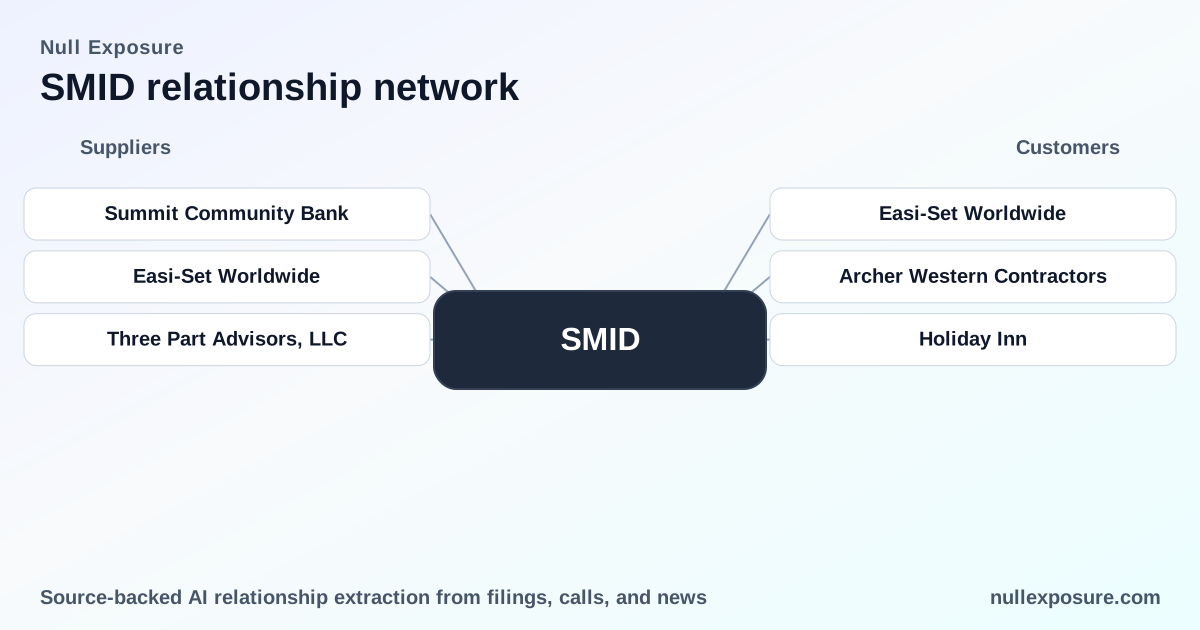
Below are every supplier/partner relationship surfaced in the public record for the supplier scope, presented with concise takeaways and source notes.
Summit Community Bank — longstanding credit counterparty (FY2017)
Smith‑Midland completed refinancing a matured line of credit for $2.0 million with Summit Community Bank on November 30, 2017, under substantially the same terms and amount, demonstrating a continuing banking relationship used to sustain working capital and seasonal needs. According to the company’s 8‑K filing reported by MarketExclusive in FY2017, Summit Community Bank served as the replacement lender for that facility. (MarketExclusive, 2017)
Easi‑Set Worldwide — licensor for architectural cladding (FY2016)
Smith‑Midland licenses facade technology from Easi‑Set Worldwide to produce high‑performance architectural cladding under its product offerings, which broadens the company’s addressable market for façade solutions and supports higher‑margin spec work. This licensor relationship is documented in architectural trade coverage referencing the product partnership in FY2016. (The Architect’s Newspaper / Archpaper, 2016)
Three Part Advisors, LLC — investor relations/IR provider (FY2025)
Smith‑Midland lists Three Part Advisors, LLC as its investor relations contact, indicating a retained communications relationship for earnings and investor outreach; this affects how the company communicates financials and strategic developments to the market. The designation is recorded in investor release materials for third‑quarter 2025. (Company press release distributed via Futunn, FY2025)
What the long‑term contract signal means for investors and operators
A company‑level disclosure indicates a long‑term financing commitment tied to equipment purchase, with a note payable term not to exceed five years and interest priced at Wall Street Journal prime plus 0.50% with a 3.50% floor. This is a clear operational constraint: Smith‑Midland finances capital equipment through multi‑year notes rather than short‑term bank lines alone.
Implications:
- Capital cycle dependency: Equipment procurement is financed over multiple years, locking in capacity decisions and creating a predictable debt service profile that investors can model.
- Interest‑rate sensitivity: The prime‑based spread with a floor exposes SMID to rising benchmark rates up to the floor level, but the floor provides downside protection for lenders and a cost floor for the company.
- Contract maturity: Five‑year max terms indicate medium‑term commitments that reduce rollover frequency but increase the importance of forecasting utilization and revenue to cover debt service.
Because the constraint excerpt does not name a specific lender, treat this as a company‑level signal about SMID’s preferred financing posture rather than evidence tying any single relationship to those exact terms.
Operational risk checklist for investors and operators
Use this checklist to prioritize diligence and negotiation focus when evaluating SMID supplier risk:
- Financial counterparties are operationally critical: bank refinancing choices (e.g., Summit Community Bank) directly affect liquidity and the ability to fund seasonal backlog.
- Licensing partners expand product reach but create dependency: the Easi‑Set license boosts spec capabilities; losing it would narrow product offering and influence margins.
- Investor communications matter: an established IR firm (Three Part Advisors) improves market transparency and reduces execution risk on capital raises or refinancing.
- Debt structure is meaningful: multi‑year equipment notes create predictable cash‑flow obligations; model amortization and interest floors explicitly.
- Concentration risk: given the small‑cap scale, a few counterparties carry outsized influence over operations and market perception—price that into scenario analyses.
How to act on these relationship signals
For investors: stress test models for a scenario where equipment debt service rises with rates and plant utilization underperforms; assess covenant tightness and liquidity buffers given a $2.0 million historical line refinancing precedent.
For operators and suppliers: prioritize maintaining strong bank relationships and preserve licensing agreements through product quality and timeliness; contracts that secure medium‑term financing for equipment should be negotiated to match production cycle cash flows.
Learn more about mapping supplier risk and finance exposure at https://nullexposure.com/.
Bottom line and next steps
Smith‑Midland is a profitable small‑cap manufacturer whose capital structure and supplier relationships—bank financing, licensor agreements, and investor communications—are central to execution. The company’s dependence on medium‑term equipment financing and a narrow set of critical partners elevates operational leverage and makes supplier counterparties strategic risk drivers. For analysts and counterparties, treat financing terms and licensing continuity as primary variables in any valuation or operational due diligence.
For a deeper read into supplier relationship impacts and structured supplier analytics, visit https://nullexposure.com/ and review supplier‑level risk scoring and contract‑term analysis tools.