SMJ International (SMJF): Supplier relationships, underwriting signal, and what investors should infer
SMJ International Holdings Inc. operates as a diversified holding company that builds value by acquiring and managing businesses across technology, renewable energy and consumer goods, monetizing through equity appreciation and portfolio-level cash flow generation rather than a single operating revenue stream. For investors, SMJF is a capitalization-and-portfolio play: the company’s returns depend on deal flow, execution of integrations, and access to capital markets rather than steady operating revenue. Explore supplier and capital-market mappings at https://nullexposure.com/.
Business model and operating posture: how SMJ runs and how that affects supplier risk SMJ presents as an acquisitive holding company that sources growth through purchases and strategic partnerships. That structure implies a contracting posture that is transactional and capital-market dependent: third-party relationships are frequently underwriting, advisory, legal, and integration-focused rather than long-term manufacturing or distribution contracts. The company profile shows a small market capitalization (about $75.4 million) alongside valuation multiples that reflect growth expectations: trailing P/E ~90.7, Price/Sales ~5.69, Price/Book ~12.59, EV/Revenue ~6.09 and EV/EBITDA ~70.66. Those metrics indicate investors are paying a premium for anticipated portfolio development rather than for established operating cash flows.
Operational implications for supplier contracting and concentration:
- Contracting posture: Predominantly deal-oriented (underwriters, transaction advisors, legal and consultancy suppliers) rather than large recurring vendor contracts.
- Concentration: Financials show RevenueTTM = 0, suggesting SMJ lacks reported recurring revenues; supplier exposure can therefore be lumpy and synchronized with capital events (IPOs, offerings, acquisitions).
- Criticality: Supplier relationships that enable capital raises (lead underwriters, placement agents) are highly critical to execution. Other suppliers (integration consultants, ops teams) are important but secondary to access to capital.
- Maturity: High valuation multiples with no reported trailing revenue point to early-stage portfolio positioning and high execution risk until operating businesses produce consistent cash flow.
Relationships observed: who SMJ is working with and why it matters Below is every supplier relationship surfaced in the reviewed results, presented with plain-English summaries and source references.
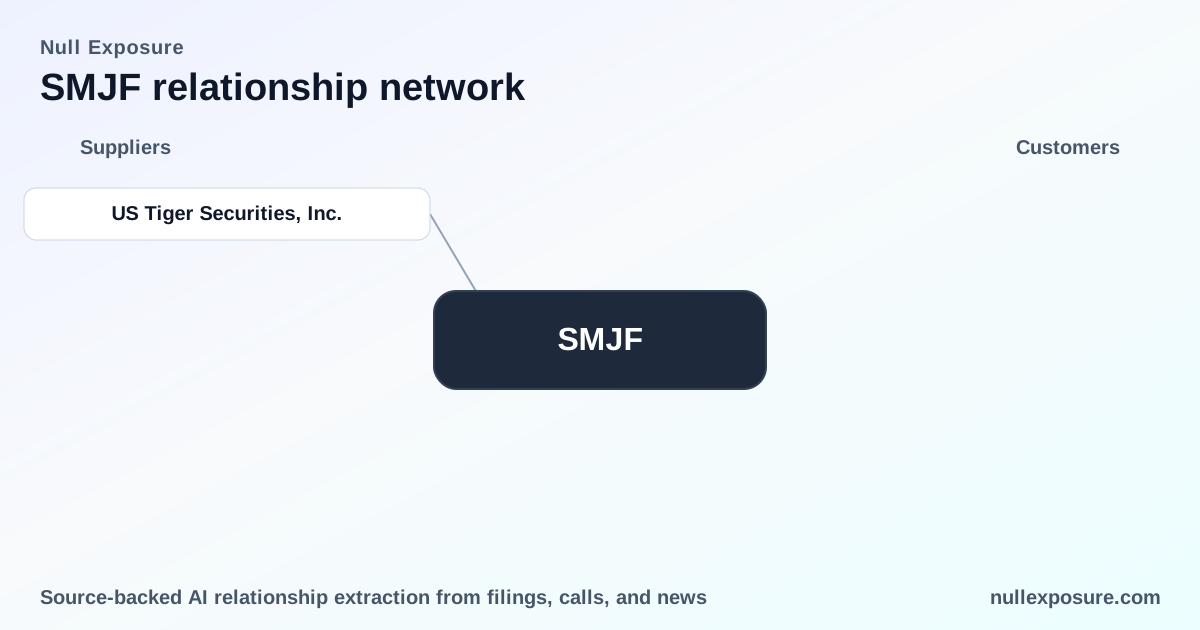
US Tiger Securities, Inc.
US Tiger Securities was identified as the lead underwriter (Representative) on SMJ’s NYSE American filing for a Premier Commercial Flooring Distributor IPO, a signal that SMJ is using established broker-dealer relationships to bring portfolio assets to public markets. This engagement shows SMJ is monetizing through traditional capital market transactions. Source: TradingView news post (March 10, 2026): https://www.tradingview.com/news/tradingview:4adab902574b3:0-smj-international-premier-commercial-flooring-distributor-files-for-nyse-american-ipo/.
Company-level constraint signals and what’s missing The dataset returned no explicit supplier constraints for SMJ (no contractual limits, no mandatory supply exclusivities, no listed SLAs). That absence is itself a company-level signal: there are no recorded supplier-side contractual constraints flagged in the reviewed records. For investors, that implies supplier obligations are either informal, transaction-specific, or not publicly disclosed—consistent with a holding company that relies on episodic transactional engagements rather than long-term supply contracts.
Why the US Tiger Securities relationship matters for equity holders Underwriter and placement relationships are a direct lever on valuation and liquidity for holding companies that rely on capital markets. A named lead underwriter indicates a formal path to public monetization for a portfolio asset, which accomplishes two objectives for SMJ: (1) crystallize value for shareholders via an IPO or secondary offering and (2) signal to the market that the company can access capital markets when required. For a firm with no reported trailing revenue, these events are the primary mechanism for value realization.
Risk and opportunity implications for investors
- Opportunity: If SMJ executes its planned capital-market transactions successfully, the company can convert asset value into realized proceeds that materially change the balance sheet and liquidity outlook. The premium valuation multiples indicate market expectation of such conversions.
- Risk: Reliance on underwriter-led transactions concentrates execution risk in capital markets; adverse market conditions or failed offerings would directly impair SMJ’s path to monetization. Given reported trailing revenue of zero, failed transactions would leave limited operational buffers.
- Counterparty exposure: Underwriters and transaction advisors are fungible short-term suppliers, but their quality and relationships matter for pricing, timing, and success probability of deals; the named lead underwriter is therefore a strategic supplier.
What investors should monitor next
- Watch for formal SEC filings or NYSE American prospectuses tied to the referenced filing; those documents will disclose underwriting fees, lock-up periods, and sponsor arrangements that materially affect investor returns.
- Track subsequent press and regulatory records that name additional advisors or joint bookrunners—the composition of the underwriting syndicate affects distribution capability and pricing.
- Monitor operating performance of the underlying portfolio companies for proof of concept that multiples are justified; absent operating revenue growth, value is contingent on capital market exits.
Mid-report action: review the supplier map and extract deeper signals at https://nullexposure.com/ to see how underwriter and advisor linkages align across SMJ’s portfolio.
Concluding view and recommended next steps SMJ International is a holding-company play whose supplier footprint, as documented, centers on capital-market intermediaries—the lead underwriter relationship with US Tiger Securities is the single explicit supplier linkage surfaced and it is consequential because it represents the mechanism by which SMJ plans to monetize at least one portfolio asset. The company’s valuation metrics show rich expectations; the absence of reported revenue elevates execution risk and places underwriting outcomes at the core of the investment thesis.
For institutional investors and operators, the immediate priority is documentary diligence: obtain the full offering prospectus, confirm underwriting terms, and map any contingent obligations that could affect proceeds or future equity dilution. For a quick starting point, revisit supplier mappings and public relationship signals at https://nullexposure.com/.
Final call to action: if you are evaluating SMJF supplier relationships or assembling counterparty risk profiles, aggregate filings and underwriter disclosures on https://nullexposure.com/ to accelerate decision-making.