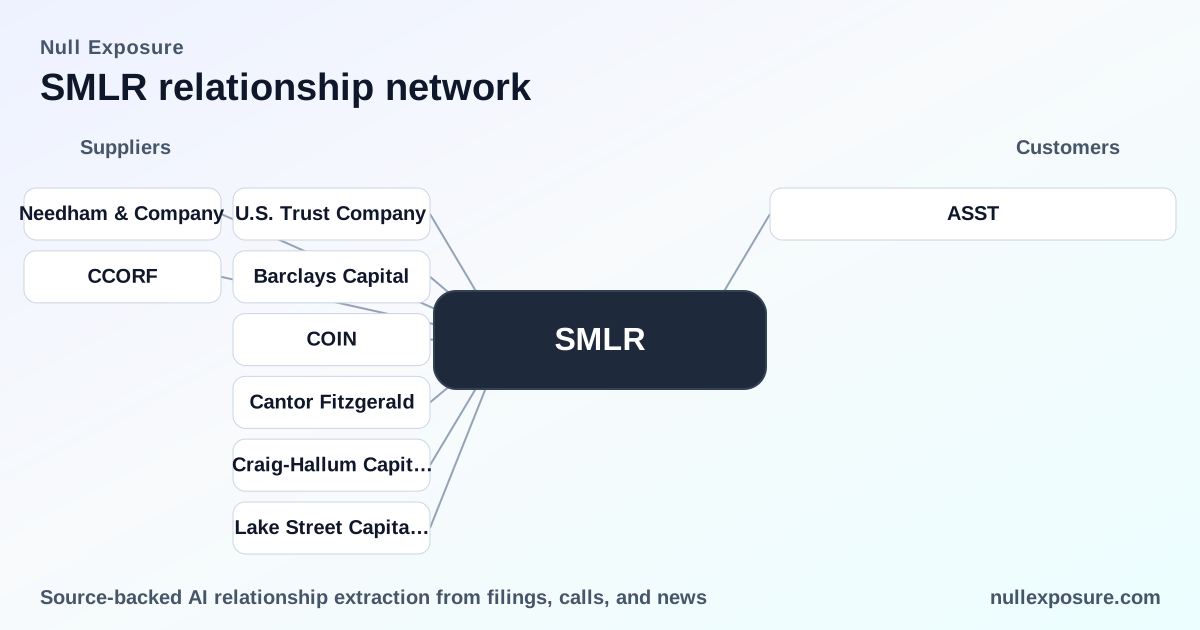
SMLR supplier relationships: capital-structure overhaul shifts counterparty risk
Semler Scientific (ticker SMLR) historically monetized through product sales and recurring service agreements in the medical-device sector, but the investor story in FY2026 is dominated by capital-structure and liquidity transactions that reshape supplier and counterparty exposures. The company’s merger with Strive reallocated conversion mechanics on its convertible notes, terminated its at-the-market equity program, and enabled the retirement of most inherited debt — actions that directly change how counterparties get paid and how future funding flows to the business.
For a concise map of counterparties and what they now represent to an investor or operator evaluating supplier risk, read on. If you want a consolidated view of supplier counterparty changes across tickers, visit the NullExposure homepage: https://nullexposure.com/
Executive snapshot: what changed in FY2026 and why it matters
- Capital-structure rework: Semler executed a supplemental indenture for its 4.25% Convertible Senior Notes due 2030 to align conversion rights with the Strive merger and to add a Strive guarantee, leaving coupon and maturity intact. (TradingView report, effective Jan 16, 2026; reported Mar 10, 2026.)
- ATM program shut down: The company mutually terminated its Controlled Equity Offering Sales Agreement (ATM) with a syndicate of investment banks as a consequence of the merger and pending delisting, removing a routine equity liquidity channel. (TradingView report, termination dated Jan 16, 2026; reported Mar 10, 2026.)
- Debt reduction: Proceeds from the overall transaction were used to retire approximately $110 million of Semler’s inherited debt, including repayment of a $20 million Coinbase credit facility. (Cointelegraph coverage, reported Mar 10, 2026.)
These moves materially change who gets paid, who guarantees obligations, and how easily Semler can access public equity markets going forward — primary considerations for counterparty prioritization and supplier contract negotiations.
The relationship roster — concise, source-backed summaries
U.S. Trust Company
U.S. Trust Company served as the counterparty for a supplemental indenture that amended Semler’s 4.25% Convertible Senior Notes due 2030 to convert into Strive Class A shares and to add a Strive guarantee while preserving maturity and interest terms; the amendment was effective Jan 16, 2026. According to a TradingView filing reported Mar 10, 2026, the change aligns the notes with the merger and extends the trustee’s role through Aug 1, 2030.
Barclays Capital
Barclays was part of the syndicate tied to Semler’s Controlled Equity Offering (ATM) that was mutually terminated on Jan 16, 2026 as the company prepared to delist following the merger with Strive. TradingView coverage on Mar 10, 2026 notes that the termination involved no exit fees and halts future ATM sales.
Coinbase (COIN)
Coinbase’s role was as a credit lender to Semler; proceeds from the deal were used to fully repay a $20 million Coinbase credit loan as part of a broader $110 million debt retirement. Cointelegraph reported on Mar 10, 2026 that this repayment eliminated the Coinbase exposure transferred in the merger.
Cantor Fitzgerald
Cantor Fitzgerald was a named agent in the terminated ATM sales agreement that Semler executed originally in April 2025 and closed on Jan 16, 2026; the mutual termination removes Cantor and the syndicate from ongoing equity distribution duties. This termination is documented in the TradingView report dated Mar 10, 2026.
Craig-Hallum Capital Group
Craig-Hallum was likewise a member of the ATM syndicate that Semler mutually terminated; TradingView’s Mar 10, 2026 note records this action and confirms there were no exit fees tied to the closure of the program.
Lake Street Capital Markets
Lake Street Capital Markets appears in the same ATM syndicate list; the Jan 16, 2026 termination ends Lake Street’s role in selling Semler shares under the previously announced program, per TradingView reporting on Mar 10, 2026.
Needham & Company
Needham & Company was one of the underwriters/agents on the ATM agreement that was terminated as part of the merger/delisting process; the TradingView report (Mar 10, 2026) lists Needham among the named parties and confirms the program’s cessation.
Canaccord Genuity (CCORF)
Canaccord Genuity, listed under symbol CCORF in the record, was part of the terminated ATM syndicate; TradingView’s Mar 10, 2026 coverage details the mutual termination effective Jan 16, 2026 and the company’s decision to cease ATM activity following the merger.
What these relationships reveal about SMLR’s operating posture
- Contracting posture: The mutual termination of the ATM program signals a deliberate retreat from routine equity issuance; Semler (now in combination with Strive) is transitioning liquidity reliance from public at-the-market sales to deal-level financing and guaranteed instruments. This reduces ongoing dependence on equity syndicates for short-term funding.
- Counterparty concentration and syndication: Semler used a syndicated model for its ATM program, dispersing execution risk across several mid-sized and bulge-bracket firms; termination centralizes counterparty exposure away from that model and toward secured lenders and guarantors.
- Criticality of counterparty roles: The supplemental indenture and the addition of a Strive guarantee make certain counterparties (trustee, guarantor) more critical to long-dated claims (notes due 2030) than the short-term ATM agents who are now disengaged.
- Maturity and timeline risk: The convertible notes retain their original maturity (Aug 1, 2030) and coupon (4.25%), so interest-rate and conversion economics remain a multi-year consideration for holders and for counterparties administering those instruments.
No formal constraint excerpts were provided in the relationship record; the above company-level signals are drawn from the contractual actions disclosed in the FY2026 reporting on the merger-related transactions.
If you track counterparty transitions across tickers or need tailored supplier exposure analysis, start here: https://nullexposure.com/
Investor implications and operator checklist
- Counterparty risk re-ranked: With the ATM agents stepping away, trustee and guarantor roles (U.S. Trust Company / Strive) are elevated in systemic importance; operational teams should prioritize documentation and service-level clarity with those counterparties.
- Liquidity runway improved but funding channels narrowed: The retirement of $110 million of debt, including the Coinbase loan, materially reduces leverage; however, termination of the ATM removes a flexible equity issuance mechanism, so future capital raises will likely be negotiated transactions rather than programmatic sales.
- Operational follow-through required: Legal teams should confirm that the supplemental indenture language fully operationalizes conversion into Strive Class A shares and that servicing arrangements for the notes are updated through 2030.
Final takeaways and next steps
- The FY2026 actions reallocate risk from dispersed ATM agents to a concentrated capital-structure relationship (trustee + Strive guarantee), while materially deleveraging the balance sheet. That combination lowers immediate default risk but increases the strategic importance of the guarantor and trustee arrangements.
- For a comprehensive view of supplier counterparty shifts across filings and news, visit NullExposure: https://nullexposure.com/
- To commission a custom report mapping your counterparty exposure to SMLR and similar tickers, start here: https://nullexposure.com/
Sources cited above include a TradingView report summarizing the supplemental indenture and ATM termination (effective Jan 16, 2026; reported Mar 10, 2026) and Cointelegraph coverage on the debt retirement and Coinbase repayment (reported Mar 10, 2026).