SMQ Supplier Relationships: What Investors and Operators Need to Know
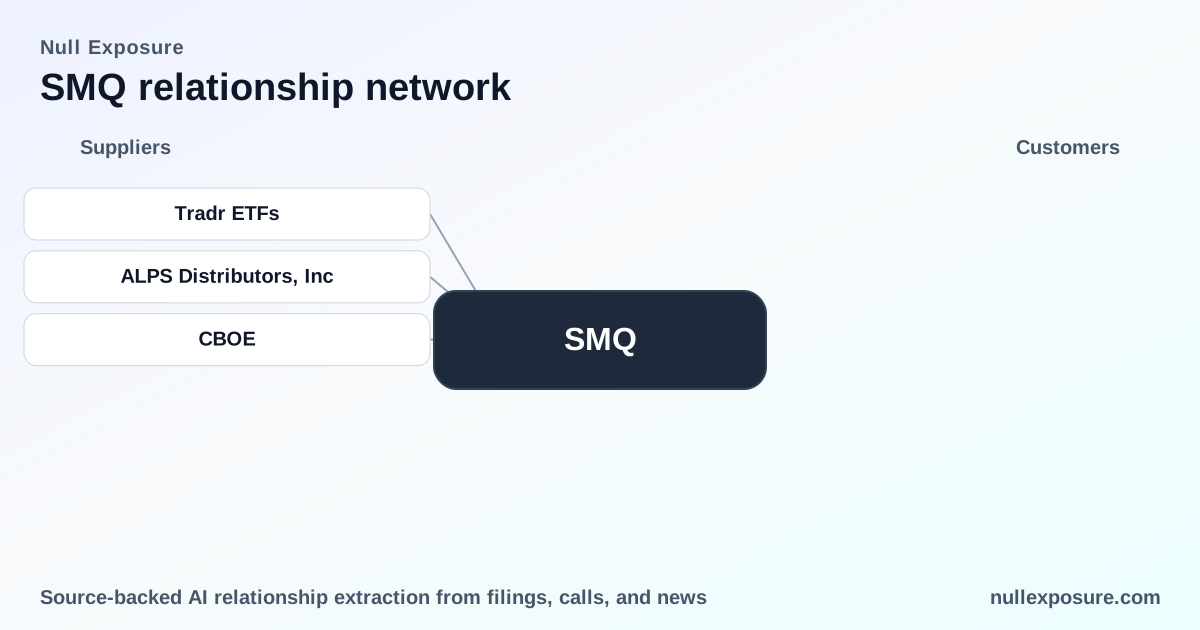
Tradr ETFs launched SMQ (Tradr 1X Short Innovation 100 Monthly ETF) as a listed inverse monthly-reset product that monetizes through fund management fees, creation/redemption mechanics with authorized participants, and distribution agreements. The issuer earns management and operational fees while relying on third-party distributors and exchange infrastructure for market access and liquidity. For investors evaluating counterparty and operational risk, the supplier map is concise: an ETF issuer (Tradr ETFs), a distributor (ALPS Distributors), and an exchange venue (Cboe). If you want a structured view of supplier exposure and counterparties for active ETF strategies, start here: https://nullexposure.com/
Launch context and why supplier mapping matters
SMQ is positioned as a specialized, professional-trader-oriented product: an inverse, monthly-reset ETF linked to the Innovation 100 (Invesco QQQ) family of exposures. That positioning makes the supplier relationships more than administrative: distribution, listing venue, and issuer operational capabilities directly determine market access, quoting behavior, and investor redemptions. The commercial economics of a new ETF are concentrated around a small set of counterparties that set the pace for growth and risk absorption.
If you want to compare supplier footprints across ETF launches and evaluate concentration risk at the issuance level, we provide practical intelligence and relationship mapping at https://nullexposure.com/.
Supplier-by-supplier breakdown: who does what
Tradr ETFs — the issuer and product architect
Tradr ETFs is the sponsor and manager of SMQ, responsible for the product design, portfolio implementation, and regulatory filings that created the fund. According to the PR Newswire release on March 10, 2026, Tradr announced the launch of the Tradr 1X Short Innovation 100 Monthly ETF under ticker SMQ, marketing the product to sophisticated investors and professional traders. (PR Newswire, March 10, 2026)
ALPS Distributors, Inc — distribution channel and intermediary
ALPS Distributors, Inc is the distributor for SMQ and handles the fund’s placement and wholesaling to broker-dealers and institutional channels; the PR Newswire announcement explicitly names ALPS as the fund’s distributor and notes it is not affiliated with AXS Investments or Tradr ETFs. (PR Newswire, March 10, 2026)
Cboe — listing venue and market infrastructure
SMQ is listed on Cboe, which provides the exchange infrastructure, trading venue, and matching engine that create on‑exchange liquidity and price discovery for the ETF. The PR Newswire release lists the fund with the exchange ticker Cboe: SMQ, confirming Cboe as the trading venue at launch. (PR Newswire, March 10, 2026)
What these relationships imply for operators and investors
The supplier set for SMQ is compact and functionally concentrated. From an operating-model perspective, this creates a small number of single points of operational and commercial dependency.
- Contracting posture: Tradr operates with short-to-medium commercial contracts with distributors and the exchange, reflecting standard ETF issuer relationships where distribution and listing agreements are transactional and renewal-driven. This posture supports agility in product launches but increases renewal risk if distribution economics disappoint.
- Concentration: The supplier footprint is highly concentrated. A single named distributor and a single exchange as venue mean distribution and trading are concentrated through one firm each, which elevates counterparty dependence relative to products with multiple APs and distributor syndicates.
- Criticality: Distributor and exchange relationships are critical to the fund’s market health—distribution affects investor reach and the exchange determines liquidity and intraday pricing. These are core operational bottlenecks rather than peripheral services.
- Maturity: SMQ is a new product with a nascent trading history and therefore operational maturity is low; early-stage visibility into creation/redemption behavior and AP engagement will define the product’s stability over the first 12–24 months after launch.
These company-level signals should frame diligence: heavy reliance on a single distributor and one exchange listing creates operational leverage that amplifies both upside (coordinated growth) and downside (distribution withdrawal or venue delisting).
Risk and return considerations driven by supplier posture
SMQ’s supplier map creates distinct risk vectors investors should price into their models:
- Liquidity execution risk: With trading centralized on Cboe, liquidity is dependent on market-makers and AP activity on that venue; intraday spreads and late-session liquidity provision will be the early indicators to monitor.
- Distribution concentration risk: ALPS controls placement efficiency and access to intermediary networks; changes in distribution strategy or rep incentives will materially influence AUM velocity.
- Operational execution risk at issuance: As a new fund, Tradr's in-house capabilities to manage creation/redemption mechanics and to communicate NAV methodology are critical; early operational missteps have outsized reputational and commercial costs.
Each of these vectors is actionable: monitor intraday spread reports on Cboe, track ALPS-led marketing and placement announcements, and watch Tradr’s filings for changes to fee schedules or authorized participant lists. For tailored monitoring and historical supplier mapping across ETF product launches, visit https://nullexposure.com/ to set alerts and comparative views.
Practical checklist for due diligence
- Confirm current authorized participant roster and whether multiple APs are active in the secondary market.
- Track daily quoted spreads and ADV on Cboe for SMQ to measure early liquidity depth.
- Monitor distributor-led communications and broker-dealer placement to gauge retail vs institutional uptake.
Final takeaway and how to act
SMQ’s supplier landscape is tight and functionally critical: a single issuer, one named distributor, and a single exchange listing. That structure enables rapid go-to-market execution but concentrates operational and commercial risk. Investors and operators should prioritize liquidity metrics on Cboe, watch ALPS distribution flows, and evaluate Tradr’s early operational disclosures.
For comparative intelligence across issuer-distributor-exchange relationships and to monitor supplier concentration for ETF products, go to https://nullexposure.com/. For subscription-level alerts and supplier risk scoring, start here: https://nullexposure.com/.