NuScale Power (SMR): Supplier relationships that define commercialization risk and runway
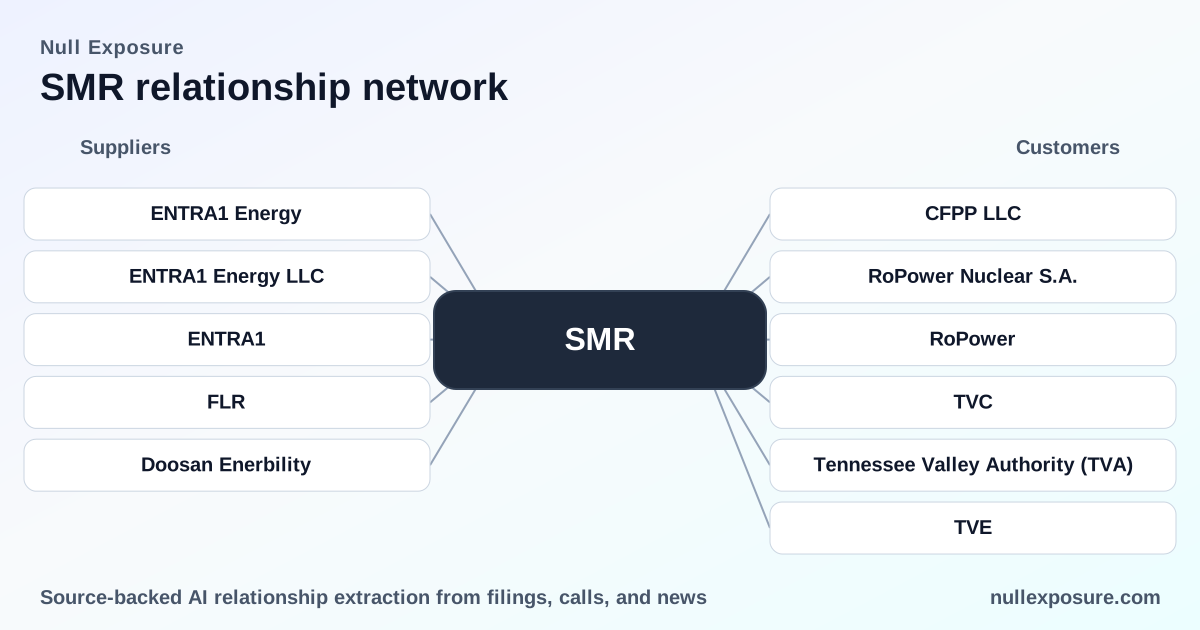
NuScale Power builds and sells modular light-water reactor plants and monetizes through licensing, engineering services, manufacturing partnerships, and large commercialization contracts. Revenue funnels from technology licensing and project development are highly dependent on a small set of commercial partners and large upfront agreements, which has translated into volatile expense recognition and concentrated counterparty exposure. Investors evaluating SMR supplier relationships should focus on counterparties that provide manufacturing scale, project delivery expertise, and commercialization distribution — and on the financial commitments NuScale has already made to those partners. For a compact supplier-risk dashboard and deep relationship tracking, visit NullExposure.
What to know first: core commercial model and why suppliers matter
NuScale’s product is capital-intensive and industrial by nature: the company licenses a modular reactor design, then relies on external manufacturers, engineering contractors, and commercialization partners to finance and deploy plants (power generation, desalination, hydrogen or district heating use cases). That operating model concentrates operational and regulatory risk in a handful of relationships and turns single large payments into material swings in reported expense and cash flow. The market’s reaction to those swings — illustrated by the spike in G&A in 3Q 2025 — is a direct function of NuScale’s contracting posture: large, project-level commitments rather than incremental supplier purchase orders.
Visit NullExposure for a concise view of how these supplier commitments are disclosed and tracked across filings.
Relationships that matter — plain-English summaries for every supplier cited
ENTRA1 / ENTRA1 Energy LLC
NuScale entered a global commercialization partnership with ENTRA1 and made a $495 million payment tied to a Tennessee Valley Authority (TVA) agreement, a transfer that NuScale disclosed in a Nov. 6, 2025 filing and that later became central to investor litigation and press coverage in early 2026. Multiple law-firm and press notices in March 2026 flagged the payment and alleged ENTRA1 lacked a proven track record in nuclear project delivery, framing the partnership as the focal point of commercial and disclosure risk (press notices and class-action filings, March 2026). According to NuScale’s updates, ENTRA1 evaluated reactor technologies and selected NuScale among options for downstream projects (NuScale 2025Q4 earnings call).
Fluor Corporation (FLR)
NuScale disclosed completion of its work on Fluor’s Phase 2 FEED (front-end engineering and design) for the proposed RoPower Doicesti plant in Romania, signaling a contractual engineering/FEED relationship tied to an international SMR project pipeline (2025Q4 earnings call). That engagement positions Fluor as an engineering/owner’s-engineer collaborator on European project development.
Doosan Enerbility
Doosan is identified by NuScale as the company’s primary manufacturing arm, responsible for fabricating key reactor components and modular assemblies, reflecting a concentrated manufacturing supply relationship that underpins NuScale’s ability to deliver physical modules (2025Q4 earnings call).
Interpreting constraints: what company-level signals reveal about NuScale’s supplier posture
The relationship constraints extracted from NuScale disclosures provide actionable, company-level signals:
- Material dependency on the supply chain: NuScale acknowledges supply-chain risk as material, including cybersecurity and delivery impacts that could “materially adversely impact” operations. This is a classic signal of operational leverage where third-party failures transmit quickly to the firm’s delivery schedule and revenue capture.
- Manufacturer role defined and concentrated: NuScale has “strategically executed supply agreements” allowing ordering of NPM components, which signals limited direct vertical integration and reliance on named manufacturers to scale production. The Doosan reference confirms a concentrated manufacturing partner.
- Third-party cybersecurity and services: NuScale contracts third-party security and monitoring services to protect systems and to perform assessments, which is consistent with an operating model that outsources non-core but critical controls.
- Active supplier engagement: NuScale reports active engagement with select suppliers for cybersecurity monitoring and remediation, indicating ongoing, operational-level interactions rather than dormant or purely strategic MOUs.
Together these constraints imply a contracting posture that blends strategic, high-value commercialization agreements with ongoing operational supplier relationships — a combination that raises both execution and disclosure risk.
Financial and strategic implications investors should weigh
- Large upfront payments can materially distort reported expenses; the $495 million transfer to ENTRA1 drove a dramatic G&A increase in 3Q 2025 and is now the subject of investor litigation coverage (Nov. 6, 2025 disclosure; March 2026 press notices). That pattern suggests project milestones and partner payments will dictate near-term cash volatility.
- Concentration risk is real: Doosan’s role as primary manufacturer and Fluor’s FEED work show a small set of counterparties control critical path items. A supplier disruption or contract failure would be consequential to deployment timelines.
- Commercialization partners can shift enterprise value: The ENTRA1 arrangement illustrates how partner selection and large commercialization agreements can transform NuScale’s near-term capitalization and investor sentiment.
For a practical way to monitor these counterparties and cross-reference filings, see NullExposure.
Quick investor checklist: red flags and monitoring triggers
- Monitor future filings for milestone-based payments and the accounting treatment of commercialization agreements; sudden G&A spikes are a visible early-warning indicator.
- Track public litigation and third-party press: class-action notices in March 2026 accelerated market scrutiny on the ENTRA1 payment (multiple law-firm press releases and newswire notices, March 2026).
- Watch supply-chain continuity metrics: any delay in Doosan manufacturing outputs or a pause in Fluor FEED progress will signal schedule risk to module deliveries.
Bottom line: concentrated relationships are the business and the risk
NuScale’s commercialization strategy depends on a tight set of counterparty relationships — a feature that enables scale but creates single-point exposures. The ENTRA1 payment episode demonstrates how a single contract can reshape reported expenses and investor narratives overnight; Fluor and Doosan illustrate the necessary industrial partnerships required to translate design into installed capacity. Investors and operators should evaluate both the contractual economics and the operational resilience of these partners before extrapolating revenue run-rate or project cadence.
For ongoing supplier risk intelligence and to track how NuScale’s partner commitments evolve in filings and news, visit NullExposure.