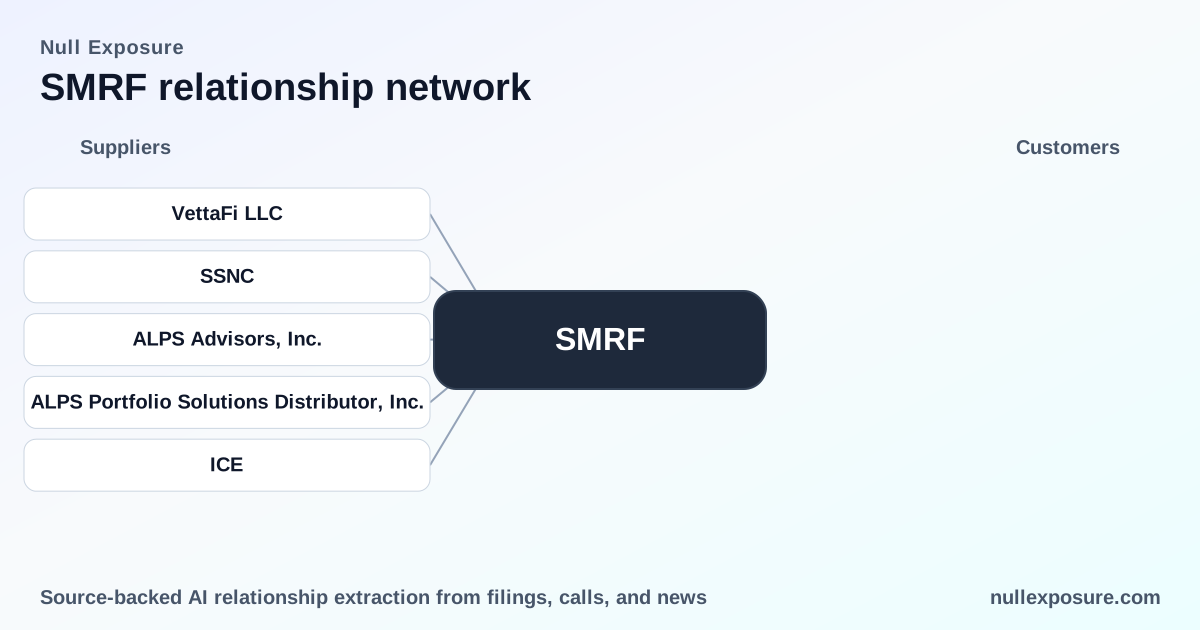
SMRF: Who runs the product, how it makes money, and what supplier ties mean for investors
SMRF (ALPS Nautilus SMR, Nuclear & Technology ETF) is an issuer-sponsored exchange-traded fund that monetizes through an expense ratio and partner fees: the sponsor/advisors handle index licensing, distribution, and fund operations, while the exchange provides liquidity and market access. Revenue to the ecosystem flows from the fund’s 0.65% expense ratio and from index licensing and service agreements with third parties. For investors evaluating supplier risk, the structure is straightforward—index licensor, sponsor/advisors, distributor, and exchange—each with discrete commercial roles and observable counterparty dependencies. Explore more about supplier mappings and commercial exposure at https://nullexposure.com/.
Quick operational thesis for investors
SMRF is a classic ETF product model: fund-level economics are driven by AUM and the 0.65% fee, while service providers capture recurring fees (index licensing, administration, distribution). The product’s success hinges on allocations into nuclear- and SMR-related equities amid thematic flows; counterparty concentration is moderate because a small set of ALPS-branded entities and external index providers supply most critical services.
Who built and sponsors the fund
SS&C ALPS Advisors and ALPS Advisors, Inc. are the operational heart of SMRF. SS&C ALPS launched the ETF and supplies branding and go-to-market; ALPS Advisors is the primary advisor. According to a press release and coverage in ETF Trends in March 2026, SS&C ALPS Advisors launched the ALPS Nautilus SMR, Nuclear & Technology ETF to capture investor demand for nuclear-related exposure. A TradingView summary also notes the fund is issued by SS&C Technologies Holdings under the ALPS brand. These relationships translate into concentrated operational control within the ALPS/SS&C family, which simplifies governance but concentrates vendor risk.
Full supplier map and what each relationship means for investors
VettaFi LLC — index provider and licensee
VettaFi is the index provider for SMRF and receives an index licensing fee that funds part of the product economics. According to ETFdb’s ETF roundup (FY2026 reporting), VettaFi is the index licensor for SMRF and is compensated via licensing. This is a standard third-party index relationship that creates a recurring licensing expense but also provides an external index governance layer.
SS&C ALPS Advisors — product launcher and sponsor
SS&C ALPS Advisors launched the ALPS Nautilus SMR, Nuclear & Technology ETF and acts as the sponsor capturing marketing and advisory economics. ETF Trends reported in March 2026 that SS&C ALPS launched SMRF to capitalize on interest in nuclear power, positioning SS&C as the fund’s commercial engine. For investors, this means strategic responsibility for distribution and product positioning sits with SS&C ALPS.
SS&C Technologies Holdings, Inc. — issuer and parent brand
SMRF shares are issued under the SS&C/ALPS umbrella, with TradingView commentary in March 2026 noting issuance by SS&C Technologies Holdings under the ALPS brand. That structure aligns legal and operational control with a large, publicly traded financial services firm, which provides corporate backing and scale for fund administration and compliance.
ALPS Advisors, Inc. — primary adviser
ALPS Advisors, Inc. is named as the primary adviser to the ETF, performing fiduciary and investment-advice functions. TradingView’s March 2026 analysis lists ALPS Advisors as the primary advisor, signaling that day-to-day advisory and portfolio-construction responsibilities are internal to the ALPS family. This creates operational simplicity but common-mode risk across ALPS-affiliated services.
ALPS Portfolio Solutions Distributor, Inc. — distributor
ALPS Portfolio Solutions Distributor, Inc. is the fund’s distributor, responsible for broker-dealer relationships and placement. TradingView’s March 2026 materials identify ALPS Portfolio Solutions Distributor as the distributor, which centralizes client-facing distribution under the ALPS distribution channel. The implication is distribution concentration—the fund’s retail and intermediary reach flows through this single distributor.
NYSE Arca — listing exchange and market venue
SMRF trades on NYSE Arca; ETF Trends notes the fund’s 0.65% expense ratio and that it is listed on NYSE Arca (March 2026 coverage). The exchange provides primary liquidity and visibility to ETFs, so market quality and spread behavior will be linked to NYSE Arca trading dynamics and ETF market-making.
Operating-model constraints and company-level signals
There are no explicit constraints listed in the supplier data for SMRF. At the company level, however, several operational signals are clear:
- Contracting posture: The fund depends on a small set of contractual relationships—index license (VettaFi), sponsor/advisors/distributor (ALPS/SS&C)—which implies relatively simple contractual management but concentrated counterparty exposure.
- Concentration: A high degree of concentration in the ALPS/SS&C family for advisory, issuance, and distribution creates potential single-vendor risk if one partner faces operational disruption.
- Criticality: Each relationship is mission-critical in sequence—index licensing affects product definition, ALPS/SS&C controls distribution and issuance, and NYSE Arca determines trading access—so failures would have immediate commercial impact.
- Maturity: The product is new as of FY2026; newness increases initial marketing and liquidity risk until AUM scales and secondary-market depth builds.
Risk/reward profile investors should weight
SMRF’s upside is tied to thematic investor demand for nuclear and SMR exposure; fund economics are straightforward—AUM growth drives sponsor revenue and third-party fees fund the service chain. On the risk side, concentration within ALPS/SS&C and reliance on an external index provider are the primary supplier risks. Liquidity execution is dependent on trading interest on NYSE Arca and active market-making.
If you want a concise supplier-risk heatmap and operational due diligence checklist for SMRF and other ALPS products, visit https://nullexposure.com/ for vendor scoring and exposure analytics.
Actionable takeaways for allocators
- Understand fee flows: The fund’s 0.65% expense ratio funds sponsor economics and index licensing; confirm how much of that fee translates to advisory vs. licensing payments in fund documentation. ETF Trends and ETFdb reporting in FY2026 confirm the 0.65% expense ratio and VettaFi licensing role.
- Assess concentration risk: ALPS/SS&C provide multiple critical services—advice, issuance, distribution—so stress-test scenarios where a single ALPS/SS&C capability is impaired.
- Monitor launch liquidity: As a FY2026 launch, early AUM and NYSE Arca trading patterns will determine execution quality; watch bid/ask spreads and creation/redemption activity closely.
For more supplier-level intelligence and to see how SMRF compares across commercial dependencies, explore our analyses at https://nullexposure.com/.
Conclusion: concise verdict
SMRF is a typical sponsor-led thematic ETF: clear fee mechanics, concentrated supplier relationships within the ALPS/SS&C ecosystem, and an externally licensed index from VettaFi. These attributes produce predictable economics but introduce concentrated counterparty exposure that investors should monitor alongside early liquidity metrics on NYSE Arca. For investors and operators seeking deeper vendor scoring and scenario modeling, visit https://nullexposure.com/ for proprietary mappings and next-step diligence.